
People-Pleasing and Self-Sabotage: When Putting Others First Means Abandoning Yourself
You consider yourself someone who cares about other people.
You're thoughtful. You're dependable. You try to be understanding, accommodating, and supportive.
When someone needs something, you're often the person they call.
And most of the time, you genuinely want to help.
But what happens when helping someone else means repeatedly putting aside something that matters to you?
Maybe you agree to something even though you already have too much on your plate.
Perhaps you avoid expressing how you really feel because you're concerned about how the other person might respond.
Or you find yourself saying, "It's fine," when internally, you know it isn't.
You may even recognize the pattern.
You know you need to establish boundaries. You understand that your time, energy, and needs are important.
Yet when the opportunity comes to speak up, something shifts.
You begin thinking about how the other person might feel.
You imagine their disappointment.
You question whether you're being selfish.
And before you know it, you've agreed to something you didn't really want to do.
At what point does being considerate of others begin coming at the expense of being considerate of yourself?
This is where people-pleasing and self-sabotage can begin to overlap.
Key Takeaways
People-pleasing involves prioritizing others' approval, comfort, or expectations, sometimes at the expense of your own needs.
Being kind and considerate isn't automatically people-pleasing.
People-pleasing may become self-sabotaging when you repeatedly abandon your priorities, boundaries, or preferences to avoid disappointing others.
Fear of rejection, guilt, conflict, and beliefs about being a good person may contribute to the pattern.
Understanding what saying no represents to you can offer insight into why boundaries feel difficult.
Hypnotherapy may provide an opportunity to explore subconscious beliefs and emotional associations connected to people-pleasing.
What Is People-Pleasing, and How Is It Different From Being Kind?

Being considerate of others is a valuable quality.
Healthy relationships often involve compromise, generosity, empathy, and a willingness to support the people we care about.
But there's an important distinction between choosing to help someone and feeling that you must help them to maintain their approval or avoid an uncomfortable response.
Imagine two people are asked to help a friend move over the weekend.
The first person checks their schedule, considers their energy, and decides they have the time and desire to help.
The second person already has plans.
They've been looking forward to having a quiet weekend after a demanding week.
But when their friend asks, they immediately feel uncomfortable.
They worry that saying no will make them seem inconsiderate.
They imagine their friend being disappointed.
So they agree.
Both people may appear equally helpful.
But their internal experiences are quite different.
For one person, helping is a choice.
For the other, helping may feel like an obligation tied to how they want to be perceived.
People-pleasing often becomes more noticeable when the desire to maintain someone else's comfort begins overriding your ability to honor your own needs.
When Does People-Pleasing Become a Form of Self-Sabotage?
People-pleasing may become self-sabotaging when your efforts to avoid disappointing others repeatedly interfere with your own goals, relationships, or well-being.
For example, imagine you're working toward an important personal goal.
You've committed to spending several evenings each week developing your business.
You're excited about the possibilities and have created a schedule to support your progress.
Then someone asks for your help.
You know that saying yes means giving up the time you set aside for yourself.
But you agree anyway.
A few days later, another request comes.
And then another.
By the end of the month, you've spent considerable time helping other people move forward while your own plans remain unfinished.
You may begin feeling frustrated with yourself.
You might even question why you struggle with consistency.
But what if the difficulty isn't simply about motivation?
What if part of the pattern involves what happens when your priorities conflict with someone else's expectations?
This is where self-sabotage can become more complex.
You consciously want to make progress.
Yet repeatedly prioritizing other people's requests may interfere with the very commitments you've made to yourself.
To explore this broader pattern, read What Is Self-Sabotage? Why You Keep Getting in Your Own Way.
5 Ways People-Pleasing Can Become a Self-Sabotaging Pattern
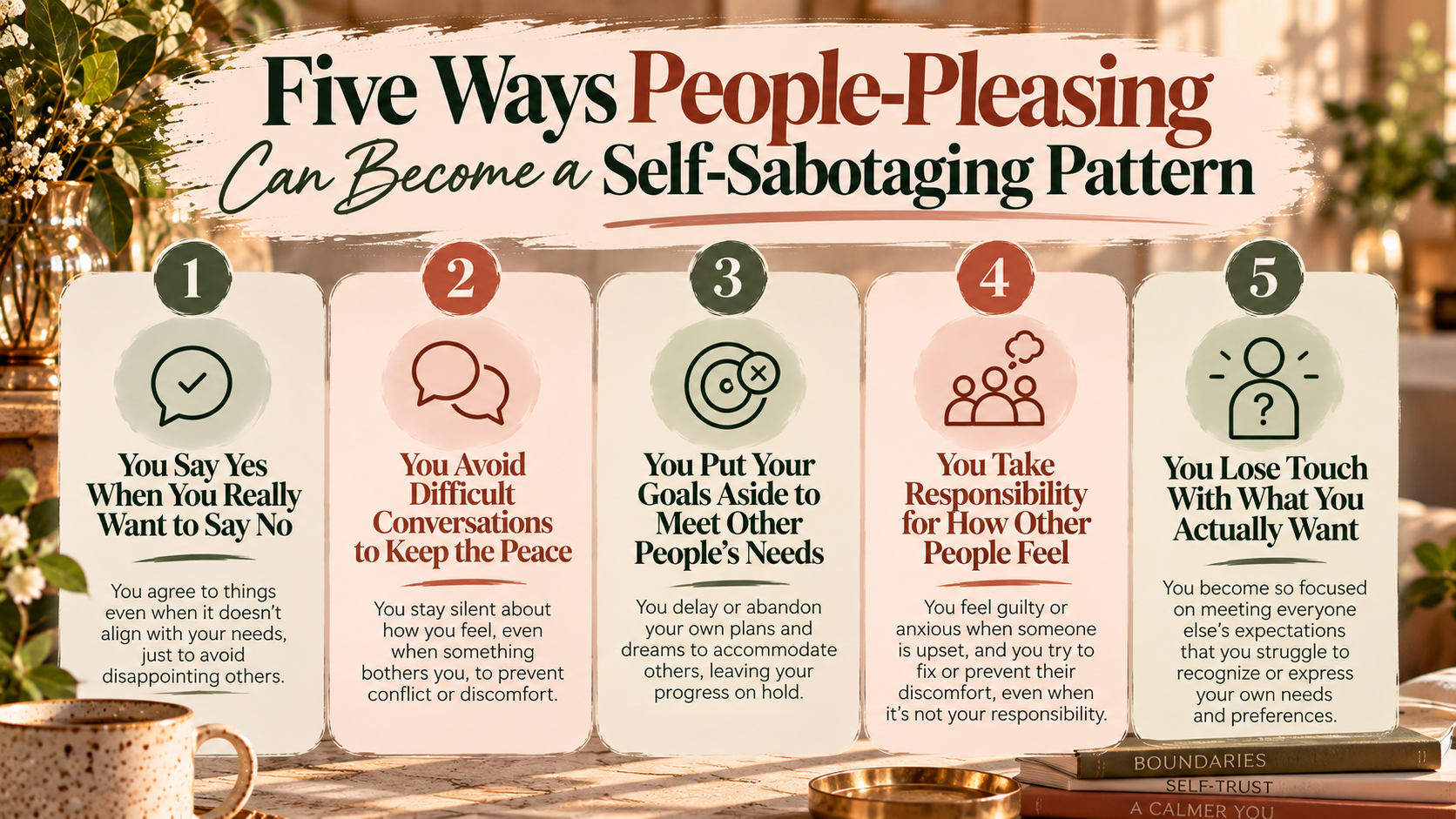
People-pleasing doesn't always involve obvious sacrifices.
Sometimes it appears through small decisions that gradually influence how you spend your time, express yourself, and experience your relationships.
1. You Say Yes When You Really Want to Say No
Someone asks you to do something.
Before you've had an opportunity to consider whether you want to, you've already agreed.
Perhaps you don't want to appear difficult.
Maybe you feel responsible for making things easier for the other person.
Or you anticipate feeling guilty if you decline.
The interesting question is:
What happens internally when you imagine saying no?
Does guilt arise?
Do you begin preparing an explanation?
Do you feel compelled to justify why your needs deserve consideration?
Your response may reveal how you've come to experience the act of setting boundaries.
2. You Avoid Difficult Conversations to Keep the Peace
You disagree with something someone says.
Or perhaps a situation has been bothering you for weeks.
You want to address it, but you begin imagining how the conversation might unfold.
What if they become upset?
What if they misunderstand you?
What if the relationship changes?
So you remain silent.
In the moment, avoiding the conversation may feel easier.
But over time, the unresolved issue may create frustration, resentment, or emotional distance.
You may be maintaining the appearance of peace while feeling increasingly disconnected from your own experience.
3. You Put Your Goals Aside to Meet Other People's Needs
You make plans for yourself.
You want to pursue a new opportunity, develop a skill, improve your routine, or spend more time doing something meaningful.
But when other people need something, your plans are often the first to change.
You tell yourself you'll return to your goals when things settle down.
Yet there's always another request, another responsibility, or another person who needs your attention.
Eventually, you may begin wondering why you struggle to follow through.
It's worth considering whether your goals have been given the same level of importance as the commitments you make to others.
4. You Take Responsibility for How Other People Feel
Someone seems disappointed.
Their tone changes.
They become quiet or frustrated.
And you immediately begin wondering what you did wrong.
Perhaps you try to make them feel better.
You offer explanations, change your plans, or reconsider a decision you've already made.
You may feel responsible for restoring their comfort, even when you've done nothing inappropriate.
This can become exhausting.
Because other people's emotional responses are influenced by many factors, including their own expectations, experiences, and choices.
Consider asking yourself:
What do I believe it means about me when someone is unhappy with a decision I've made?
5. You Begin Losing Touch With What You Actually Want
When you're accustomed to considering everyone else's preferences, identifying your own can become surprisingly difficult.
Someone asks where you'd like to eat.
You say, "Whatever you want."
They ask what you'd prefer to do.
You respond, "I'm fine with anything."
Sometimes these responses reflect genuine flexibility.
But if you consistently defer to others, you may begin noticing that you rarely stop to consider your own preferences.
You might even feel uncomfortable when someone asks what you want.
This is an important aspect of self-abandonment.
Over time, repeatedly dismissing your preferences can make it harder to recognize and communicate them.
Why Does People-Pleasing Sometimes Feel Necessary?
This is where I believe the conversation becomes particularly meaningful.
Someone may recognize that they have difficulty saying no.
They may understand that their boundaries are important.
They might even know exactly what they want to say.
But when they're standing in front of the person who has made the request, their response changes.
Suddenly, the words feel harder to express.
They begin imagining the other person's reaction.
They experience guilt, nervousness, or an urge to make the situation comfortable again.
Why?
For some people, people-pleasing may be connected to beliefs they've developed about relationships, acceptance, and what it means to be a good person.
Perhaps they learned that being helpful brought appreciation and recognition.
Maybe expressing disagreement frequently led to conflict.
Or perhaps they became accustomed to being the dependable person who kept everything running smoothly.
Over time, these experiences may influence how someone interprets situations where their needs differ from another person's.
Saying no may begin to feel like being selfish.
Expressing disappointment may feel like creating conflict.
Prioritizing yourself may feel like letting someone down.
And when these meanings become familiar, people-pleasing can begin feeling less like a conscious decision and more like an automatic response.
The question becomes: What does disappointing someone else mean about you?
That question may lead to a deeper understanding of the pattern.
The Relationship Between People-Pleasing, Identity, and Self-Worth

Think about the roles you've occupied throughout your life.
Perhaps you've always been the responsible one.
The understanding one.
The person who keeps the family together.
The one everyone can count on.
These identities may reflect qualities you genuinely value.
But what happens when you begin feeling that you must maintain those roles to remain accepted, appreciated, or worthy?
Imagine someone who has spent years being recognized for their generosity.
They're the person who always shows up.
They rarely complain.
They make accommodations and try to ensure everyone feels supported.
Now imagine that person begins making different choices.
They decline an invitation.
They express a preference.
They establish a boundary.
Someone responds with disappointment.
Suddenly, they begin questioning themselves.
Am I becoming selfish?
Am I being inconsiderate?
What if they don't see me the same way anymore?
The situation may involve a relatively simple boundary.
But internally, it may feel connected to something much larger.
Their sense of identity.
Their relationships.
Their beliefs about what makes them a good person.
And possibly their sense of self-worth.
This is why I find identity such an important part of exploring self-sabotaging patterns.
Because sometimes changing a behavior also means reconsidering the beliefs you've developed about who you're supposed to be.
Why Setting Boundaries Can Feel Uncomfortable Even When You Know They're Necessary
Let's say you've decided that you need to establish a boundary with someone.
You've thought about the situation.
You know what you want.
You understand why the boundary matters.
But when the moment arrives, you hesitate.
Your mind begins anticipating possible reactions.
You wonder whether the other person will become upset.
You imagine having to defend your decision.
You feel an urge to explain yourself.
And sometimes, you abandon the boundary before you've even expressed it.
This can be frustrating, particularly when you've already spent considerable time thinking about what you need to do.
But intellectual understanding and emotional experience don't always change at the same pace.
You may consciously recognize that a boundary is reasonable while still experiencing discomfort when you attempt to establish it.
That discomfort may be connected to previous experiences, familiar relationship dynamics, or beliefs about how others should respond to you.
It's also important to consider your circumstances. In some relationships, expressing boundaries can involve genuine risks or consequences. Recognizing those realities is different from assuming every uncomfortable response is simply an internal pattern.
For everyday people-pleasing behaviors, however, exploring the meaning you've attached to disagreement or disappointment may help you better understand why certain boundaries feel particularly difficult.
How People-Pleasing Can Lead to Resentment and Emotional Exhaustion
When you continually prioritize other people's needs, you may begin experiencing frustration that doesn't always make sense at first.
You might feel irritated when someone asks for another favor.
You may begin resenting responsibilities you previously accepted.
Or you might feel unappreciated, even though others continue expressing gratitude.
Sometimes resentment develops when there's a growing difference between what you're agreeing to and what you genuinely want.
Imagine repeatedly saying yes to requests while privately wishing someone would recognize that you're overwhelmed.
You may hope they'll notice how much you're doing.
Perhaps you want them to offer help or tell you it's okay to take time for yourself.
But they may have no idea how you're experiencing the situation.
From their perspective, you've agreed willingly.
This creates an important opportunity for reflection.
What am I hoping other people will recognize about my needs that I haven't yet communicated?
For some people, this question reveals how much they've relied on others to notice their limits rather than expressing them directly.
And that realization can become an important part of developing healthier boundaries.
5 Questions to Help You Recognize People-Pleasing Patterns
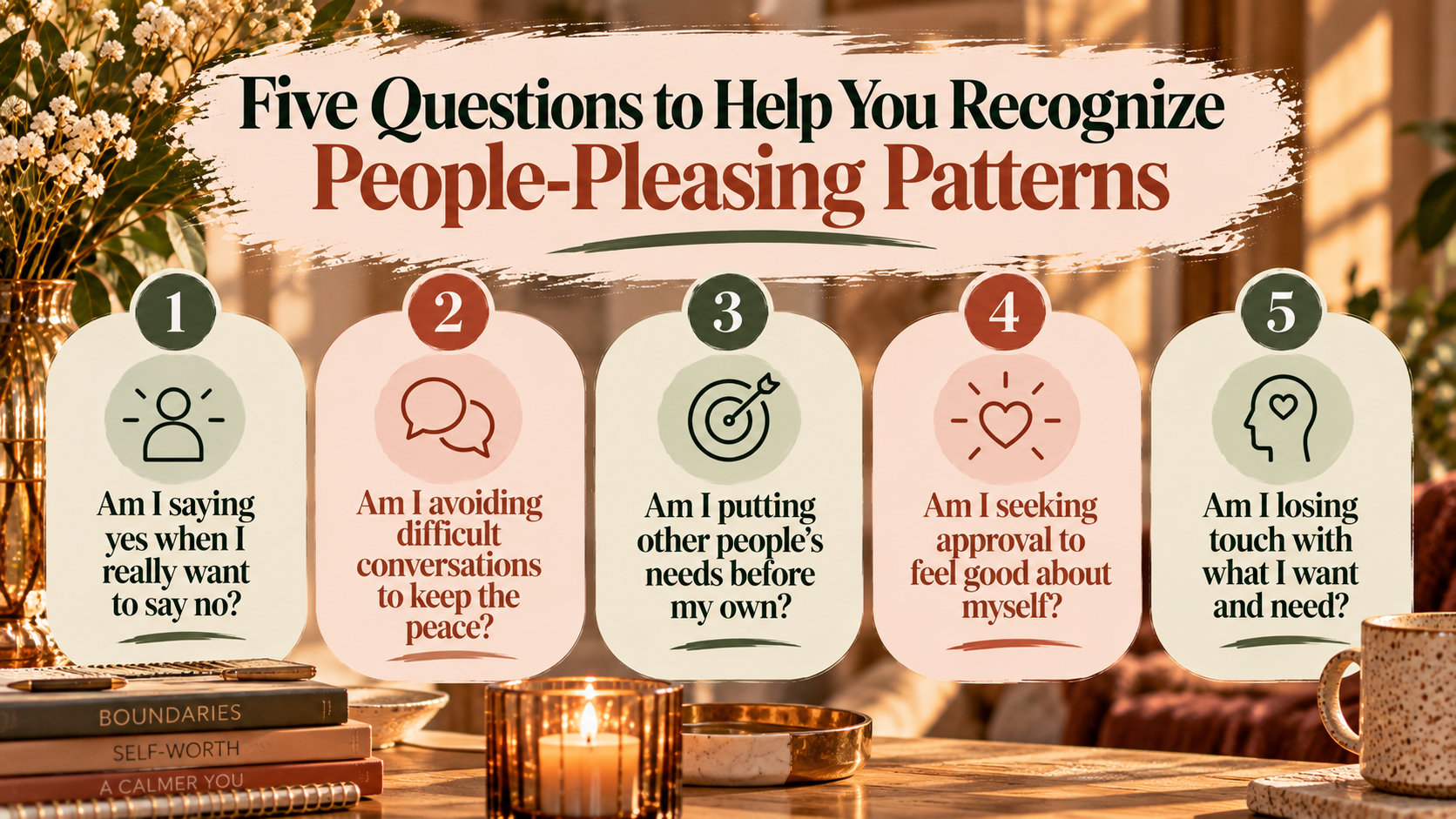
If you're beginning to recognize yourself in these examples, consider exploring the following questions.
1. What happens for me when someone asks for something I don't want to do?
Notice your immediate thoughts, feelings, and responses.
Do you feel comfortable considering your options?
Or do you feel pressure to agree?
2. What do I imagine will happen if I disappoint someone?
Consider the outcome you're anticipating.
Are you concerned about conflict, rejection, criticism, or a change in the relationship?
3. What does saying no mean about the kind of person I am?
Explore whether you've connected setting boundaries with being selfish, inconsiderate, or unkind.
4. Where am I expecting others to recognize needs I haven't expressed?
Consider whether you're waiting for someone to notice your exhaustion, frustration, or desire for support.
5. Who am I when I'm not meeting someone else's expectations?
This question may invite you to explore your identity beyond the roles you've become accustomed to fulfilling.
These questions are intended to support reflection rather than lead you toward a predetermined explanation.
Your experiences, relationships, and reasons for responding the way you do are unique.
How I Approach People-Pleasing and Self-Sabotage in My Hypnotherapy Practice

When someone tells me they struggle with people-pleasing, I'm interested in understanding what happens for them when their needs conflict with someone else's expectations.
Because two people may have difficulty saying no for very different reasons.
One person may worry about being rejected.
Another may feel responsible for other people's happiness.
Someone else may have developed a strong identity around being helpful, dependable, or accommodating.
Rather than assuming I know what the behavior means, I prefer to explore the person's experience through thoughtful questions.
For example, I might ask:
What happens for you when you consider saying no?
What are you anticipating from the other person?
What would their disappointment mean to you?
And what happens to your own needs in that moment?
These questions create space for clients to begin recognizing connections between their thoughts, feelings, beliefs, and responses.
Sometimes a person discovers that a boundary represents much more to them than a simple decision.
It may be connected to acceptance, belonging, responsibility, or their understanding of who they are.
My approach to hypnotherapy involves exploring subconscious beliefs, emotional associations, and habitual responses that may be contributing to recurring patterns of self-sabotage.
The intention is to help clients develop greater awareness and explore ways of responding that are more consistent with their values and goals.
Can Hypnotherapy Help With People-Pleasing and Boundaries?
Hypnotherapy may be an option for individuals who want to explore recurring patterns associated with people-pleasing, self-doubt, and difficulty establishing boundaries.
Through focused attention, relaxation, imagery, and suggestion, hypnotherapy can provide an opportunity to examine familiar beliefs and consider alternative responses.
For example, someone who associates saying no with being selfish may want to explore a different understanding of what it means to be considerate of themselves and others.
Another person may want to develop greater confidence expressing preferences or navigating everyday disagreements.
The experience is individualized, and results vary.
Hypnotherapy is not a guaranteed solution for people-pleasing. When difficulties with boundaries occur in relationships involving coercion, intimidation, or abuse, appropriate safety planning and qualified professional support are especially important.
For individuals exploring recurring patterns of self-sabotage in everyday relationships, hypnotherapy may offer another way to examine how their beliefs and habitual responses influence their choices.
How to Begin Moving Beyond People-Pleasing
Recognizing a people-pleasing pattern can be an important step toward developing a different relationship with your needs and boundaries.
Here are several ways to begin.
Give Yourself Time Before Responding
When someone makes a request, consider allowing yourself a moment before answering.
You might say, "Let me check my schedule and get back to you."
This creates an opportunity to consider whether you genuinely want to agree.
Notice the Difference Between Guilt and Responsibility
Feeling guilty doesn't automatically mean you've done something wrong.
When guilt arises after setting a reasonable boundary, consider what the feeling represents to you.
Are you responding to something harmful you've done?
Or are you experiencing discomfort because you're making a choice that differs from what others may expect?
Practice Expressing Your Preferences
Begin noticing situations where you automatically defer to someone else.
When appropriate, practice expressing what you'd actually prefer.
This might involve choosing a restaurant, suggesting an activity, or communicating how you'd like to spend your time.
Small moments can provide opportunities to become more comfortable recognizing and expressing your needs.
Reconsider What Being a Good Person Means to You
If you've connected kindness with always being available, consider expanding that definition.
Can you be thoughtful and still have limits?
Can you care about someone's feelings while making a different decision?
Can you value a relationship while acknowledging that your needs matter within it?
These questions can help you explore a more balanced understanding of consideration and responsibility.
Pay Attention to What Happens After You Set a Boundary
Notice the thoughts and feelings that follow.
Do you begin second-guessing yourself?
Do you feel compelled to explain further?
Do you want to reverse your decision?
Understanding these responses can help you recognize how the pattern continues even after you've taken a different action.
When Putting Yourself First Feels Unfamiliar

Sometimes the most challenging part of changing a people-pleasing pattern is becoming accustomed to a different way of experiencing yourself.
You may be familiar with being available.
With anticipating other people's needs.
With making accommodations.
With keeping everyone comfortable.
As you begin making different choices, you may notice that your relationships and routines require adjustments.
And those adjustments may bring up new questions.
What does it mean to prioritize myself?
How do I want to show up in my relationships?
What responsibilities genuinely belong to me?
What kind of relationship do I want to develop with my own needs?
These questions are worth exploring because moving beyond people-pleasing involves more than changing how often you say yes or no.
It can also involve reconsidering the beliefs and expectations that influence how you experience yourself in relation to others.
Feeling Stuck Between Supporting Others and Honoring Yourself?
If you're beginning to recognize how people-pleasing has influenced your decisions, relationships, or personal goals, you may be wondering what comes next.
Sometimes having a space for reflection and ongoing encouragement can support the process of exploring familiar patterns.
Stuck to Striving is a community centered on self-awareness, reflection, and moving beyond patterns that can keep you feeling stuck.
If you'd like to continue exploring these experiences, I invite you to join us.

Explore the Stuck to Striving Community
Ready to Explore Your Individual Patterns?

If people-pleasing, difficulty setting boundaries, or self-doubt have become recurring challenges, personalized hypnotherapy may be another option to consider.
During a free 15-minute consultation, we can discuss what you've been experiencing, what you'd like to change, and whether hypnotherapy may be appropriate for your goals.
Schedule Your Free 15-Minute Consultation
Prefer to Begin Independently?

My Overcoming Self-Sabotage Hypnotic Programming Audio offers a self-guided experience for individuals interested in exploring their internal dialogue and relationship with familiar patterns.
Explore the Overcoming Self-Sabotage Audio.
Frequently Asked Questions About People-Pleasing and Self-Sabotage

Is people-pleasing a form of self-sabotage?
People-pleasing can become self-sabotaging when repeatedly prioritizing others' approval or expectations interferes with your own needs, boundaries, relationships, or personal goals.
Why do I feel guilty when I say no?
For some people, guilt may be connected to beliefs about responsibility, kindness, acceptance, or what it means to be a good person. Feeling guilty doesn't necessarily mean a boundary is unreasonable.
What's the difference between kindness and people-pleasing?
Kindness generally involves consideration and choice. People-pleasing often involves feeling pressured to accommodate others because of concerns about disapproval, conflict, or rejection.
Can people-pleasing affect self-worth?
Yes. Some individuals connect their sense of worth to being helpful, needed, or approved of by others. This can make disagreement or disappointing someone feel particularly uncomfortable.
Why is setting boundaries so difficult even when I know they're necessary?
You may intellectually understand the importance of boundaries while still experiencing guilt, anxiety, or uncertainty when attempting to establish them. Familiar relationship dynamics and beliefs about others' reactions may contribute to this experience.
Can hypnotherapy help with people-pleasing?
Hypnotherapy may help some individuals explore beliefs, emotional associations, and habitual responses connected to people-pleasing and boundary difficulties. Results vary, and other forms of support may also be appropriate depending on the circumstances.
A Different Way to Think About Putting Yourself First
Perhaps you've spent much of your life being the person others can depend on.
You've learned to anticipate needs, offer support, and make accommodations.
And those qualities may be part of what makes your relationships meaningful.
But it's worth considering whether the way you've been caring for others has left enough room for you to care for yourself.
When someone else's expectations conflict with your needs, what happens?
Do you feel able to consider both?
Or does your attention immediately shift toward keeping the other person comfortable?
Sometimes the most meaningful change begins when you recognize that your needs deserve the same thoughtful consideration you've been giving everyone else.
What might your relationships look like if being considerate of yourself became just as familiar as being considerate of others?