
Does Hypnotherapy Really Work for Weight Loss? What the Research Says
Have you ever found yourself wondering whether hypnotherapy for weight loss is actually legitimate—or whether it's just another promise that sounds good but doesn't deliver?
If so, you're not alone.
Many people who search this question have already spent years trying different approaches. They've counted calories, followed meal plans, downloaded fitness apps, joined weight-loss programs, and started over more times than they can remember. They aren't necessarily looking for another miracle. They're looking for something that explains why knowing what to do doesn't always make it easier to actually do it.
That question is one of the reasons hypnotherapy has become increasingly popular in conversations about weight management.
Some people describe it as life-changing. Others dismiss it as little more than relaxation. And if you've started researching online, you've probably noticed something confusing: one article says hypnosis works, while another says there's little evidence that it does.
So what's the truth?
The honest answer is more nuanced than either extreme.
Hypnotherapy is not a magic solution that causes weight loss on its own. It doesn't burn calories, speed up your metabolism, or replace nutritious eating, physical activity, medical care, or healthy lifestyle habits.
What it may do is help support changes in the habits, routines, emotional responses, and patterns that influence your everyday decisions around food and movement.
Understanding that difference is important because it changes the question entirely.
Instead of asking:
"Can hypnosis make me lose weight?"
A more useful question becomes:
"Can hypnotherapy help me change the behaviors that make lasting weight loss difficult?"
For many people, that's where the real conversation begins.
In this article, you'll learn what current research says about hypnotherapy for weight loss, why the findings sometimes appear contradictory, what hypnosis can realistically help with, and how to decide whether it may be an appropriate part of your own weight-loss journey.
Why So Many People Ask This Question

One of the biggest misconceptions about weight loss is that people struggle simply because they don't know enough.
In reality, most adults already understand the basics.
They know vegetables are generally healthier than fast food.
They know regular movement benefits the body.
They know sleep matters.
They know drinking water is important.
They know consistency usually produces better results than perfection.
Yet despite having that knowledge, millions of people still find themselves repeating behaviors they genuinely want to change.
They may reach for snacks after a stressful day.
Eat while watching television without realizing how much they've consumed.
Promise themselves they'll start fresh on Monday.
Feel motivated for two weeks before old routines quietly return.
These experiences don't necessarily mean someone lacks motivation or discipline.
More often, they suggest that everyday behaviors have become deeply familiar patterns.
Think about how many things you do automatically every day.
You probably don't consciously think about brushing your teeth, locking your front door, or the route you drive to work. Those behaviors have been repeated enough times that they require very little deliberate thought.
Eating behaviors can develop in much the same way.
A stressful afternoon becomes associated with stopping for coffee and something sweet.
Watching a favorite television show becomes linked with popcorn or chips.
Feeling overwhelmed leads to standing in front of the refrigerator without ever making a conscious decision to do so.
Over time, these routines begin feeling automatic.

That is one reason people become curious about hypnotherapy.
Rather than focusing exclusively on what someone should eat, hypnotherapy explores the thoughts, expectations, emotions, and habitual responses that may influence why certain behaviors keep repeating.
What Is Hypnotherapy for Weight Loss?
Hypnotherapy for weight loss is the intentional use of hypnosis to support healthier behaviors related to weight management.
It is important to distinguish between hypnosis and hypnotherapy, because the terms are often used interchangeably even though they describe different things.
Hypnosis refers to a state of focused attention in which a person becomes more absorbed in internal experiences while remaining aware of what is happening around them.
Hypnotherapy is the therapeutic use of that focused state to work toward a particular goal.
When someone seeks hypnotherapy for weight loss, the goal usually isn't to make food taste different or eliminate hunger altogether.
Instead, sessions may focus on supporting changes in areas such as:
emotional eating
stress eating
automatic snacking
nighttime eating
consistency with healthy habits
confidence around food choices
motivation for regular movement
self-perception
responding differently to common triggers
Every person's experience is different because every person's patterns are different.
Someone who struggles with emotional eating after difficult conversations may need a different approach than someone whose biggest challenge is grazing while working from home.
Rather than applying the same script to everyone, effective hypnotherapy should be individualized around the person's goals and the situations they repeatedly encounter.
What Does the Research Actually Say?
This is where many articles become overly simplistic.
Some claim that hypnosis is scientifically proven to produce weight loss.
Others suggest it has been completely disproven.
Neither statement accurately reflects the current body of research.
Studies examining hypnosis for weight loss have produced mixed findings.
Some research has found that hypnosis may provide additional benefit when used alongside behavioral weight-management programs.
Other studies have found little or no significant difference, particularly when hypnosis is delivered through a short recording or measured over a very brief period.
At first glance, those conclusions appear contradictory.
But they often aren't studying the same thing.
One study might examine a personalized series of hypnotherapy sessions delivered over several months.
Another might evaluate whether listening to a generic audio recording for three weeks changes body weight.
Those are very different interventions.
Researchers are also measuring different outcomes.
Some studies focus only on pounds lost.
Others examine eating behaviors, self-confidence, adherence to healthy habits, or long-term maintenance.
Because the methods vary so widely, it's difficult to make broad claims based on any single study.
A balanced reading of the evidence suggests something important:
Hypnotherapy should not be presented as a stand-alone weight-loss method.
However, there is ongoing interest in how it may support behavior change when combined with other healthy lifestyle strategies.
That distinction matters.
If someone expects hypnosis to create weight loss without changing anything else, they're likely to be disappointed.
If someone uses hypnotherapy as one part of a broader approach to developing healthier habits, the conversation becomes much more realistic.
Why the Research Doesn't Always Agree
If you've spent time researching hypnotherapy for weight loss, you've probably noticed that one article cites a study showing positive results, while another points to research showing little effect.
That can feel frustrating.
After all, if the science is "settled," shouldn't every study reach the same conclusion?
Not necessarily.
Research is only as meaningful as the question it's trying to answer. And when it comes to hypnotherapy, researchers have asked very different questions using very different methods.
For example, consider a few of the variables that can change from one study to another:
Was hypnosis delivered by an experienced hypnotherapist or through a generic audio recording?
Did participants receive one session or several sessions over multiple weeks?
Were participants also following a structured nutrition or lifestyle program?
Did they practice self-hypnosis between sessions?
How long were they followed after the intervention?
Were researchers measuring weight alone, or were they also measuring eating behaviors, confidence, and long-term adherence?
Those differences matter.
Imagine comparing two exercise studies.
One group works with a personal trainer three times a week for six months. Another group watches a single online workout video and is measured two weeks later.
Both studies involve "exercise," but they aren't evaluating the same experience.
Hypnotherapy research can be similar.
This is one reason it's important to look beyond headlines.
Rather than asking whether one study "proves" hypnosis works or doesn't work, it's more helpful to ask:
What type of hypnotherapy was studied?
Who participated?
How long did the intervention last?
What outcomes were measured?
How applicable are those findings to real-world practice?
Those questions provide a much clearer understanding than simply looking at whether a study reached statistical significance.
What Hypnotherapy May Actually Help With

When people hear "weight loss hypnosis," they often imagine that the goal is to make someone instantly stop wanting unhealthy foods.
That isn't how responsible hypnotherapy is typically approached.
Instead, many sessions focus on the situations that repeatedly interfere with healthy choices.
For example:
A person may eat every evening after work—not because they're physically hungry, but because arriving home has become mentally associated with relaxation.
Someone else may snack whenever they're anxious because food has gradually become their primary coping strategy.
Another person may abandon healthy routines after one unplanned meal because they unconsciously believe they've already "failed."
These situations aren't simply about food.
They're about learned responses.
Hypnotherapy may help people become more aware of these patterns while reinforcing healthier alternatives.
That could include:
Pausing before automatically reaching for food
Recognizing emotional hunger versus physical hunger
Practicing different responses to stress
Strengthening consistency after setbacks
Developing a more supportive internal dialogue
Viewing exercise as self-care rather than punishment
Reinforcing realistic expectations instead of perfectionism
Notice something important.
None of these involve hypnosis magically causing weight loss.
Instead, they involve supporting behaviors that influence everyday decisions.
That's a much more realistic—and evidence-consistent—way to understand the role hypnotherapy may play.
What Hypnotherapy Cannot Do
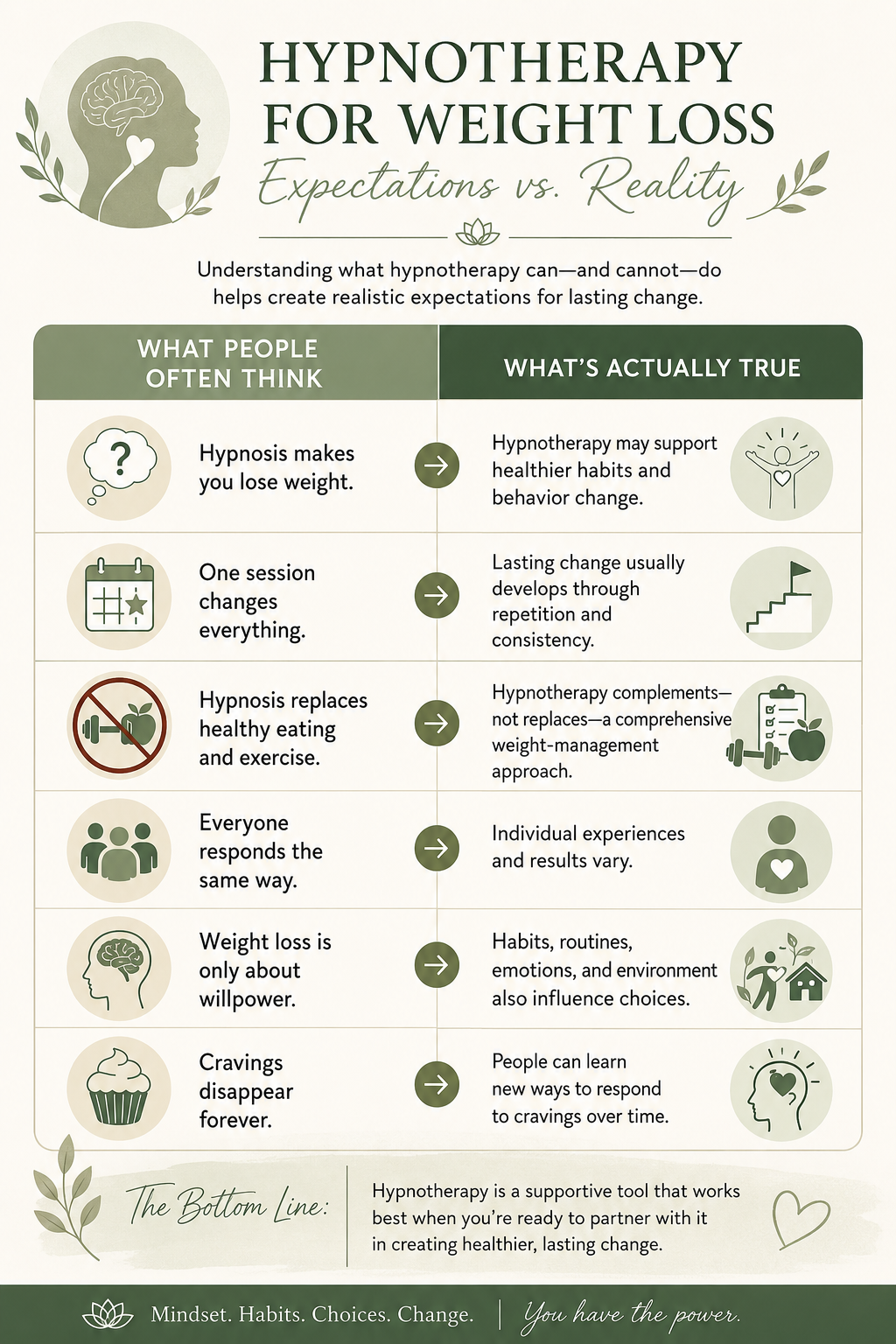
Just as important as understanding what hypnotherapy may support is understanding what it cannot realistically do.
Hypnotherapy cannot:
Burn body fat.
Speed up your metabolism.
Replace nutritious eating.
Replace regular physical activity.
Eliminate every craving.
Cure obesity.
Treat eating disorders.
Replace medical care.
Override serious medical conditions affecting weight.
If someone promises those outcomes, it's worth approaching those claims with caution.
Weight management is influenced by many factors, including genetics, medications, hormones, sleep, medical conditions, nutrition, physical activity, stress, environment, and personal circumstances.
No single intervention addresses all of those variables.
Hypnotherapy works best when it is viewed as one piece of a much larger picture.
Who May Benefit Most?

Hypnotherapy is not equally appropriate for everyone.
People who often benefit from exploring it tend to share something in common.
They usually don't lack information.
Instead, they struggle with consistency.
You may be a good candidate if you find yourself thinking things like:
"I know what I should do. I just don't keep doing it."
"I eat when I'm stressed."
"Every Monday I start over."
"Once I make one unhealthy choice, I give up."
"I always do well until life gets busy."
"I eat without even realizing it."
These experiences often involve habits that have become familiar over time.
Hypnotherapy may help support changes in those habitual responses.
On the other hand, if someone is seeking treatment for an eating disorder, severe depression, trauma, or another mental health condition, care from an appropriately licensed healthcare or mental health professional is essential. Hypnotherapy should never be viewed as a replacement for those services.
So...Does Hypnotherapy Really Work?
The answer depends on what you expect it to do.
If you expect hypnotherapy to make weight disappear without changing your eating habits, movement, or overall lifestyle, current research does not support that expectation.
If you expect it to permanently eliminate cravings or guarantee weight loss, that also goes beyond what responsible practitioners should promise.
However, if you're looking for support in changing the habits, routines, emotional responses, and automatic behaviors that repeatedly influence your choices, hypnotherapy may be a valuable complement to a broader weight-management plan.
Many people don't need more information.
They need help consistently applying what they already know.
That's an important distinction—and one that changes the entire conversation.
Final Thoughts
Weight loss is rarely about information alone.
Most people already understand the basics of healthy eating and regular movement. The challenge often begins when stress, emotions, routines, and familiar habits influence everyday decisions.
That's where hypnotherapy may have a role.
Not because it replaces nutrition or exercise.
Not because it guarantees weight loss.
But because it may help support the behavioral patterns that make long-term consistency difficult.
If you're considering hypnotherapy, approach it with realistic expectations. Ask questions. Look for a qualified practitioner who communicates honestly about what hypnosis can and cannot do. And remember that sustainable weight management is usually built through many small, repeatable choices—not one dramatic intervention.
Hypnotherapy may become one of the tools that helps you make those choices more consistently.
Choose Your Next Step

Everyone begins their journey from a different place. Choose the next step that best fits where you are today.
📚 Want to Learn More?
Explore Hypnotherapy for Weight Loss: The Complete Guide for a comprehensive look at how hypnotherapy may support healthier habits, emotional eating, cravings, motivation, and long-term behavior change.
🎧 Ready to Get Started on Your Own?
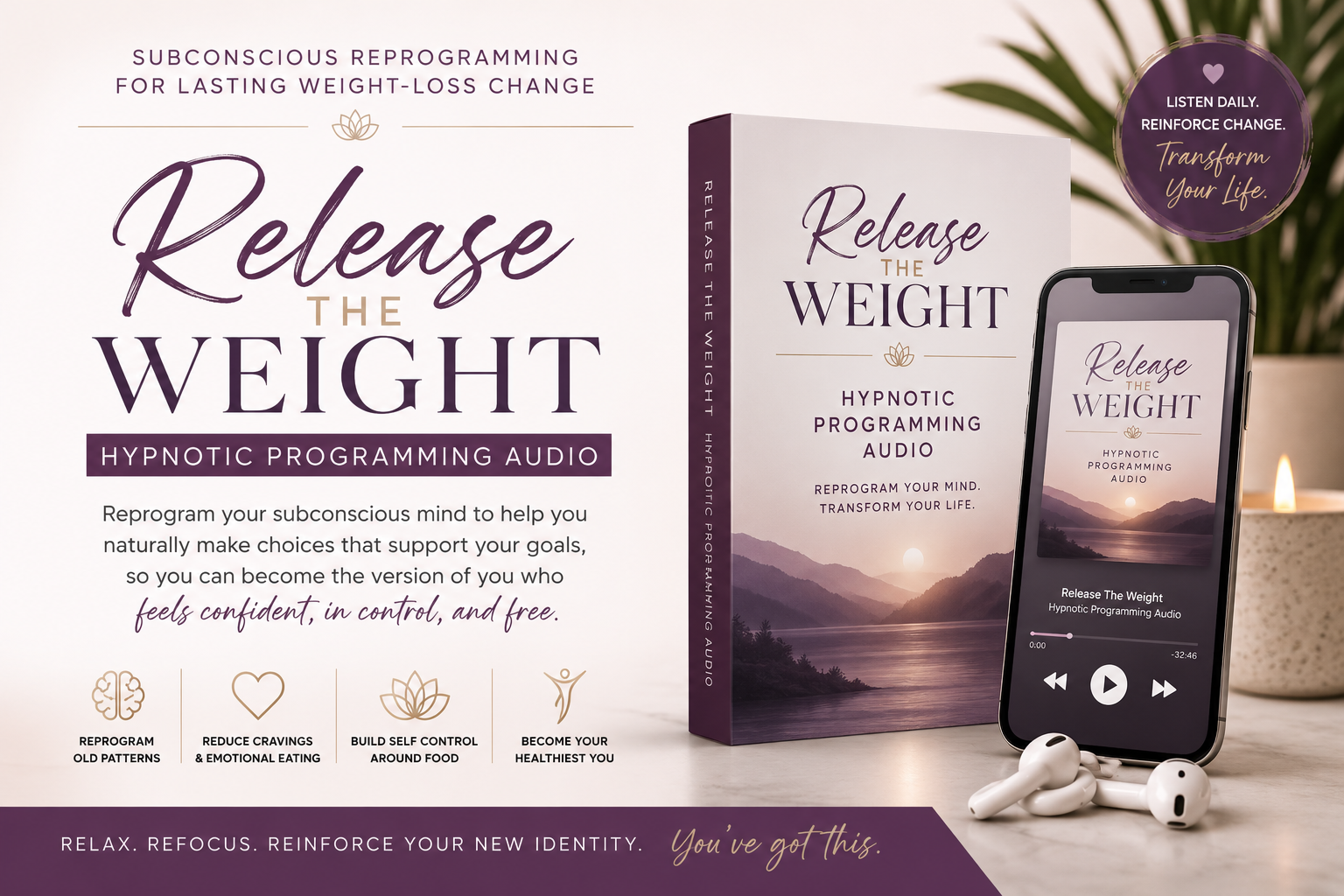
Release the Weight Hypnotic Programming Audio is a self-guided audio designed to help reinforce healthier thought patterns, habits, and consistency as part of a broader weight-management approach.
Available for $27.
💬 Looking for Personalized Support?
Schedule a Free 15-Minute Consultation to ask questions, discuss what you've been struggling with, and determine whether my approach to weight-loss hypnotherapy may be a good fit for you.
