
Hypnotherapy for Weight Loss:
The Complete Guide

You may already know what you are “supposed” to do to lose weight.
You may understand nutrition, recognize the importance of movement, and know that consistency matters.
Yet knowing what to do does not always make it easy to follow through—especially when stress, emotions, cravings, routines, and familiar eating patterns begin influencing your choices.
That gap between knowing and doing can be deeply frustrating.
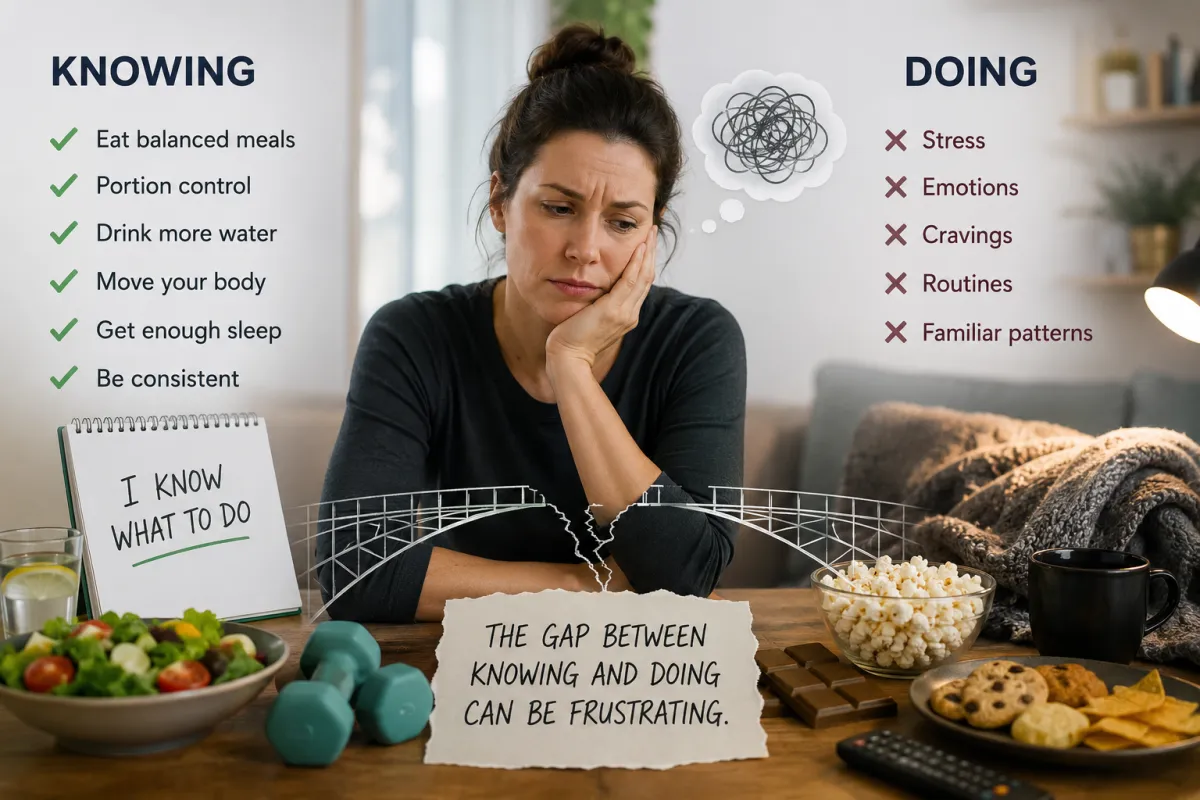
It can leave you questioning your motivation, criticizing your discipline, or wondering why you keep returning to behaviors you genuinely want to change. But repeated difficulty does not necessarily mean you are lazy, weak, or incapable of succeeding.
Many daily behaviors become automatic through repetition. You may reach for something sweet after dinner without consciously deciding to.
You may snack while watching television, eat when you feel overwhelmed, or abandon your efforts after one choice that did not go as planned. Over time, these responses can begin to feel less like decisions and more like familiar patterns.
Hypnotherapy for weight loss is intended to help you explore and work with some of those patterns.
It does not burn fat, replace nutritious eating, or make weight disappear without effort.
Instead, it may complement the physical components of weight management by helping reinforce healthier thoughts, responses, expectations, and behaviors.
This complete guide explains what weight loss hypnotherapy is, how hypnosis works, what current research suggests, which eating patterns it may help address, what happens during a session, and how to decide whether this approach is right for you.
For a closer examination of the available evidence, read Does Hypnotherapy Really Work for Weight Loss? What the Research Says.
Table of Content

What Is Hypnotherapy for Weight Loss?
How Does Hypnotherapy for Weight Loss Work?
Why Weight Loss Is About More Than Food
Does Hypnotherapy Really Work for Weight Loss?
Common Weight-Loss Patterns Hypnotherapy May Help Address
What Happens During a Weight-Loss Hypnotherapy Session?
How Many Hypnotherapy Sessions Are Needed?
Is Hypnotherapy Safe?
Hypnotherapy and GLP-1 Medications
Who May Be a Good Fit?
How to Choose the Right Hypnotherapist for Weight Loss
Frequently Asked Questions
About Erika’s Approach
Choose Your Next Step
What is Hyponotherapy for Weight Loss?

Hypnotherapy for weight loss uses hypnosis as part of a structured process intended to support changes in the thoughts, habits, emotional responses, and daily behaviors connected to weight management.
Hypnosis refers to a state of focused attention in which outside distractions may become less prominent and a person may become more absorbed in ideas, imagery, and suggestions. Hypnotherapy is the purposeful use of that state to support a particular goal.
Although the words are sometimes used interchangeably, hypnosis is the focused state or process, while hypnotherapy describes how hypnosis is applied.
In weight-related work, hypnotherapy may focus on areas such as:
Recognizing emotional or environmental eating cues
Becoming more aware of physical hunger and fullness
Reducing automatic snacking
Reinforcing consistency with movement
Responding differently to stress
Changing all-or-nothing thinking
Strengthening confidence in healthier choices
Developing a more supportive self-perception
Recovering from setbacks without abandoning the overall goal
Hypnotherapy does not cause the body to lose weight by itself. It is not a substitute for appropriate nutrition, physical activity, medical evaluation, or necessary mental health care.
Its role is different.
A person may consciously decide to prepare meals, move more often, or stop eating in front of the television. Yet when the familiar situation occurs, an established response may take over.
Hypnotherapy is designed to help reinforce a different response before the moment arrives again.
It is therefore best understood as a complementary approach.
It may support the behavioral side of weight management while you continue addressing the physical, nutritional, medical, and practical parts of the process.
To explore the process more deeply, read How Does Hypnotherapy for Weight Loss Work?
You can also review Weight Loss Hypnosis Myths Debunked for clarification about what hypnosis can and cannot do.
How Does Hypnotherapy for Weight Loss Work?

Hypnosis involves focused attention, reduced awareness of peripheral distractions, and an increased ability to become absorbed in suggestions or imagery.
It is not the same as being unconscious, asleep, or controlled by another person.
Definitions used in hypnosis research consistently emphasize focused attention and responsiveness to suggestion.
You experience forms of absorption in ordinary life.
You may become so involved in a book that you briefly stop noticing the room around you.
You may drive a familiar route and realize you remember very little of the journey.
You may watch a movie and emotionally respond even though you know the story is fictional.
During a formal hypnosis session, that focused state is used intentionally.
The hypnotherapist may guide you through relaxation, imagery, focused breathing, direct or indirect suggestions, metaphor, or other techniques.
The specific approach depends on the practitioner, the client, and the goal of the session.
In weight-related hypnotherapy, the work may involve imagining yourself responding differently in familiar situations.
For example, you might mentally rehearse arriving home after a stressful day, pausing before entering the kitchen, identifying what you actually need, and choosing a response that supports your goal.
That rehearsal does not remove your ability to choose.
It gives you an opportunity to strengthen another possible response.
Consider someone who eats every evening while watching television. The behavior may have started as an occasional choice but eventually became associated with sitting on the couch, turning on a particular show, or reaching a certain time of night.
The environment itself begins cueing the behavior.
Hypnotherapy may help the person become more aware of that sequence, weaken the assumption that television automatically requires food, and reinforce another evening routine.
You remain capable of thinking, speaking, disagreeing, and ending the experience.
Hypnosis does not take away your values or personal control.
For a detailed walkthrough, visit What Happens During a Weight Loss Hypnotherapy Session?
Why Weight Loss Is About More Than Food

Food matters. Nutrition matters.
Energy intake, movement, sleep, health conditions, medications, hormones, environment, and access to resources can all influence body weight.
But a person’s relationship with food is rarely shaped by information alone.
You may know that you are not physically hungry and still feel drawn to eat.
You may create a realistic plan and abandon it after a stressful day.
You may make progress for several weeks and then return to an old routine after one disruption.
Some of the most common patterns include:
Eating in response to stress, boredom, loneliness, or frustration
Snacking automatically while driving or watching television
Craving a particular food at the same time each day
Eating late at night after restricting food earlier
Viewing one unplanned choice as proof that the entire day is ruined
Postponing movement until you feel motivated
Speaking to yourself in ways that create discouragement rather than direction
Returning to familiar habits during periods of change
Giving up when progress is slower than expected
These patterns can have biological, nutritional, emotional, environmental, social, and habitual influences.
It would be inaccurate to reduce every weight-related struggle to the subconscious mind.
For example, persistent hunger might be influenced by inadequate nutrition, a medication, insufficient sleep, a medical condition, or the way food is distributed throughout the day.
Intense cravings may involve restriction, environmental exposure, emotional associations, or physical needs.
Understanding the pattern comes before trying to change it.
This is also why willpower alone is often unreliable.
Willpower can fluctuate with fatigue, stress, decision overload, environment, and emotional state.
A sustainable approach usually requires supportive routines and repeatable responses—not constant internal struggle.
Explore these subjects further in
Emotional Eating vs. Physical Hunger,
Stress Eating: Why It Happens,
Mindless Eating: Why We Eat Without Thinking,
Understanding Weight Loss Self-Sabotage, and
Why Willpower Isn’t Enough for Lasting Weight Loss.
Does Hypnotherapy Really Work for Weight Loss?

Research on hypnosis for weight loss has produced mixed results.
Some studies suggest that hypnosis may provide additional benefit when combined with behavioral or lifestyle programs.
Other studies have found limited or no significant effect, particularly when hypnosis is brief, delivered through a generic recording, or evaluated over a short period.
One randomized study of adults with severe obesity examined self-hypnosis alongside lifestyle intervention.
It found that participants who practiced self-hypnosis more consistently experienced some favorable outcomes, but the findings did not establish hypnosis as a stand-alone solution for weight loss.
A separate three-week study of audio self-hypnosis found no statistically significant effect on weight loss during that brief period.
That result illustrates one of the challenges in interpreting the research: a short audio intervention is not necessarily equivalent to individualized hypnotherapy delivered over time.
Earlier reviews have also noted that studies of hypnosis alone are limited and often contain methodological weaknesses.
Some evidence has been more favorable when hypnosis is combined with behavioral weight-management support.
The quality of the research varies because studies differ in several important ways:
The type of hypnosis used
Whether the intervention is personalized or standardized
The number and length of sessions
Whether participants practice self-hypnosis
The behavioral or nutritional program used alongside hypnosis
The length of follow-up
Participant expectations and engagement
The outcome being measured
A study measuring pounds lost after three weeks is asking a different question from a study examining behavior, self-efficacy, or maintenance over several months.
The most responsible conclusion is that hypnotherapy should not be promoted as a proven method that directly causes weight loss. It may be more useful as behavioral support—helping some people work with habits, emotional cues, self-perception, and consistency alongside appropriate lifestyle and medical care.
Read Does Hypnotherapy Really Work for Weight Loss? What the Research Says for a more detailed review.
Common Weight Loss Patterns Hypnotherapy May Help Address

People seek weight loss hypnotherapy for different reasons.
One person may struggle with emotional eating.
Another may follow a reasonable plan during the day but eat continuously at night.
Someone else may experience all-or-nothing thinking that turns one unplanned meal into several weeks of discouragement.
Hypnotherapy should not assume that every person has the same underlying pattern.
The purpose is to identify the specific situations, thoughts, feelings, expectations, and routines that influence your behavior.
That understanding can then guide the session.
Emotional Eating

Emotional eating occurs when food is used primarily in response to an emotional experience rather than physical hunger.
That does not mean every enjoyable or comforting meal is a problem. Food naturally carries emotional and social meaning. It may remind you of family, celebration, safety, tradition, or connection.
The difficulty occurs when eating becomes one of the main ways you respond to stress, loneliness, anger, sadness, boredom, overwhelm, or even excitement.
Physical hunger often develops gradually and can usually be satisfied by different foods. Emotional hunger may feel sudden, specific, and urgent.
You may want a particular texture or flavor and continue eating even when your body feels physically full.
The pattern can become self-reinforcing:
An emotion creates discomfort.
Eating provides temporary relief or distraction.
Guilt or disappointment follows.
Those emotions create another reason to eat.
Hypnotherapy may help by increasing awareness of the moment between the emotion and the behavior.
It may also be used to rehearse alternative responses, strengthen emotional tolerance, and separate food from a particular emotional cue.
The goal is not to eliminate emotion or create rigid control. It is to widen the range of responses available to you.
Read Emotional Eating vs. Physical Hunger and Can Hypnosis Help Emotional Eating?
Stress Eating

Stress eating often develops because food provides something immediate: pleasure, comfort, stimulation, relief, or a pause from responsibility.
After a demanding day, reaching for food may feel like the first moment that belongs to you. The behavior may be less about hunger and more about decompression.
This does not mean stress eating is simply a discipline problem.
Stress can affect sleep, attention, decision-making, appetite, routines, and the ability to pause before reacting. If a particular food repeatedly follows stressful experiences, the mind may begin associating that food with relief.
Hypnotherapy may support a different sequence.
Instead of moving directly from stress to eating, you might practice recognizing the internal signal, naming what you need, and choosing between several forms of relief.
Those options could include rest, movement, conversation, quiet, breathing, music, journaling, or an intentional meal if you are physically hungry.
The aim is not to forbid food.
It is to make eating a conscious choice rather than the only available response.
Learn more in Stress Eating: Why It Happens.
Sugar Cravings

Sugar cravings can have several influences.
They may be affected by hunger, meal composition, restriction, sleep, stress, environment, habit, medication, or an association between sweetness and reward.
Because the causes vary, hypnosis should not be presented as something that simply switches cravings off.
A craving may also be connected to a routine.
You finish dinner and expect dessert.
You sit at your desk in the afternoon and think about something sweet.
You stop at the same store on the way home.
The cue and behavior become paired.
Hypnotherapy may help when cravings contain a strong learned or automatic component.
A session might focus on noticing the cue earlier, delaying the automatic response, imagining another choice, or reducing the sense that the craving must be acted upon immediately.
It cannot diagnose or correct a medical, hormonal, medication-related, or nutritional issue.
Persistent or unusual changes in appetite should be discussed with an appropriate healthcare provider.
Read Can Hypnosis Help Sugar Cravings?
Late-Night Eating

Late-night eating is not caused by one single issue.
Some people eat at night because they have not eaten enough during the day.
Others are tired, stressed, bored, lonely, or finally free from daytime responsibilities.
For some, evening eating is a deeply established routine.
Restriction can also contribute.
If you spend the day trying to eat as little as possible, your physical hunger may become more intense at night. In that situation, the solution is not simply stronger resistance.
Before changing the behavior, it helps to understand its function.
Are you physically hungry?
Are you seeking comfort?
Is eating linked with television?
Does nighttime feel like your only opportunity for pleasure or privacy?
Are you reacting to overly rigid rules from earlier in the day?
Hypnotherapy may be useful when part of the pattern is automatic or cue-driven.
It may support a more intentional evening routine, a pause before eating, or a different expectation about what nighttime represents.
Explore the issue in Late-Night Eating: Causes and Solutions.
Mindless Eating

Mindless eating happens when food is consumed with limited awareness of the decision, quantity, pace, or physical experience.
It may occur while watching television, scrolling on a phone, working, driving, preparing food, or standing in the kitchen.
Environmental cues matter.
Visible food, large containers, repeated exposure, convenient access, and distracted settings can all influence how much a person eats.
The behavior may continue because attention is directed somewhere else.
Hypnotherapy may support greater awareness by reinforcing simple moments of interruption:
Pausing before opening a package
Sitting down to eat
Removing screens
Noticing flavor and texture
Checking physical fullness
Deciding intentionally whether to continue
This is not about monitoring every bite with anxiety.
It is about becoming present enough to participate in the decision.
Read Mindless Eating: Why We Eat Without Thinking.
Weight-Loss Self Sabotage

People often use the phrase “self-sabotage” when they repeatedly act against a goal they genuinely want.
But the word can sound accusatory—as though one part of you is intentionally trying to ruin your progress.
Usually, the pattern is more complicated.
You may return to something familiar when change begins feeling uncertain.
You may have perfectionistic expectations that make normal setbacks feel unacceptable.
You may interpret slower progress as failure.
You may unconsciously protect yourself from disappointment by stopping before you can be disappointed again.
Self-sabotage can also be a conflict between immediate relief and a longer-term goal.
The immediate choice solves something in the present moment, even when it creates consequences later.
Hypnotherapy may help explore the purpose the behavior has been serving.
Once that purpose is understood, you can begin developing another response that meets the need without repeatedly moving you away from your goal.
The objective is not to fight against yourself.
It is to understand the pattern well enough to create a more useful one.
Read Understanding Weight Loss Self-Sabotage.
Body Image and Self-Perception

How you perceive yourself can influence how you care for yourself.
If your internal dialogue is consistently critical, movement may feel like punishment, food choices may become moral judgments, and setbacks may confirm a negative identity.
Body shame is not a reliable foundation for sustainable behavior change.
You can desire weight-related change while also treating your current body with respect. The two are not mutually exclusive.
Hypnotherapy may support healthier self-perception by helping you rehearse an identity connected to consistency, care, capability, and participation.
Rather than waiting to become a different person before treating yourself differently, you begin practicing the behaviors of the person you are becoming.
That does not require pretending to love every part of your body. It means reducing the use of humiliation as motivation.
Explore this further in Body Image and Weight Loss.
Motivation and Exercise Consistency
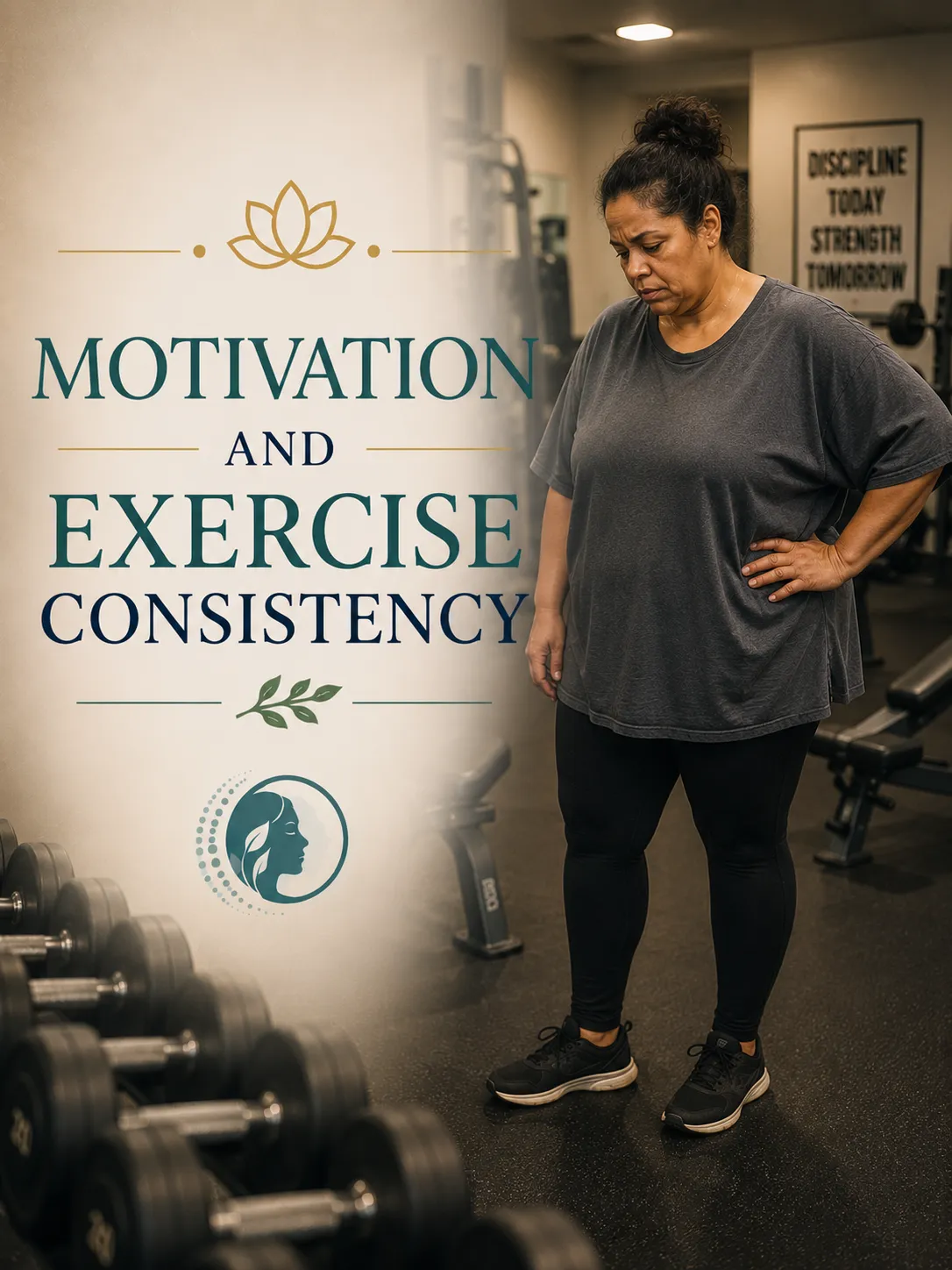
Motivation naturally changes.
You may feel energized when beginning a new routine, but novelty fades. Work becomes demanding, sleep changes, the weather shifts, or progress becomes less visible.
If movement only happens when you feel highly motivated, consistency becomes difficult.
Routines, cues, environment, and identity may matter more than continually trying to create enthusiasm.
A person who sees movement as part of daily self-care does not need to feel inspired every time.
Hypnotherapy may help reinforce a more supportive relationship with physical activity.
It may focus on reducing dread,
mentally rehearsing the routine,
connecting movement with immediate benefits,
or strengthening the expectation that you follow through even when motivation is moderate.
The goal is not to force intense exercise.
It is to make appropriate movement more familiar and repeatable.
Read Can Hypnotherapy Improve Motivation to Exercise?
and
Why Willpower Isn’t Enough for Lasting Weight Loss.
What Happens During a Weight-Loss Hypnotherapy Session?

A weight-loss hypnotherapy session typically begins with conversation rather than hypnosis.
Your hypnotherapist may ask about your goals, eating patterns, previous weight-loss experiences, routines, triggers, expectations, and the situations in which you struggle most.
This part matters because “I want to lose weight” is broad.
Two people may have the same goal but completely different barriers.
One may eat in response to stress.
Another may struggle with consistency after traveling.
Another may understand hunger and nutrition but abandon progress whenever the scale changes slowly.
The hypnotherapist may also explain hypnosis, correct misconceptions, discuss consent, and clarify what you can expect.
When the hypnosis portion begins, you may be invited to focus on breathing, a visual point, bodily relaxation, imagery, counting, or the practitioner’s voice.
There is no single induction that works identically for everyone.
Once focused, the session may include:
Suggestions connected to your goals
Mental rehearsal of new responses
Imagery
Metaphor
Exploration of competing patterns
Reinforcement of confidence and consistency
Attention to hunger, fullness, or emotional cues
Future pacing, in which you imagine handling an upcoming situation differently
You usually remain aware and capable of communicating.
Some people feel deeply relaxed, while others simply feel focused.
Depth of relaxation is not the sole measure of whether the session is useful.
At the end, you are guided back to ordinary alertness.
The session may conclude with discussion, reflection, or a recommendation to practice a particular skill or listen to a recording between appointments.
Experiences vary, and not every practitioner uses the same methods.
Read What Happens During a Weight Loss Hypnotherapy Session?
and
Weight Loss Hypnosis Myths Debunked.
How Many Hypnotherapy Sessions Are Needed for Weight-Loss?

There is no universal number of sessions that works for every person.
The appropriate length depends on several factors:
The goal you want to address
How long the pattern has been present
Whether several behaviors are involved
Your physical and medical context
Your readiness to participate
How consistently you practice between sessions
The way you respond to hypnosis
Whether additional professional support is needed
Someone working on a specific snacking routine may have a different process from someone navigating emotional eating, body image, repeated weight regain, and several competing habits.
It is also important to distinguish between noticing an early change and establishing a sustained pattern.
You might experience a different perspective after one session. That does not automatically mean the pattern has been fully integrated into daily life.
Repetition,
practice,
and adjustment are often part of meaningful behavior change.
Be cautious of promises that one hypnosis session will permanently transform every eating behavior or guarantee a particular amount of weight loss.
A consultation can help clarify your goal and whether a short or more structured process may be appropriate.
Read How Many Hypnotherapy Sessions Are Needed for Weight Loss?
Is Hypnotherapy Safe?
Hypnosis is generally considered low risk when used appropriately, although no complementary approach is appropriate for every person or every situation.
NCCIH notes that hypnosis has been studied for several health-related concerns, while established medical sources describe it as a focused state in which people usually remain calm, aware, and responsive.
You do not surrender control during hypnosis.
You can hear, think, speak, reject a suggestion, move, or end the session.
You are not required to reveal private information, and you cannot be ethically compelled to act against your values.
Working with a properly trained practitioner is important.
Before beginning, disclose relevant medical, neurological, and mental health information.
Certain symptoms or diagnoses may require coordination with—or referral to—a licensed healthcare or mental health professional.
Hypnotherapy should not be used to delay necessary medical care, replace treatment for an eating disorder, or independently manage serious psychiatric symptoms.
You should seek appropriately licensed support when concerns include:
Suspected or diagnosed eating disorders
Suicidal thoughts or self-harm
Psychosis or significant loss of contact with reality
Severe or unstable mental health symptoms
Unexplained or rapid changes in appetite or weight
Medical symptoms requiring evaluation
Safety also includes ethical marketing.
A responsible hypnotherapist should not promise guaranteed weight loss, tell you to discontinue prescribed treatment, or claim hypnosis can cure a medical condition.
Read Is Hypnotherapy Safe for Weight Loss?
and
Choosing the Right Hypnotherapist for Weight Loss.
Hypnotherapy and GLP Medications

GLP-1 and GLP-2 medications and hypnotherapy serve different purposes.
GLP-1 receptor agonists are prescription medications that act through physiological pathways and are used under medical supervision.
Research has shown that medications in this class can contribute to weight loss for eligible patients, but decisions about beginning, changing, or stopping them belong between you and your prescribing provider.
Hypnotherapy does not replace the medication, increase its pharmacological effect, or determine whether it is medically appropriate.
Its possible role is behavioral.
For example, someone using a GLP-1 medication may still want support with:
Eating routines
Emotional eating
Body image
Consistency with movement
Adjusting to changing appetite
Fear of weight regain
Self-perception
Maintaining supportive habits
Following medical and nutritional recommendations
Who May Be a Good Fit for Weight-Loss Hypnotherapy

Weight-loss hypnotherapy may be worth exploring when you:
Understand many of the behaviors that would support your goal but struggle to practice them consistently
Notice recurring eating patterns connected to stress, boredom, routine, or emotion
Feel caught in all-or-nothing thinking
Want to build a more supportive relationship with movement or self-care
Are curious about hypnosis and willing to participate
Understand that hypnosis is not a passive or guaranteed solution
Are prepared to address medical and nutritional needs with appropriate professionals
Want a complementary form of behavioral support
Are willing to practice new responses outside the session
You do not need to be perfectly confident or completely free from skepticism.
It is reasonable to have questions.
However, another form of support may need to come first when you are
experiencing an active eating disorder,
severe psychological symptoms, an unexplained medical issue, or
a situation requiring licensed clinical care.
Hypnotherapy may also be a poor fit if you want someone to make you change without your participation
or
expect hypnosis to replace nutrition, movement, medication, or medical evaluation.
A responsible consultation should help determine fit rather than pressure you to purchase a program.
How to Choose the Right Hypnotherapist for Weight Loss

Choosing a hypnotherapist involves more than finding someone who uses the word “hypnosis.”
Ask about the practitioner’s
education,
hypnosis training,
professional experience,
and scope of practice.
Because hypnosis laws and professional requirements vary by location, determine what credentials are relevant where the practitioner works.
Look closely at how they communicate.
A trustworthy practitioner should be able to explain:
What hypnosis is
What a session may involve
What their role includes
What their role does not include
How they protect privacy
What results can and cannot be promised
When they refer to another professional
Be cautious if a practitioner:
Guarantees a specific amount of weight loss
Claims one session works for everyone
Tells you that nutrition or exercise does not matter
Promises to cure obesity or an eating disorder
Advises you to disregard medical guidance
Uses shame, fear, or humiliation
Avoids questions about training
Suggests hypnosis removes all personal choice
Rapport also matters.
You should feel able to ask questions, express concerns, disagree, and participate in setting the goal.
The practitioner should be interested in your specific pattern—not simply applying the same script to every person seeking weight loss.
Read Choosing the Right Hypnotherapist for Weight Loss.
Frequently Asked Questions

Can Hypnosis make me lose weight?
Hypnosis does not directly burn calories or cause body fat to disappear.
Its possible role is behavioral. Hypnotherapy may help reinforce habits, responses, and expectations that support your broader weight-management efforts. Nutrition, movement, sleep, medical factors, medications, and other physical considerations still matter. Results vary, and hypnosis should not be promoted as a guaranteed method of weight loss.
Is Hypnotherapy a replacement for diet and exercise?
No.
Hypnotherapy is a complementary approach. It may help you become more consistent with appropriate eating, movement, and self-care behaviors, but it does not replace the physical components of weight management.
Your needs may also include support from a physician, registered dietitian, licensed mental health professional, or another qualified provider.
Will I lose control during Hypnosis?
No.
Hypnosis does not remove your awareness, judgment, or values. Most people can hear the practitioner, think about what is being said, communicate, and end the experience. You cannot be ethically forced to accept a suggestion simply because you are hypnotized.
Can everyone be hypnotized?
People vary in their responsiveness to hypnosis, and the experience does not feel identical for everyone. Some become deeply absorbed, while others remain more analytical or aware of their surroundings. Expectations, comfort, attention, the approach used, and rapport with the practitioner can all influence the experience. You do not have to feel unconscious or extraordinarily relaxed for the session to be meaningful.
Can Hypnotherapy help emotional eating?
It may help some people identify emotional triggers, interrupt automatic responses, and practice alternatives to eating. However, emotional eating can have many causes. If it is connected to significant depression, trauma, an eating disorder, or another mental health concern, care from an appropriately licensed professional may be necessary.
Can Hypnosis stop sugar cravings?
Hypnosis cannot guarantee that cravings will disappear. Sugar cravings may involve hunger, nutrition, restriction, sleep, stress, environment, medication, or habit. Hypnotherapy may be most relevant when cravings are strongly linked to learned routines, emotional cues, or automatic responses.
How quickly will i notice a difference?
Some people notice a shift in awareness, confidence, or behavior relatively early. Others need repetition and time. Noticing an early difference is not the same as establishing a lasting pattern. Your experience will depend on the goal, the complexity of the behavior, your participation, and other factors affecting weight management.
How many sessions will I need?
There is no standard number for everyone. A specific and limited habit may require a different level of support from several interconnected patterns. A consultation can help clarify the goal and the type of process that may be appropriate. Be cautious of guarantees based on a predetermined number of sessions.
Is online Hypnotherapy effective?
Many people can engage in hypnosis remotely when they have privacy, a stable connection, a safe environment, and a practitioner who is experienced in virtual sessions. Whether online or in person is better may depend on your comfort, needs, location, and the practitioner’s approach.
Can Hypnotherapy be used alongside GLP Medications?
Hypnotherapy may be used as complementary behavioral support while someone is under medical care for a GLP-1 and GLP-2 medications. It does not replace prescribing guidance or medical monitoring. Always discuss medication-related questions, nutrition concerns, and side effects with qualified providers.
What is I have an eating disorder?
Hypnotherapy for general weight management is not a substitute for specialized eating-disorder treatment. If you have—or suspect you may have—an eating disorder, seek evaluation and support from appropriately trained and licensed healthcare and mental health professionals. Hypnosis should only be considered within a properly coordinated plan when clinically appropriate.
How do I know whether Hypnotherapy is right for me?
Begin by considering what you want help changing. If you notice recurring behavioral patterns, are open to hypnosis, understand its limitations, and want complementary support, a consultation may help you decide. A reputable practitioner should answer your questions honestly and tell you when another service is more appropriate.
For additional answers, visit the Weight Loss Hypnotherapy FAQ.
About Erika's Approach

My approach to hypnotherapy for weight loss begins with a simple observation:
many people do not need another list of rules.
They already know many of the choices that could support their goals.
The difficulty is applying that knowledge when
stress is high,
motivation changes,
an old routine is triggered,
or one setback begins feeling like proof that nothing works.
I specialize in weight-loss hypnotherapy and have worked with more than 70 clients seeking support with weight-related behaviors and patterns.
I also bring personal perspective from releasing 83 pounds.
My experience is not presented as a promise that your path will look like mine.
Every person has a different history, body, environment, set of needs, and definition of progress.
The work is individualized and non-shaming.
Rather than treating you as though you lack discipline, I look at what is happening around the behavior:
What triggers it?
What does it provide in the moment?
What do you expect to happen?
What familiar thought appears?
What would a more supportive response look like?
What needs to be reinforced for that response to become easier to practice?
Hypnotherapy remains within its appropriate role.
I do not use it as a replacement for medical care, nutrition guidance, psychotherapy, or eating-disorder treatment.
When another professional is needed, that support should be included.
The goal is not to make you dependent on willpower or on the Hypnotherapist.
It is to help you participate more intentionally in the choices that shape your life.
Choose Your Next Step

You may be ready to explore the topic more deeply, begin with a self-guided resource, or speak with someone about personalized support.
Choose the next step that fits where you are now.
Want to Learn More?

Explore the supporting resources throughout this guide to learn more about
emotional eating,
cravings,
stress eating,
self-sabotage,
hypnosis safety,
research,
and what happens during a session.
Ready to Begin on Your Own?

The Release the Weight Hypnotic Programming Audio is a self-guided resource designed to support healthier thoughts, habits, and consistency as part of a broader weight-management effort.
It does not replace medical,
nutritional,
or mental health care
and does not guarantee weight loss.
Looking for Personalized Support?

Schedule a Free 15-Minute Consultation to
ask questions,
discuss the patterns you are experiencing,
and determine whether my approach may be a good fit for you.
The consultation is informational and does not obligate you to begin a program.
Final Thoughts