
Procrastination or Self-Sabotage? What May Really Be Keeping You Stuck
You have something you want to accomplish.
Maybe it's starting a business, applying for a new opportunity, getting consistent with your health goals, or finally following through on something you've been thinking about for months.
You know what needs to happen. You've probably even made a plan.
And yet, when it's time to take action, something shifts.
You find another task to complete. You convince yourself you'll feel more prepared tomorrow. You start researching again, even though you already have enough information.
Before you know it, another day has passed.
And the question becomes: Why do I keep procrastinating when this is something I genuinely want?
Sometimes procrastination is connected to exhaustion, competing priorities, or a task that simply doesn't interest you. Other times, it may be part of a recurring pattern that interferes with your goals.
Understanding the difference can help you approach change in a more meaningful way.
Key Takeaways
Procrastination involves delaying something you intended to do, often despite expecting consequences.
Self-sabotage describes patterns that interfere with your own goals or intentions.
Procrastination can become a form of self-sabotage when repeated avoidance consistently prevents you from moving toward something important.
Perfectionism, fear of judgment, uncertainty, and emotional discomfort may contribute to procrastination.
Understanding what happens immediately before you avoid a task can offer insight into the pattern.
Hypnotherapy may provide an opportunity to explore subconscious beliefs and emotional associations connected to recurring avoidance.
What Is the Difference Between Procrastination and Self-Sabotage?
Although procrastination and self-sabotage are often discussed together, they aren't exactly the same thing.
Procrastination is the act of delaying a task or decision, particularly when you recognize that postponing it may create problems later.
Self-sabotage is a broader description of behaviors or patterns that interfere with something you consciously want to achieve.
For example, imagine you've been wanting to start a business.
You spend weeks researching, developing ideas, creating plans, and organizing everything you might need.
But when it's time to introduce your business to potential customers, you suddenly decide your website needs another revision.
Then you need new photos.
Then you need to research another marketing strategy.
Each task feels productive. And some of them may genuinely be useful.
But the one action that would move you closer to your goal continues to be postponed.
This is where procrastination and self-sabotage may overlap.
The important question becomes:
What happens for you when preparation turns into the possibility of actually being seen, evaluated, or successful?
That question invites us to look beyond the unfinished task and explore the experience surrounding it.
For a broader understanding of these patterns, read What Is Self-Sabotage? Why You Keep Getting in Your Own Way.
Why Do I Procrastinate Even When Something Matters to Me?

This is one of the most interesting aspects of procrastination.
You might assume that the more important something is, the easier it should be to prioritize.
But sometimes, the importance of the goal adds another layer of pressure.
Think about the difference between sending an ordinary email and sending an application for an opportunity you've wanted for years.
Both actions may take approximately the same amount of time.
Yet one feels simple, while the other carries a completely different emotional weight.
The application might bring up questions such as:
What if I'm rejected?
What if I'm accepted and people expect more from me?
What if I make a mistake?
What if I'm not as prepared as I thought?
What happens if my life actually changes?
You may genuinely want the opportunity while also feeling uncertain about everything that could come with it.
And when those feelings arise, postponing the task may provide immediate relief.
The difficulty is that temporary relief can make avoidance increasingly familiar.
Over time, you may find yourself repeating the same cycle whenever something feels particularly meaningful.
Five Reasons Procrastination May Become a Self-Sabotaging Pattern
There isn't one explanation for why people procrastinate.
However, certain experiences can make avoidance especially appealing.
1. Perfectionism Makes Starting Feel Risky
When you hold yourself to exceptionally high standards, beginning a task can feel uncomfortable.
You might tell yourself that you need more time, more information, or better circumstances before moving forward.
Sometimes preparation is necessary.
But when your standards continually move further away, preparation can become a way of delaying the possibility of making a mistake.
Consider asking yourself:
What would it mean about me if I tried my best and the result still wasn't perfect?
Your answer may reveal more than another productivity strategy.
2. Fear of Judgment Makes Visibility Uncomfortable
Certain goals require you to become more visible.
Starting a business, sharing your ideas, applying for a promotion, or expressing what you want in a relationship can all create opportunities for other people to form opinions.
And being seen can feel vulnerable.
You may begin questioning your abilities or imagining how others will respond.
So you postpone the action.
The delay may temporarily reduce the discomfort associated with being evaluated.
3. Success May Bring Expectations You're Unsure About
Sometimes the concern isn't limited to whether you'll succeed.
It's also about what success might require.
Perhaps achieving your goal would mean accepting greater responsibility, becoming more visible, setting different boundaries, or changing how you spend your time.
You may want the outcome while feeling uncertain about the expectations that come with it.
This can create an interesting internal conflict: you're working toward something that also represents a significant change.
Related reading: Why Do I Self-Sabotage When Things Are Going Well?
4. Overthinking Creates the Feeling of Progress
Researching, planning, comparing options, and thinking through possibilities can be valuable.
But there's a point when thinking about taking action begins replacing the action itself.
You might spend hours learning about the best way to accomplish something while repeatedly avoiding the first practical step.
The activity feels productive because you're engaged with your goal.
Yet you're still in the same position.
One question worth exploring is:
What am I hoping to feel certain about before I allow myself to begin?
5. Familiar Habits Offer Immediate Comfort
Imagine you've planned to spend an hour working on an important personal goal after work.
But when the time comes, you're tired, the couch looks inviting, and your favorite show is available.
You tell yourself you'll begin tomorrow.
Sometimes rest really is what you need.
Other times, the familiar routine may offer immediate comfort when the alternative requires effort, uncertainty, or emotional discomfort.
The distinction matters.
Instead of automatically criticizing yourself for choosing comfort, consider what you were experiencing when you decided to postpone your plans.
How Procrastination Can Become a Repeating Cycle
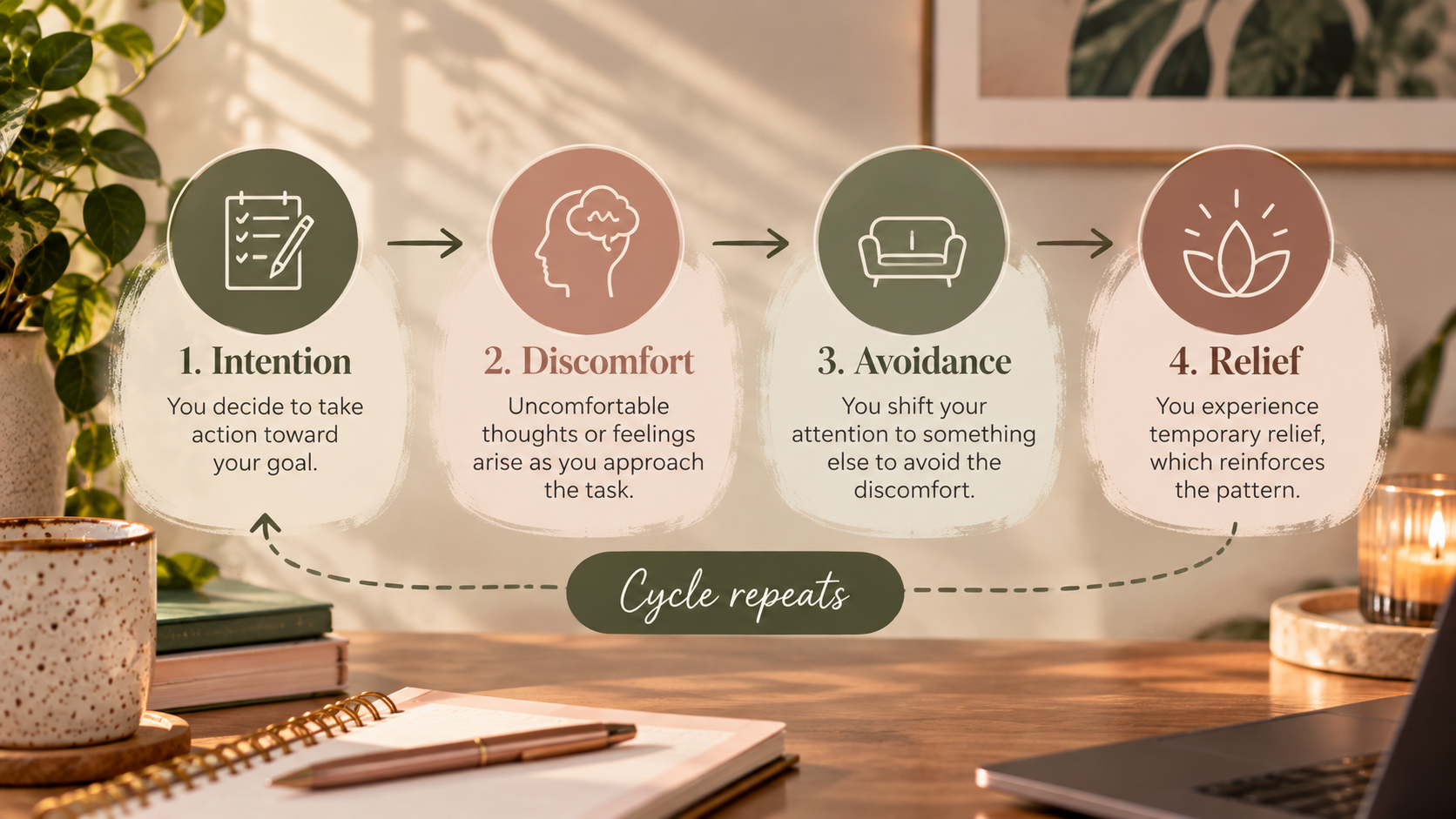
Procrastination often follows a recognizable sequence.
A simplified example of how temporary relief can reinforce procrastination.
You begin with an intention.
As you approach the task, uncomfortable thoughts or feelings arise.
You avoid the task and experience relief.
Later, the unfinished task remains, often accompanied by frustration, guilt, or additional pressure.
When you approach it again, the discomfort may feel even greater.
This helps explain why repeatedly telling yourself to just do it may not resolve the problem.
You may need to understand what makes avoidance appealing in the first place.
Why Willpower May Not Be Enough to Stop Procrastinating
Willpower can help you push through certain situations.
But when procrastination repeatedly appears around similar experiences, relying on determination alone may leave an important part of the pattern unexplored.
For example, you might create a detailed schedule, set reminders, or promise yourself that tomorrow will be different.
Those tools can be useful.
But suppose the moment you begin working on something important, you experience intense self-doubt.
Your mind starts imagining mistakes, criticism, or disappointment.
You suddenly feel compelled to do something else.
The challenge may involve more than remembering your schedule.
It may also involve learning how to respond differently to the thoughts and feelings that arise when you begin.
I explore this distinction further in How to Stop Self-Sabotaging: Why Willpower May Not Be Enough
How to Recognize What's Happening Right Before You Procrastinate

One of the most useful places to begin is the moment immediately before avoidance.
Rather than reviewing everything you failed to accomplish at the end of the day, become curious about what happened when you first considered taking action.
Here are five questions you can use for reflection.
A moment of reflection
1. What was I about to do when I decided to postpone it?
2. What thoughts came up immediately before I changed direction?
3. What was I feeling in that moment?
4. What did choosing another activity allow me to experience or avoid?
5. Where else in my life have I noticed a similar response?
You may notice that certain situations consistently bring up similar responses.
Perhaps you delay tasks when you're unsure how others will evaluate your work.
Maybe you avoid taking action when the outcome could create additional responsibility.
Or perhaps your procrastination increases when you feel overwhelmed and have difficulty identifying where to begin.
Each possibility invites a different conversation.
And that is why understanding your individual experience matters.
How I Approach Procrastination and Self-Sabotage in My Hypnotherapy Practice

When someone tells me they struggle with procrastination, I'm interested in understanding more than what they keep putting off.
I want to know what happens when they try to move forward.
What are they thinking?
What are they anticipating?
What does taking action represent to them?
And what changes internally when they decide to postpone it?
Two people can procrastinate on the exact same task for very different reasons.
One person may be concerned about making a mistake.
Another may feel overwhelmed by the number of decisions involved.
Someone else may associate completing the task with greater visibility or expectations.
If we assume that all three people need the same solution, we may overlook the experiences that make their patterns unique.
The behavior gives us information. The pattern gives us context.
In my hypnotherapy practice, I use thoughtful questions and individualized exploration to help clients become more aware of beliefs, emotional associations, and habitual responses that may be influencing their choices.
I am particularly interested in helping clients discover their own insights.
Because sometimes the most meaningful realization comes when someone recognizes a connection they hadn't previously considered.
Can Hypnotherapy Help With Procrastination and Self-Sabotage?
Hypnotherapy may be useful for individuals who want to explore recurring patterns connected to procrastination, avoidance, and self-doubt.
During hypnotherapy, we can work with focused attention, relaxation, imagery, and suggestion while exploring how someone experiences a particular challenge.
For example, a person who continually postpones opportunities might begin examining the beliefs and emotional associations they connect with being successful, visible, or evaluated.
Another person might explore their relationship with mistakes, uncertainty, or the pressure to meet certain expectations.
The purpose is to develop greater awareness and support responses that are more consistent with the person's goals.
Hypnotherapy is not a guaranteed solution for procrastination, and practical circumstances also matter. Sometimes difficulties with follow-through are connected to workload, fatigue, executive-function challenges, or other factors that deserve appropriate support.
However, when procrastination appears alongside recurring self-sabotaging patterns, exploring the internal experience can be a valuable part of the process.
What Can You Do When You Recognize the Pattern?

Awareness can create an opportunity to respond differently.
Here are a few ways to begin.
Start With the Smallest Meaningful Action
Instead of focusing on everything required to complete a goal, identify one action that moves you closer.
If you're avoiding writing an important proposal, that might mean opening the document and outlining the first section.
The goal is to create an opportunity to begin.
Notice What Changes When You Start
Pay attention to the thoughts and feelings that arise.
Does the task suddenly seem more difficult?
Do you begin questioning your abilities?
Does another activity become unusually appealing?
These observations can help you understand the conditions surrounding your procrastination.
Reconsider What Progress Needs to Look Like
Sometimes your expectations make a task feel larger than it needs to be.
Consider what meaningful progress would look like if you allowed yourself to work in stages.
A completed first draft, a difficult conversation, or a single application may represent significant movement.
Explore the Pattern With Curiosity
When you notice yourself avoiding something important, ask:
What is it about this particular step that feels difficult for me right now?
Allow the answer to be specific.
You may discover that the task itself is manageable, while the meaning you've attached to it creates discomfort.
And sometimes that insight becomes the starting point for a different response.
Feeling Stuck? Find Support Through Stuck to Striving
Understanding why you procrastinate is an important first step. But sometimes, having a space to reflect, gain new perspectives, and stay connected to your personal growth can make the journey feel more intentional.
Stuck to Striving is a community created for people who want to become more aware of the patterns keeping them stuck and begin exploring new ways of thinking, responding, and moving forward.
If you're ready to continue the conversation beyond this article, I invite you to explore the community.
Explore the Stuck to Striving Community

Explore Personalized Hypnotherapy

If procrastination and self-sabotage have become recurring challenges, we can discuss what you've been experiencing and whether hypnotherapy may be an appropriate next step.
Schedule a Free 15-Minute Consultation
Prefer to Begin Independently?

The Overcoming Self-Sabotage Hypnotic Programming Audio offers a self-guided way to begin exploring your internal dialogue and patterns.
A Different Way to Think About Procrastination
The next time you notice yourself postponing something important, consider looking more closely at the experience.
What are you anticipating?
What feels uncertain?
What becomes easier when you decide to wait?
And what might become possible if you understood that response more clearly?
Procrastination can be frustrating, especially when it repeatedly interferes with goals that matter to you.
But recognizing the pattern gives you information you can begin working with.
Sometimes the most useful starting point is understanding what happens in the moment between deciding to act and choosing to wait.
Frequently Asked Questions About Procrastination and Self-Sabotage

Is procrastination always a form of self-sabotage?
No. Procrastination can occur for many reasons, including fatigue, overwhelm, competing priorities, or difficulty organizing a task. It may be considered self-sabotaging when repeated delays consistently interfere with goals that are important to you.
Why do I procrastinate even when I really want something?
Important goals can carry emotional pressure. Concerns about failure, judgment, uncertainty, responsibility, or changing expectations may make certain tasks uncomfortable to approach.
Can perfectionism cause procrastination?
Yes. Perfectionism can contribute to procrastination when someone continually delays beginning or completing tasks because they feel their work must meet exceptionally high standards.
How do I know whether my procrastination is connected to fear of success?
Notice whether your avoidance increases when an opportunity could bring greater visibility, responsibility, or expectations. These observations may provide clues, although they do not establish a single cause.
Can hypnotherapy help me stop procrastinating?
Hypnotherapy may help some people explore the beliefs, emotional associations, and habitual responses connected to recurring avoidance. The approach and results vary by individual.
What is the first step toward changing a procrastination pattern?
Begin by observing what happens immediately before you postpone an important task. Identifying the thoughts, feelings, and circumstances surrounding the delay can help you choose a more appropriate strategy.