
What Is Self-Sabotage? Why You Keep Getting in Your Own Way
You know what you want to do.
You may even know exactly what steps you need to take.
You make the plan. You tell yourself that this time will be different. Maybe you start strong and feel completely committed to making a change.
And then, somehow, you find yourself right back in a familiar pattern.
You procrastinate on something that matters to you. You keep preparing instead of starting. You wait until conditions feel perfect. You say yes when you really want to say no. You begin making progress and suddenly lose momentum. Or an opportunity you've wanted finally appears—and instead of moving toward it, you start finding reasons to pull away.
From the outside, it can look like a lack of motivation or follow-through.
From the inside, it can be incredibly frustrating.
You might find yourself wondering:
Why do I keep doing this?
Why can't I just follow through?
I know what I need to do, so why am I still making the same choices?
This is where understanding self-sabotage can change the conversation.
Self-sabotage is a recurring pattern of behaviors, thoughts, or choices that interferes with something you consciously want. It can show up as procrastination, perfectionism, people-pleasing, negative self-talk, starting and stopping, avoiding opportunities, or pulling back when things are going well.
Sometimes the behavior makes more sense when you begin looking at the subconscious pattern underneath it.
Instead of looking only at what you're doing, it can be helpful to become curious about what keeps making that response feel familiar, necessary, comfortable, or safer than the alternative.
Key Takeaways
Self-sabotage is usually a pattern, not one isolated choice. Look for behaviors that repeatedly interfere with goals, relationships, opportunities, or changes that matter to you.
It can take many forms. Procrastination, perfectionism, people-pleasing, negative self-talk, starting and stopping, and pulling away from opportunities can sometimes become self-sabotaging patterns.
The behavior may only be part of the story. Exploring what happens before the behavior—and what the response may help you avoid—can provide important context.
Knowing better doesn't always mean automatically doing differently. Familiar responses, beliefs, expectations, and learned patterns may continue to influence behavior.
Awareness creates another place to begin. Instead of focusing only on stopping the behavior, you can begin exploring the pattern underneath it.
What Is Self-Sabotage?

Self-sabotage happens when a recurring behavior, thought pattern, or response interferes with a goal, relationship, opportunity, or change that matters to you.
You may consciously want one outcome while repeatedly responding in ways that make that outcome more difficult to reach.
You may want to complete a project but repeatedly put it off.
You may want a healthier relationship but find yourself falling into the same communication patterns.
You may want to pursue an opportunity but talk yourself out of taking the next step.
You may want to establish a new routine but repeatedly find yourself starting, stopping, and starting over.
The important word here is pattern.
Missing a workout once isn't necessarily self-sabotage. Putting off one task doesn't automatically mean you're sabotaging yourself. Changing your mind about a goal isn't necessarily self-sabotage either.
What becomes more interesting is when you notice a recurring pattern in which your actions repeatedly move you away from something you genuinely say you want.
And those patterns aren't always deliberate.
You don't necessarily wake up thinking, How can I ruin my progress today?
Often, you are making choices that make sense in the moment.
Avoiding the conversation brings temporary relief.
Waiting gives you more time to prepare.
Saying yes prevents possible conflict.
Staying quiet protects you from being judged.
Stopping after a setback protects you from experiencing another one.
Talking yourself out of the opportunity removes the uncertainty that comes with taking it.
In the short term, the response may accomplish something.
The problem is that what provides relief, familiarity, or protection in the moment can also interfere with what you want in the long term.
What Are the Signs of Self-Sabotage?
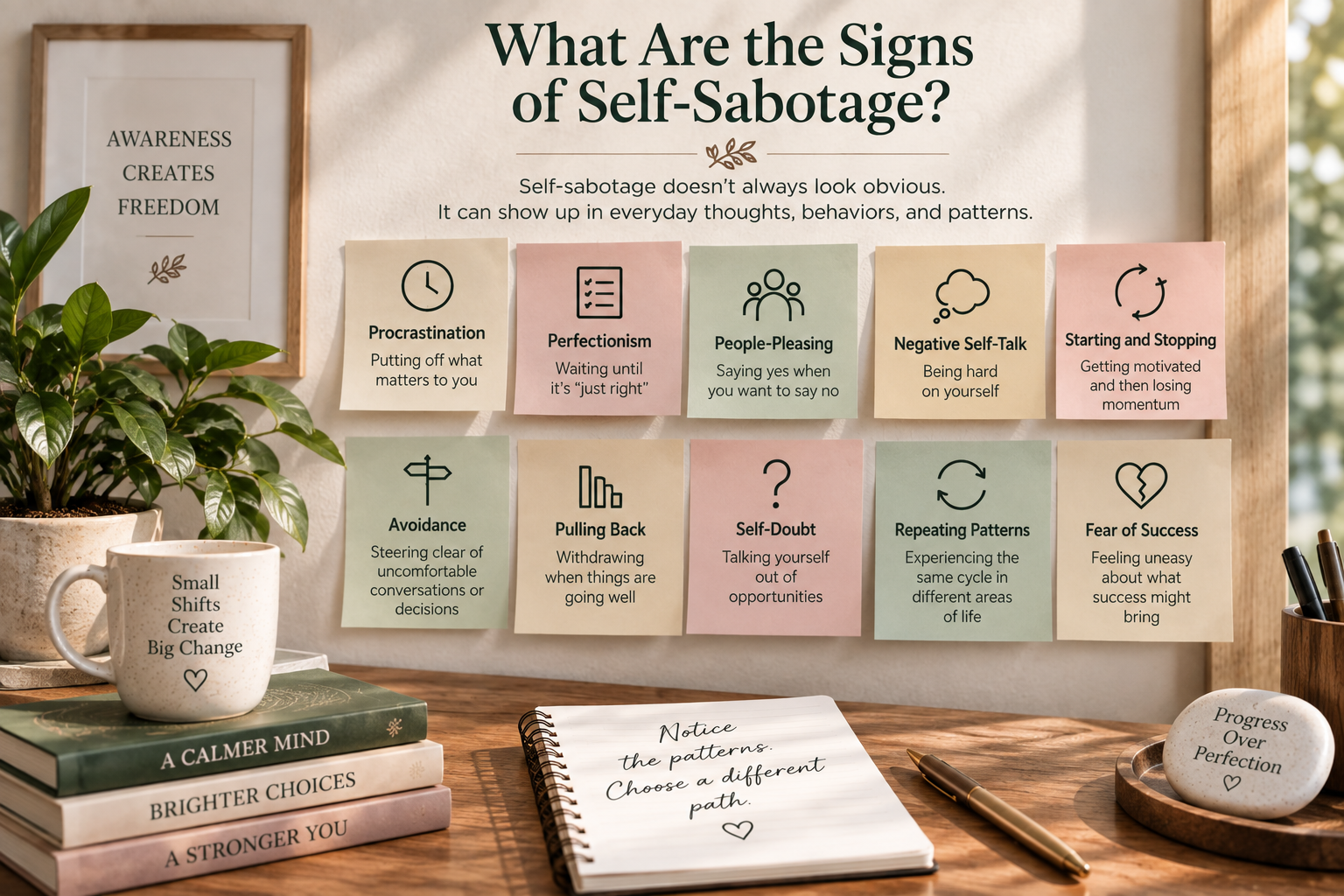
Self-sabotage doesn't look the same for everyone. Common signs may include:
Repeatedly putting off things that are important to you
Waiting until you feel completely ready or conditions are perfect
Starting goals with enthusiasm and repeatedly abandoning them
Talking yourself out of opportunities you genuinely want
Being highly critical of yourself after mistakes
Prioritizing other people's approval at your own expense
Pulling back when you're making meaningful progress
Avoiding conversations, decisions, or actions that feel uncomfortable
Turning one setback into a reason to abandon an entire goal
Repeating similar patterns across different goals, relationships, or areas of your life
One of the clearest clues isn't any single behavior.
It's repetition.
When the circumstances change but you keep finding yourself in a familiar cycle, there may be a larger pattern worth exploring.
What Does Self-Sabotage Look Like?

One reason self-sabotage can be difficult to recognize is that it doesn't always look destructive.
Sometimes it looks like avoidance.
Sometimes it looks like being responsible.
Sometimes it looks like overthinking.
Sometimes it even looks like preparation.
The behavior itself may change depending on the situation, but the underlying cycle can be surprisingly similar.
Procrastination
You know something needs to be done, but you continue putting it off.
Maybe you tell yourself you'll feel more motivated tomorrow. Maybe you complete ten less important tasks before touching the one that actually matters.
Eventually, the deadline gets close enough that urgency forces you into action—or the opportunity passes altogether.
Procrastination can have many causes, so procrastinating doesn't automatically mean you're self-sabotaging. But when delaying important actions repeatedly keeps you from goals that matter to you, it's worth looking more closely at the pattern.
Related: Procrastination or Self-Sabotage? What May Really Be Keeping You Stuck
Perfectionism
Perfectionism can be particularly difficult to recognize as self-sabotage because it can look like having high standards.
You want to do something well.
So you research a little longer.
Make another revision.
Wait until you have more information.
Decide you need better equipment, another certification, more confidence, more money, more time, or a better plan.
Preparation isn't inherently a problem. Neither are high standards.
But perfectionism can become a barrier when the requirement to do something exceptionally well prevents you from doing it at all.
Related: Perfectionism and Self-Sabotage: Why Waiting Until It's Perfect Keeps You Stuck
People-Pleasing
You agree when you want to decline.
You prioritize someone else's comfort while ignoring your own needs.
You avoid saying what you really think because you're concerned about disappointing someone, creating tension, or being perceived differently.
Keeping the peace may work temporarily.
But repeatedly abandoning your own needs, boundaries, preferences, or priorities can eventually interfere with your relationships, goals, and sense of self.
Related: People-Pleasing as Self-Sabotage: When Keeping Everyone Happy Costs You
Negative Self-Talk
Sometimes the pattern happens almost entirely inside your own head.
I'm probably going to mess this up.
I'm not ready.
I'm not good enough.
Other people are better at this than I am.
What if I embarrass myself?
There's no point. I never stick with anything anyway.
When those thoughts have been repeated often enough, they can begin to feel less like thoughts and more like facts.
And when you already expect yourself to fail, taking the risk required to move forward can become much harder.
Fear of Success
Fear of failure makes intuitive sense.
Fear of success can be harder to recognize.
Success can bring visibility.
Expectations.
Responsibility.
Change.
The possibility of being judged.
Pressure to maintain what you've accomplished.
Or uncertainty about who you'll become if your life actually changes.
You can consciously want the opportunity and still feel uncomfortable with everything that might come with having it.
That internal conflict can show up as hesitation, procrastination, overthinking, minimizing your abilities, or pulling back just as something begins working.
Related: Fear of Success and Self-Sabotage: Why Part of You May Be Afraid to Move Forward
Starting and Stopping
You start the routine.
Buy the planner.
Create the schedule.
Commit to the goal.
For a while, you're all in.
Then something interrupts the momentum.
You miss a day. Life becomes busy. Motivation changes. Something doesn't go according to plan.
And instead of adjusting, you stop.
Eventually, you begin again—often with another burst of motivation and another promise that this time you'll do it differently.
When this happens repeatedly across different goals, the issue may be bigger than finding the right planner, routine, or productivity system.
There may be a pattern underneath the pattern.
Related: Why You Keep Starting and Stopping—even When You Really Want to Change
If you're beginning to recognize these patterns and want a space to continue exploring them, the Stuck to Striving Community offers an opportunity for ongoing reflection.
Why Do People Self-Sabotage?

There isn't one reason people self-sabotage. Repeated self-sabotaging behaviors may be connected to avoidance, learned responses, expectations, internal beliefs, fear of failure or success, discomfort with uncertainty, or other patterns that have become familiar over time.
Self-sabotage can seem irrational when you look only at the outcome.
If you want the promotion, why wouldn't you apply?
If you want the business, why aren't you putting yourself out there?
If you want a different relationship dynamic, why do you keep responding the same way?
If you want to finish the project, why are you doing everything except finishing it?
The behavior can begin to make more sense when you stop looking at it only through the lens of the goal.
Instead, ask:
What might this response be doing for me right now?
That question doesn't excuse behavior or mean every action has a hidden psychological meaning.
It simply creates room to become curious.
The Behavior May Be Protecting You From Something
Avoidance can provide immediate relief.
If sending the application creates discomfort, not sending it removes that feeling temporarily.
If setting a boundary creates the possibility that someone will be upset with you, saying yes avoids that discomfort.
If publishing your work creates the possibility of criticism, continuing to perfect it keeps you away from judgment.
If getting close to someone creates vulnerability, pulling away restores distance.
The long-term consequences may be frustrating, but the immediate response can still feel protective.
That distinction matters.
If you focus only on forcing yourself to stop the behavior without understanding what the behavior may be accomplishing, you can find yourself in an exhausting battle with yourself.
Familiar Patterns Can Become Automatic
Think about how many things you do every day without carefully deciding how to do them.
You probably don't consciously analyze every step involved in brushing your teeth, typing a familiar password, driving a familiar route, or responding when someone says your name.
Repetition creates familiarity.
Emotional and behavioral responses can become familiar too.
The way you respond to criticism.
What you tell yourself when something goes wrong.
How you behave when someone is disappointed with you.
What happens when you begin receiving attention.
How you respond when something feels uncertain.
What you do after making a mistake.
Over time, some responses can begin happening so quickly that they feel automatic.
That doesn't mean they can't change.
It means that understanding the pattern may be an important part of changing it.
You Can Want Change and Still Feel Uncomfortable With It
This is one of the most confusing parts of self-sabotage.
You can genuinely want something and still experience resistance when you move toward it.
Imagine someone who wants to grow her business.
Growth sounds exciting.
But growth might also mean being more visible, charging more, being evaluated by more people, managing more responsibility, making bigger decisions, and stepping into an identity she hasn't experienced before.
Consciously, she wants growth.
At the same time, parts of that growth may feel unfamiliar or uncomfortable.
So she finds herself tweaking her website again instead of publishing it.
Researching another strategy instead of implementing the one she already has.
Waiting until she's "ready" to make the video.
Turning down an opportunity because the timing isn't quite right.
Each decision can be explained logically on its own.
It's the repeating pattern that tells us there may be something more worth exploring.
Related: Why Do I Self-Sabotage When Things Are Going Well?
Self-Sabotage Isn't Always Obvious

Some forms of self-sabotage are easy to identify.
Others sound perfectly reasonable.
"I'll start Monday."
"I just need to do a little more research."
"I need to get organized first."
"I'm waiting for the right time."
"I need to feel more confident before I do it."
"I don't want anyone to be disappointed."
"I'm just being realistic."
"Maybe this isn't the right opportunity for me."
Any one of those statements could be completely true.
That's why recognizing self-sabotage isn't about treating every hesitation as evidence that you're standing in your own way.
Look at the larger pattern.
How often does "I need more time" become another month?
How often does "I'm getting prepared" keep you from actually beginning?
How often does "I don't want to disappoint them" result in disappointing yourself?
How often does one imperfect day become permission to abandon the entire goal?
How often do you finally get close to something you've wanted and suddenly discover ten reasons it might be a bad idea?
The pattern often tells you more than any individual decision.
How I Look at Self-Sabotage in My Hypnotherapy Practice

When someone comes to me saying, "I keep procrastinating," my interest isn't only in the procrastination.
I'm curious about the pattern surrounding it.
When does it happen?
What kinds of situations trigger it?
What happens internally when it's time to move forward?
What changes when the person gets close to completing the goal?
Where else has this pattern appeared?
Two people can display the same behavior for very different reasons.
That's why I don't assume every instance of procrastination, perfectionism, people-pleasing, starting and stopping, or difficulty following through means the same thing.
The behavior gives us information.
The pattern gives us context.
In my work, I'm less interested in simply asking, "How do we make you stop doing this?"
I'm also interested in exploring:
"What makes this response make sense to some part of you?"
That question can take the conversation somewhere very different.
Instead of immediately treating the behavior as something that needs to be fought, we can become curious about the experiences, beliefs, associations, expectations, or learned responses that may be connected to it.
And sometimes that is where the visible behavior begins to make much more sense.
Why Willpower May Not Be Enough

Willpower and discipline can be useful, but they may not address every factor keeping a recurring self-sabotaging pattern in place.
When people recognize a pattern they want to change, the first response is often:
I just need to be more disciplined.
Sometimes additional structure, accountability, planning, or discipline really does help.
There are plenty of situations where the solution is practical.
But what happens when you've already tried the planners?
The routines?
The motivational videos?
The habit trackers?
The promises to yourself?
And you still eventually return to the same cycle?
At that point, asking yourself to "try harder" may give you more of the same experience.
Willpower can help you make a different choice in a particular moment.
Understanding the pattern can help you become curious about why you repeatedly have to fight yourself to make that choice in the first place.
That is a different question.
And sometimes it's the more useful one.
Read next: How to Stop Self-Sabotaging: Why Willpower May Not Be Enough
What Does the Subconscious Have to Do With Self-Sabotage?

Subconscious patterns may influence self-sabotage by shaping automatic expectations, emotional responses, internal dialogue, and learned ways of responding. A person can consciously want change while still find themselves pulled toward a familiar response.
When I talk about subconscious patterns in my hypnotherapy practice, I'm referring to learned associations, expectations, internal beliefs, emotional responses, and automatic ways of responding that can operate outside of our immediate conscious awareness.
You don't have to consciously think:
I am afraid of being judged, so I am going to procrastinate today.
Your experience may simply be:
I don't feel like doing it.
I'll do it later.
I'm not ready yet.
Something about this doesn't feel right.
This is one reason simply knowing better doesn't always translate into consistently doing something differently.
Repetition Creates Familiarity
The more often a thought or response is repeated, the more familiar it can become.
If your internal response to mistakes has repeatedly been harsh criticism, self-criticism may arise automatically after a mistake.
If you've spent years avoiding conflict, saying what you really need may feel uncomfortable even when you know intellectually that the conversation is necessary.
If quitting after a setback has happened repeatedly, stopping may feel more familiar than adjusting and continuing.
Familiarity can exert a powerful pull.
Beliefs Can Influence What You Expect
The beliefs you carry about yourself may affect how you interpret experiences.
Consider the difference between:
"I made a mistake."
and
"I always mess everything up."
One describes an event.
The other turns the event into evidence about identity.
If your internal story is I never follow through, every setback can reinforce that story.
If your internal story is people won't like me if I disappoint them, saying no may feel much more threatening.
If your internal story is I'm not the kind of person who succeeds at this, opportunities may create doubt instead of excitement.
These beliefs aren't always sitting at the front of your mind.
Sometimes you recognize them only after you begin paying attention to the pattern.
Automatic Responses Can Happen Quickly
Something happens.
You feel something.
A thought appears.
You respond.
Often, that sequence occurs so quickly that it feels like one event.
Part of becoming aware of a pattern is learning to create more space between those pieces.
What happened?
What did I immediately assume?
What did I feel?
What did I want to avoid?
What did I do next?
What happened afterward?
That curiosity can reveal a lot.
Familiar Doesn't Necessarily Mean Helpful
A familiar response can feel natural simply because you've practiced it many times.
That doesn't make it permanent.
Instead of asking:
"What's wrong with me?"
A more useful question may be:
"What pattern keeps showing up here?"
That shift—from judgment to curiosity—is often where meaningful exploration begins.
Related: How Subconscious Patterns Can Keep Self-Sabotage Going
How Do You Know If You're Self-Sabotaging?

One way to recognize possible self-sabotage is to look for recurring patterns rather than isolated decisions. Pay particular attention to situations where you repeatedly move away from something you genuinely want.
You can start by asking yourself:
What do I repeatedly say I want but struggle to follow through on?
When do I tend to lose momentum?
What usually happens immediately before I stop, avoid, withdraw, or change direction?
Do I tend to pull back when something becomes more visible, vulnerable, uncertain, or important?
Where am I waiting to feel confident before taking action?
What do I avoid even though avoiding it tends to create a larger problem later?
Do I abandon the entire plan after one mistake or imperfect day?
Where am I consistently prioritizing other people's comfort over my own needs?
What do I repeatedly tell myself about who I am or what I'm capable of?
And perhaps one of the most revealing questions:
Where has the same pattern appeared in different areas of my life?
Maybe you've changed the goal five times but keep experiencing the same cycle.
The job changes.
The relationship changes.
The routine changes.
The business strategy changes.
The details are different.
But somehow, the pattern feels familiar.
That's often worth exploring.
Can You Stop Self-Sabotaging?

Self-sabotaging patterns can change, but changing them usually begins with recognizing the pattern rather than focusing only on the individual behavior.
Awareness can help you identify what triggers the response, what happens immediately beforehand, and what may be keeping the cycle going.
For some people, that means becoming more aware of triggers.
For others, it means noticing their internal dialogue.
It might involve changing routines, creating accountability, practicing boundaries, tolerating discomfort differently, developing new responses to setbacks, or seeking appropriate professional support.
And sometimes it means exploring what sits underneath the behavior.
Rather than beginning with:
"How do I force myself to stop doing this?"
Try asking:
"What happens right before I do this?"
"What does this response help me avoid?"
"What am I expecting will happen if I do move forward?"
"When have I felt this way before?"
"What would I have to believe about myself for this response to make sense?"
Those questions don't always produce immediate answers.
They're invitations to look beneath the surface.
Where Hypnotherapy May Fit

Hypnotherapy offers one way to explore subconscious patterns, associations, internal beliefs, expectations, and automatic responses that may be connected to behaviors you want to change.
In my work at Erika Hypnotherapy, I help clients become curious about the subconscious patterns connected to the behaviors they want to change.
That may include patterns involving procrastination, perfectionism, people-pleasing, negative self-talk, fear of success, confidence, relationships, starting and stopping, or difficulty following through.
The goal isn't to tell you that every behavior has one hidden cause.
Human behavior is more complex than that.
Instead, hypnotherapy can provide a focused space to explore the associations, beliefs, internal responses, and patterns that may be influencing how you respond.
Because sometimes the behavior you've been trying so hard to change is only the part of the pattern you can see.
Understanding what sits underneath it can give you a different place to begin.
Related: Can Hypnotherapy Help With Self-Sabotage? What to Expect
Recognizing the Pattern Is a Beginning. What Comes Next?

Sometimes, understanding why you keep getting in your own way brings up another question:
Now that I'm beginning to recognize these patterns, how do I start responding differently?
Developing self-awareness is an ongoing process. As you begin noticing your thoughts, reactions, and familiar behaviors, you may find yourself wanting a space to continue exploring what you're discovering.
That's why I created the Stuck to Striving Community.
It's a space for thoughtful reflection, greater self-awareness, and exploring the patterns that may be keeping you feeling stuck.
Whether you're beginning to recognize self-sabotaging behaviors or working toward a different relationship with yourself, you're invited to continue that exploration with us.
Explore the Stuck to Striving Community
Ready to Explore the Pattern Underneath the Behavior?

If you recognize yourself in some of these patterns and you're curious about what may be contributing to them, you can start with a free 15-minute consultation.
We'll talk about what you've been experiencing, the pattern you'd like to change, what you've already tried, and whether hypnotherapy may be an appropriate next step for you.
Schedule a Free 15-Minute Consultation
Prefer to Start on Your Own?
If you're beginning to recognize some of these patterns but aren't ready for an individual hypnotherapy session, you can also begin with a self-guided option.

The Overcome Self-Sabotage Hypnotic Programming Audio was created to help you begin working with the internal dialogue and subconscious patterns that may be connected to self-sabotaging behaviors.
You can listen privately and begin bringing greater awareness to the patterns you want to change.
Explore the Overcome Self-Sabotage Hypnotic Programming Audio
A Different Way to Look at Self-Sabotage

Self-sabotage can be frustrating because there can be such a large gap between what you know and what you do.
You know the deadline matters.
You know you should set the boundary.
You know you want the opportunity.
You know one setback doesn't erase your progress.
You know you've made this promise to yourself before.
And yet knowing doesn't always change what happens next.
That's why I encourage people to become curious about the pattern instead of immediately judging the behavior.
Your procrastination may not tell the whole story.
Neither may your perfectionism.
Your people-pleasing.
Your tendency to start and stop.
Your negative self-talk.
Or the strange urge to pull back just when things begin moving in the direction you said you wanted.
Look underneath the behavior.
Notice when the pattern appears.
Notice what seems to activate it.
Notice what you tell yourself in those moments.
Notice what the response allows you to avoid.
And notice where the same pattern may have appeared before.
Because self-sabotage often makes more sense when we understand the subconscious pattern underneath the behavior.
And once you can begin seeing the pattern, you have a different place from which to begin changing it.
Frequently Asked Questions About Self-Sabotage

Is self-sabotage always conscious?
No. People aren't necessarily consciously deciding to interfere with their own goals. Some responses can become habitual or automatic, which is one reason a person may recognize the consequences of a behavior while continuing to repeat it.
What are common examples of self-sabotage?
Self-sabotage can include repeated procrastination, perfectionism that prevents action, negative self-talk, people-pleasing, abandoning goals after setbacks, avoiding important conversations, pulling away from opportunities, or repeatedly starting and stopping.
The context matters. One instance of any of these behaviors doesn't automatically make it self-sabotage. The recurring pattern and how it affects your goals are more informative.
Why do I self-sabotage even when I know better?
Knowing something consciously doesn't always mean your automatic responses immediately change. Learned expectations, beliefs, emotional responses, habits, avoidance, and familiar ways of responding may all influence behavior.
Instead of focusing only on why you "know better," it may help to explore what tends to happen immediately before the behavior occurs.
Is procrastination a form of self-sabotage?
It can be, particularly when procrastination repeatedly prevents you from taking actions connected to goals that matter to you. However, procrastination can occur for many reasons, so it shouldn't automatically be labeled self-sabotage.
Read more: Procrastination or Self-Sabotage? What May Really Be Keeping You Stuck
Can perfectionism be self-sabotage?
Perfectionism can become self-sabotaging when the need to do something perfectly consistently prevents you from beginning, completing, sharing, or moving forward with it.
Read more: Perfectionism and Self-Sabotage: Why Waiting Until It's Perfect Keeps You Stuck
Why do I self-sabotage when things are going well?
Progress can introduce new experiences such as visibility, responsibility, uncertainty, vulnerability, or changing expectations. If those experiences feel uncomfortable, someone may find themselves hesitating or returning to familiar behaviors even though they consciously want the progress they've made.
Read more: Why Do I Self-Sabotage When Things Are Going Well?
How can I recognize my self-sabotaging patterns?
Look for repetition rather than isolated incidents. Pay attention to situations where you repeatedly move away from goals you genuinely want, what tends to happen immediately beforehand, what you're thinking or feeling in those moments, and what the behavior allows you to avoid or postpone.
Can hypnotherapy help with self-sabotage?
Hypnotherapy can be used as one approach for exploring subconscious patterns, associations, beliefs, internal dialogue, and automatic responses that may be connected to behaviors someone wants to change.
Whether hypnotherapy is appropriate depends on the individual and what they are experiencing. A consultation can help determine whether your goals fit within the scope of hypnotherapy.
Read more: Can Hypnotherapy Help With Self-Sabotage? What to Expect