
Can Hypnotherapy Help With Self-Sabotage? Understanding the Approach
You've noticed that you keep putting things off, even when they're important to you.
You recognize that you say yes when you want to say no.
Perhaps you've become aware that you question yourself whenever an exciting opportunity appears, or that you tend to abandon your goals when things begin getting uncomfortable.
You've read about self-sabotage. You've reflected on your experiences. You may even understand some of the beliefs and expectations that influence your behavior.
And now you're wondering:
Can hypnotherapy help me change these patterns?
It's a reasonable question.
Especially when you've spent time trying to think differently, make better decisions, or become more consistent, yet continue finding yourself in familiar situations.
Hypnotherapy is one approach that may help individuals explore habitual responses, beliefs, emotional associations, and the ways they experience themselves.
But what does that actually mean?
What happens during hypnotherapy?
And how might it support someone who wants to move beyond simply recognizing their self-sabotaging patterns?
Let's explore.
Key Takeaways
Hypnotherapy uses focused attention, imagery, and therapeutic suggestions to support exploration and change.
Some self-sabotaging behaviors involve learned habits, emotional associations, and expectations that influence how we respond.
Recognizing a pattern is valuable, but developing different responses may require additional experiences and practice.
Hypnotherapy may help individuals explore familiar patterns and mentally rehearse alternative ways of responding.
Hypnotherapy can be conversational, involve more formal guided hypnosis, or incorporate both approaches.
My approach to hypnotherapy focuses on three interconnected processes: Uncover, Transform, and Reinforce.
Hypnotherapy is not a guaranteed solution for self-sabotage, and results depend on individual circumstances.
You can begin exploring your patterns through self-reflection, educational resources, and community experiences before deciding whether individualized hypnotherapy is right for you.
For a broader understanding of these patterns, read What Is Self-Sabotage? Why You Keep Getting in Your Own Way
What Is Hypnotherapy?
Hypnotherapy is an approach that uses hypnosis and related techniques to support personal or therapeutic goals.
Hypnosis generally involves focused attention and increased engagement with internal experiences, such as thoughts, imagery, sensations, and suggestions.
During hypnosis, you may become more absorbed in what you're imagining or experiencing while remaining aware of your surroundings.
Some people describe hypnosis as deeply relaxing.
Others experience it as a state of focused concentration.
And some notice that it feels similar to becoming absorbed in a book, a meaningful conversation, or a familiar daydream.
The experience varies from person to person.
Hypnotherapy uses that focused attention intentionally.
Depending on the individual and their goals, a session might involve guided imagery, exploring beliefs, examining familiar responses, rehearsing new behaviors, or working with suggestions that support a desired experience.
Importantly, hypnosis doesn't require someone to surrender control.
You remain an active participant in the experience.
And the work is most useful when it reflects your goals, preferences, and willingness to participate.
How Is Hypnotherapy Connected to Self-Sabotage?
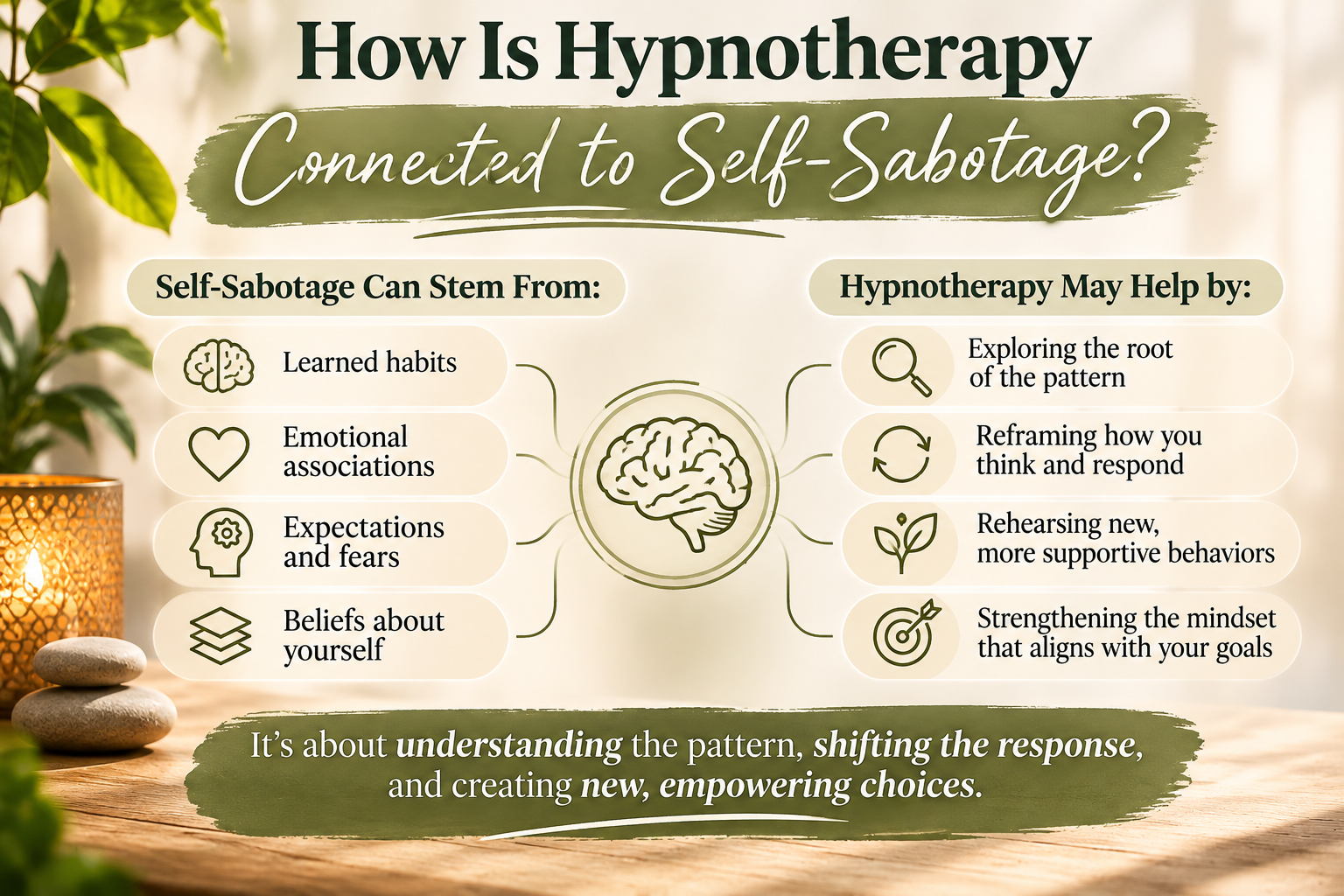
Self-sabotage is a term commonly used to describe behaviors that interfere with goals, intentions, or personal well-being.
For example, someone may want to build confidence but repeatedly avoid opportunities that would help them become more visible.
Another person may want healthier relationships but struggle to communicate boundaries.
Someone else may want to become more consistent but repeatedly abandon their plans when they experience uncertainty or frustration.
These behaviors can involve several interacting influences.
There may be learned habits.
Emotional responses.
Expectations about what might happen.
Beliefs about yourself.
Or circumstances that make certain choices more difficult.
Consider someone who wants to begin sharing their professional expertise more publicly.
They know what they want to say.
They have the experience.
They understand that greater visibility could create opportunities.
But whenever they prepare to share something, they begin questioning themselves.
What if someone disagrees?
What if I make a mistake?
What if people expect more from me afterward?
Eventually, they decide to wait.
And for the moment, that decision reduces their discomfort.
Over time, however, they become frustrated because they're not moving toward the opportunities they want.
Hypnotherapy may provide a structured way to explore the beliefs, emotional associations, and habitual responses connected to experiences like this.
It may also create opportunities to imagine and rehearse responding differently.
The goal is to better understand the individual's experience and explore what might support meaningful change.
Why Knowing What to Do Doesn’t Always Change What You Do
One of the most frustrating aspects of self-sabotage is recognizing a behavior and continuing to repeat it.
You know you want to set boundaries.
Yet you agree to something you don't want to do.
You know you want to become more visible.
Yet you hesitate when an opportunity appears.
You know you want to follow through.
Yet you find yourself putting things off.
And afterward, you wonder why your actions didn't reflect your intentions.
The distinction between understanding a behavior and responding differently is important.
Some responses become habitual through repeated experiences.
Others may be influenced by expectations or emotional associations that arise quickly in familiar situations.
For example, you might understand that setting boundaries is healthy while still experiencing guilt when you disappoint someone.
You may recognize that making mistakes is part of learning while still feeling anxious about being judged.
Or you may know that consistency requires practice while interpreting a setback as evidence that you're incapable of succeeding.
Understanding these responses can provide useful insight.
But developing a different response may also involve practicing what you want to experience instead.
This is one area where hypnotherapy may be useful.
Through focused attention, imagery, and suggestion, individuals may explore familiar responses and rehearse alternative ways of thinking, feeling, or behaving.
If you'd like to explore this distinction further, read Why Do I Keep Self-Sabotaging Even When I Know Better?
Can Hypnotherapy Change Subconscious Patterns?
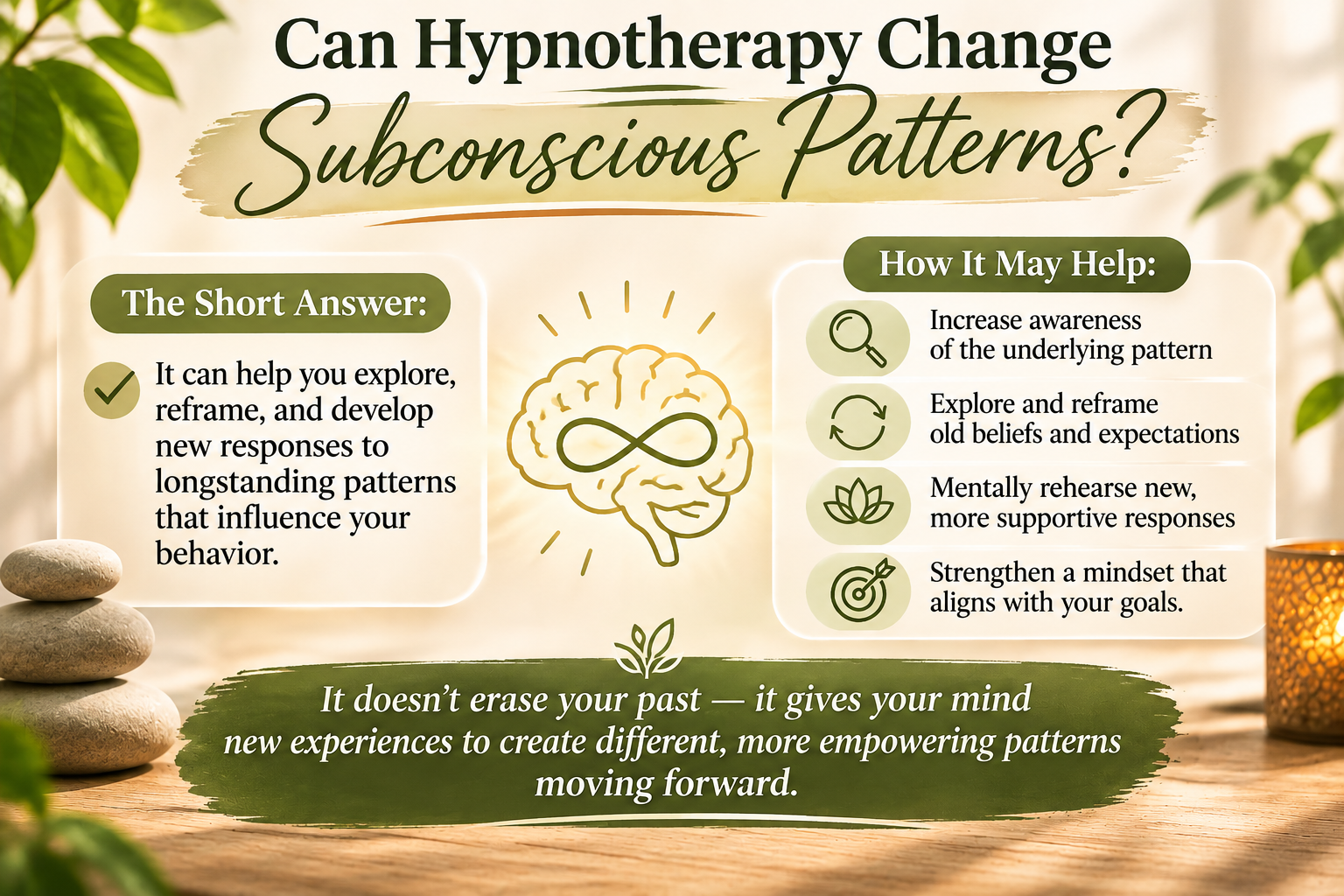
When people talk about subconscious patterns, they're often referring to learned associations, expectations, and habitual responses that influence behavior without requiring deliberate thought each time.
For example, someone may automatically become quiet when they anticipate disagreement.
Another person may begin overexplaining whenever they worry about being misunderstood.
Someone else may feel compelled to perfect every detail before sharing their work.
These patterns can become familiar ways of responding.
Hypnotherapy may help some individuals become more aware of the thoughts, feelings, and associations surrounding those responses.
It can also provide an opportunity to explore alternative interpretations and mentally practice different behaviors.
For example, someone who associates visibility with criticism might use guided imagery to rehearse speaking confidently in a situation that previously felt intimidating.
Someone who struggles with boundaries might explore what it feels like to communicate a preference while remaining connected to their sense of self-respect.
Someone who anticipates failure might practice imagining themselves responding constructively to setbacks.
These experiences can complement the practical actions someone takes outside a session.
However, it's important to understand that hypnotherapy doesn't literally erase beliefs or memories.
And experiencing a shift during a session doesn't automatically mean a longstanding behavior has permanently changed.
Meaningful progress is also reflected in what someone begins noticing, practicing, and experiencing in everyday life.
My Approach to Hypnotherapy: Uncover, Transform, Reinforce
At Erika Hypnotherapy, my work is centered on helping individuals explore the patterns influencing their experiences and develop responses that better support what they want to achieve.
My approach is integrative and identity-centered.
That means we're interested in the behaviors someone wants to change, as well as the beliefs, emotional responses, expectations, and ways of understanding themselves that may accompany those behaviors.
The work follows three interconnected processes:
Uncover. Transform. Reinforce.
These aren't rigid stages that every client must complete in a particular number of sessions.
They provide a flexible framework for understanding what we're exploring and how the work may develop.
1. Uncover: Understanding the Pattern Beneath the Behavior

The first part of my approach involves exploring what someone is experiencing.
Let's say you recognize that you procrastinate whenever an important opportunity appears.
We might begin by discussing what happens in those moments.
What are you thinking?
What are you anticipating?
What feelings arise?
What does putting the task off allow you to experience in the moment?
And where else have you noticed similar responses?
Sometimes these questions reveal beliefs or expectations that someone hadn't previously considered.
Perhaps they associate mistakes with embarrassment.
Perhaps they anticipate criticism.
Perhaps they're concerned about whether they can maintain success.
Or perhaps the situation brings up something entirely different.
An important part of my approach is allowing clients to arrive at their own understanding.
I don't want to assign meaning to someone's experience simply because a particular behavior appears familiar.
Two people may procrastinate for completely different reasons.
And even when a response seems to serve a protective purpose, that's something we explore together rather than assume.
The intention is to help you recognize what may be influencing your response and what you would prefer to experience instead.
2. Transform: Exploring and Experiencing a Different Response
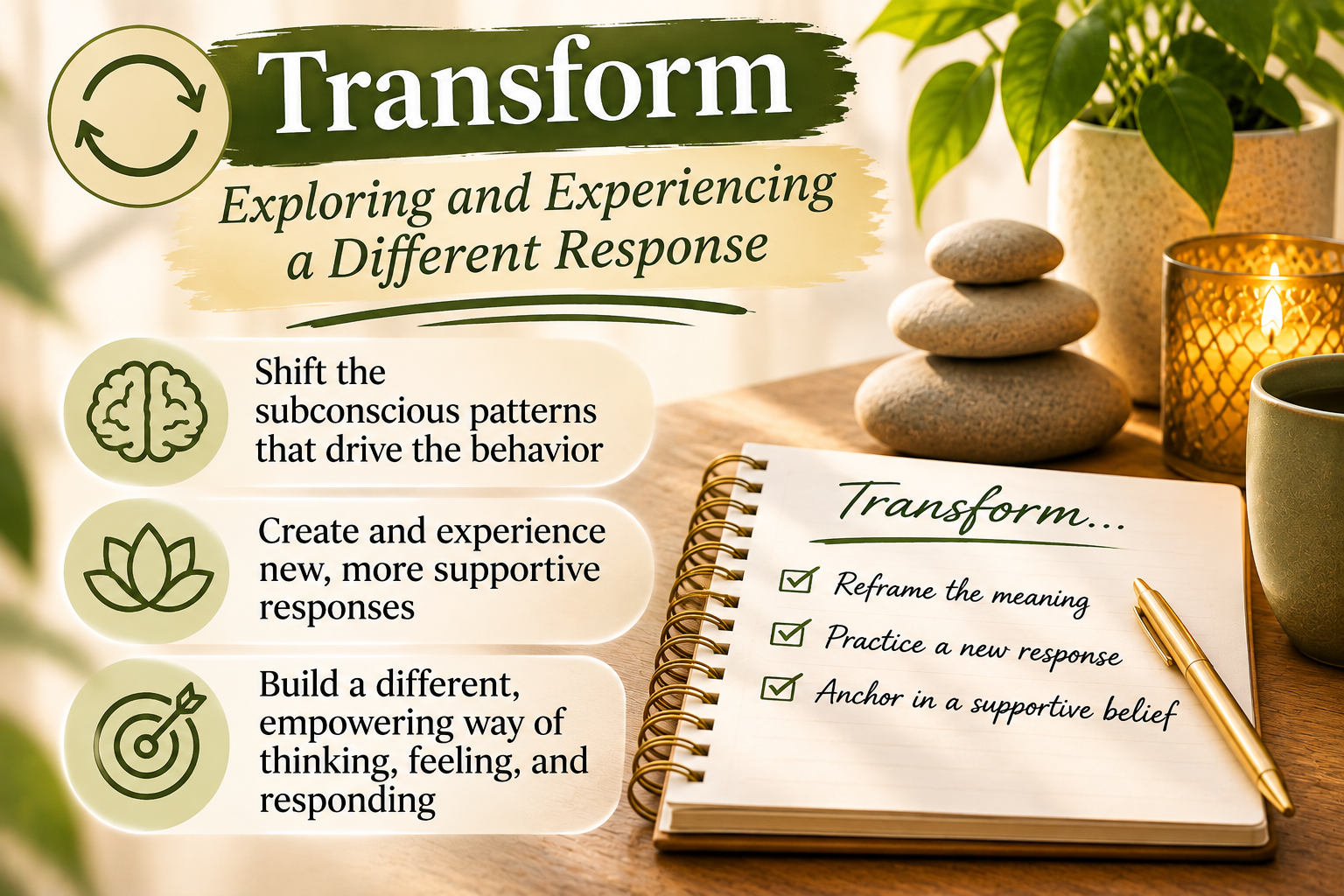
Once we've developed a clearer understanding of the pattern, we can begin exploring what might support a different experience.
This may involve working with beliefs, expectations, emotional associations, or habitual responses that no longer seem to support your goals.
It also involves identifying what you want to develop in their place.
For example, someone who struggles with visibility may want to experience greater confidence expressing their ideas.
Someone who frequently people-pleases may want to feel more comfortable communicating their preferences.
Someone who repeatedly abandons goals may want to develop a stronger sense of self-trust and follow-through.
Depending on the individual, we may use focused attention, guided imagery, reframing, conversational hypnotic techniques, or more formal hypnosis.
The intention is to create opportunities to experience a different response rather than only discuss it.
And the desired response comes from the client.
What does confidence mean to you?
How would you recognize self-trust in your everyday life?
What would it feel like to respond to a familiar situation in a way that aligns with your values?
These are the kinds of questions that help guide the work.
3. Reinforce: Strengthening New Responses Through Experience and Practice
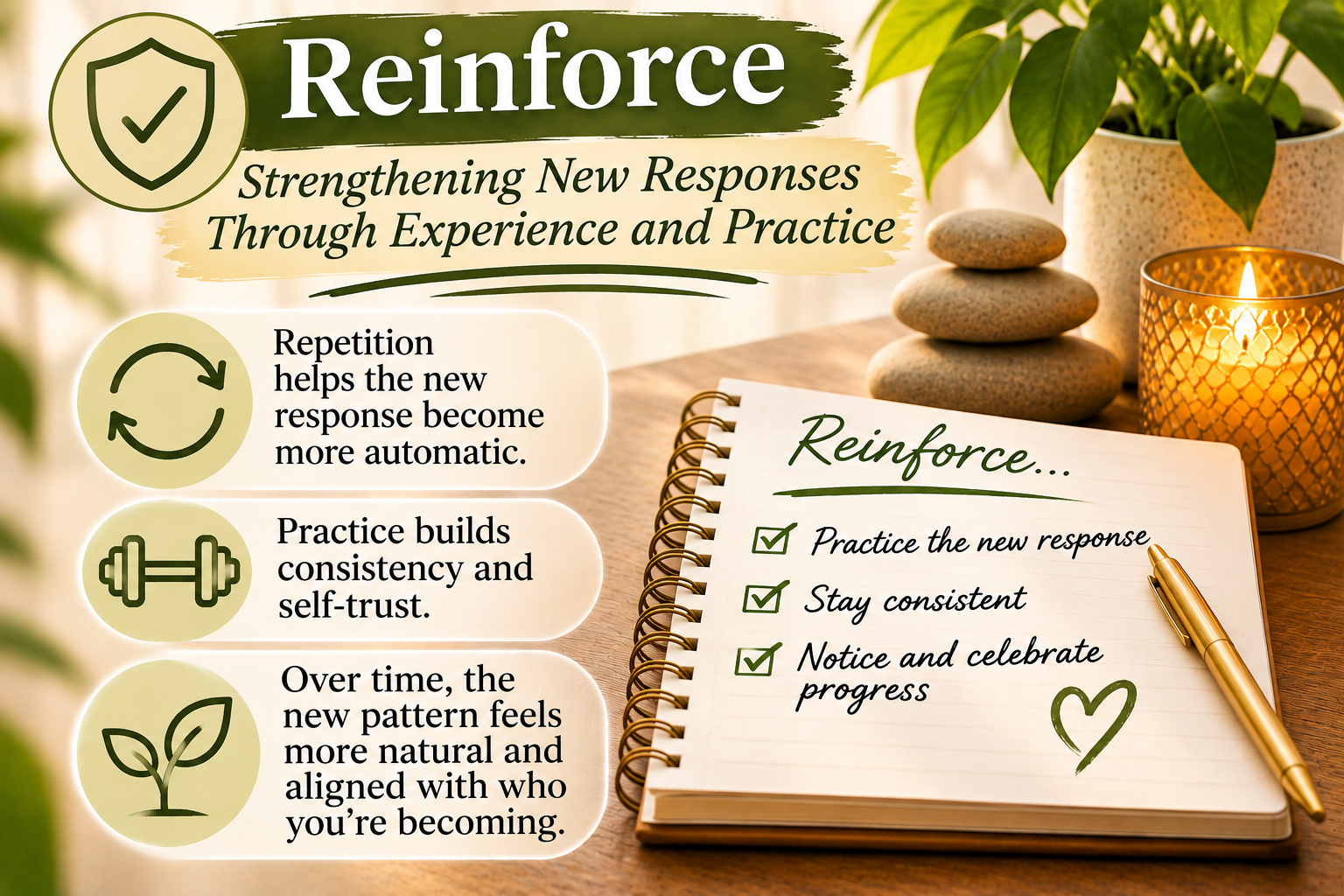
Developing a different response during a session can be meaningful.
But what happens when you return to everyday life?
What happens when you encounter the same situation that previously brought up discomfort?
How do you begin applying what you've explored?
This is where reinforcement becomes important.
Depending on your needs, we may use hypnotic programming, repeated imagery, future rehearsal, reflection, or between-session practices to support the responses you're developing.
For example, someone working on boundaries may practice recognizing their preferences and allowing themselves time before responding to requests.
Someone working on visibility may begin taking manageable steps toward sharing their ideas.
Someone working on consistency may focus on responding differently when their plans don't go as expected.
We also pay attention to what happens in real situations.
What feels different?
What remains challenging?
What have you learned?
And what might need additional attention?
The intention is to support responses that become increasingly familiar and useful in your everyday experiences.
Does Hypnotherapy Always Involve Lying Down With Your Eyes Closed?
This is one of the questions I think is worth discussing because many people have a particular image of what hypnosis looks like.
They imagine sitting or reclining in a comfortable chair, closing their eyes, listening to someone's voice, and becoming deeply relaxed.
And yes, a hypnotherapy session can involve that kind of experience.
But hypnosis-related techniques can also be incorporated into conversation.
In my practice, some sessions involve in-depth conversations that include purposeful questions, focused attention, imagery, and exploration of internal experiences.
Other sessions may involve more formal guided hypnosis or hypnotic programming.
Sometimes both approaches are used.
A conversational session might involve exploring a familiar response while paying close attention to what you're imagining, feeling, anticipating, or beginning to understand.
A more formal hypnosis experience might involve guided relaxation, imagery, suggestions, or mental rehearsal.
Neither approach is automatically more effective simply because it looks or feels more like traditional hypnosis.
The approach depends on the individual, their goals, preferences, and response to the work.
What Might a Hypnotherapy Session for Self-Sabotage Look Like?
Imagine someone who wants to become more confident speaking up in professional settings.
They've recognized that they often remain quiet during meetings, even when they have ideas they want to share.
They know they want to contribute more.
But when an opportunity appears, they hesitate.
During an initial session, we might explore what happens in those moments.
Perhaps they notice that they're anticipating criticism.
Perhaps they become concerned about saying something incorrectly.
Perhaps they begin comparing themselves to others.
We might explore what those expectations mean to them and whether similar responses appear elsewhere.
As their understanding develops, we can begin identifying what they'd prefer to experience.
Maybe they want to feel comfortable contributing without needing every thought to be perfectly worded.
Maybe they want to trust their professional judgment.
Or perhaps they want to become more comfortable allowing others to have different opinions.
Depending on their preferences and needs, we might use imagery or hypnotic techniques to help them experience and rehearse those responses.
Then we would explore how they can begin applying that work outside the session.
Perhaps they decide to share one idea during their next meeting.
Afterward, we can reflect on what happened.
What did they anticipate?
What did they actually experience?
What felt different?
What might they practice next?
The work develops around the individual rather than following a predetermined explanation for why they struggle.
Can Hypnotherapy Help With Procrastination, Perfectionism, and People-Pleasing?
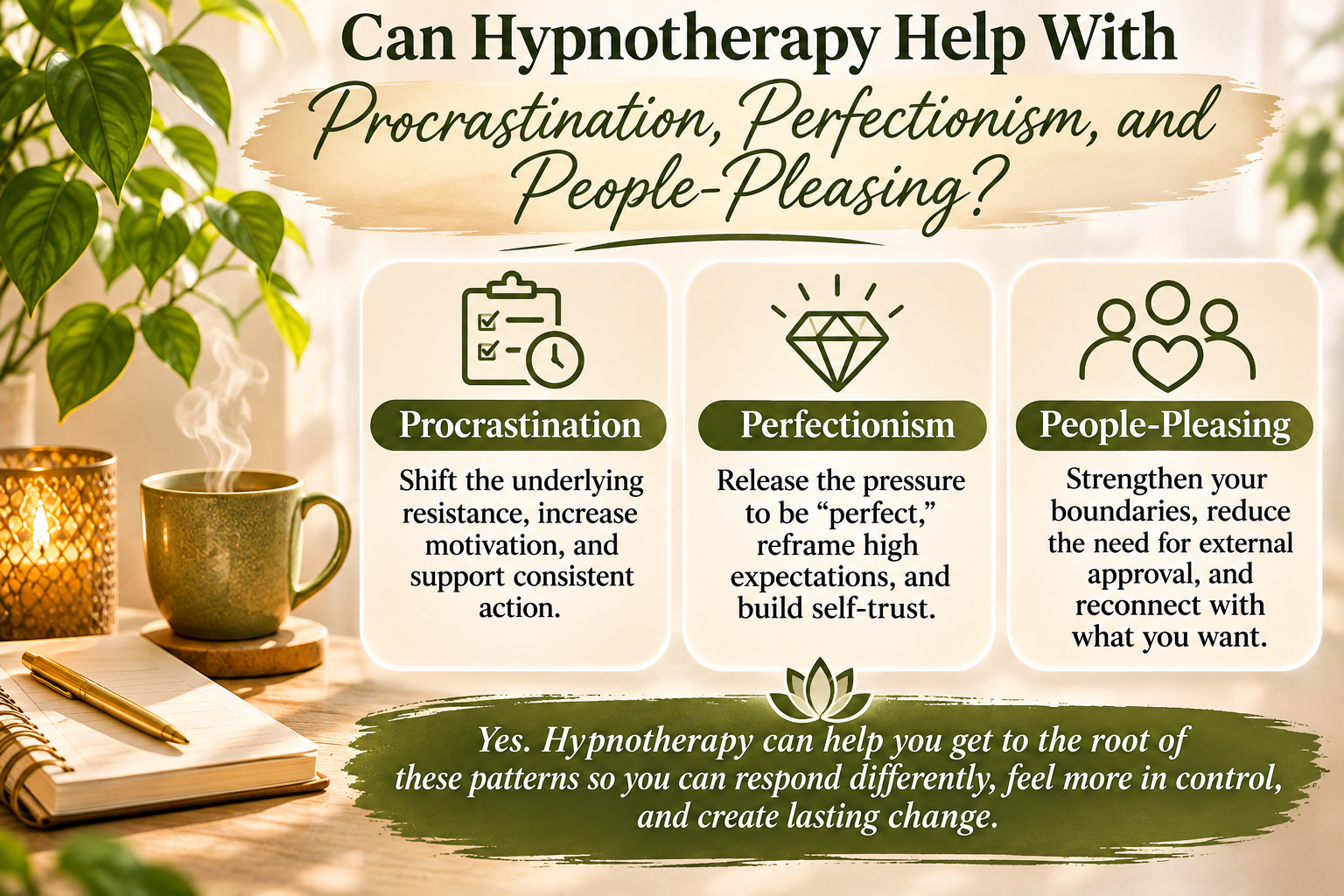
These are three common behaviors people associate with self-sabotage.
And although they may look different, each can involve familiar responses that interfere with someone's goals.
Procrastination
Someone may procrastinate when a task creates uncertainty, overwhelm, or concerns about their performance.
Hypnotherapy may provide an opportunity to explore those experiences and rehearse more manageable ways of approaching the task.
Related reading: Procrastination or Self-Sabotage? What May Really Be Keeping You Stuck
Perfectionism
Someone may feel that their work must meet extremely high standards before they're comfortable sharing it.
Hypnotherapy may support exploration of the beliefs and expectations associated with those standards, alongside practicing more flexible responses.
Related reading: Perfectionism and Self-Sabotage: When High Standards Keep You Stuck
People-Pleasing
Someone may repeatedly prioritize other people's preferences while struggling to communicate their own.
Hypnotherapy may help them explore what they anticipate when they express their needs and mentally rehearse responding with greater self-trust.
Related reading: People-Pleasing and Self-Sabotage: When Putting Others First Means Abandoning Yourself
These are examples rather than explanations that apply to everyone.
A person's behavior may involve multiple influences, including circumstances, responsibilities, health, stress, and relationships.
The most useful approach begins with understanding the individual.
Is Hypnotherapy Effective for Self-Sabotage?
This is an important question, and it deserves a thoughtful answer.
Research on hypnosis and hypnotherapy suggests that these approaches may be helpful for certain concerns, particularly in some clinical applications such as pain management and as an adjunct to other interventions.
However, research specifically examining hypnotherapy for self-sabotage as a broad category is limited.
Self-sabotage itself isn't a single clinical diagnosis. It's a term used to describe different behaviors and experiences that may interfere with someone's goals.
That makes it difficult to offer one universal answer about effectiveness.
Some individuals may find hypnotherapy useful for exploring habitual responses, developing self-awareness, or rehearsing new behaviors.
Others may benefit more from different approaches or a combination of supports.
Results vary, and no responsible practitioner can guarantee that a particular pattern will disappear or that a specific outcome will occur.
The most useful question may be whether hypnotherapy is an appropriate approach for your individual goals and circumstances.
Do You Need Hypnotherapy to Begin Changing Self-Sabotaging Patterns?
No.
There are several ways to begin exploring familiar patterns.
You might start by noticing when a behavior appears.
You might reflect on the thoughts and expectations surrounding it.
You might begin identifying how you would prefer to respond.
Or you might experiment with small, practical changes in everyday situations.
Educational resources, reflective exercises, supportive communities, and appropriate professional services can all play different roles.
In fact, becoming more aware of your patterns can help you determine what kind of support you want.
Perhaps you're still discovering what keeps you feeling stuck.
Perhaps you've recognized several patterns but aren't sure how they're connected.
Or perhaps you've developed a clear understanding of what you want to achieve and feel ready for more individualized work.
Each of these experiences may call for a different next step.
And that's part of the reason I created the Stuck to Striving Community.
Start by Exploring Your Patterns in the Stuck to Striving Community

If you're beginning to recognize familiar patterns in your life, you don't have to figure out what they all mean at once.
Sometimes the next useful step is having a place to explore what you're noticing.
That's what the Stuck to Striving Community was created to support.
It's a free space where we explore self-sabotage, subconscious patterns, and the experiences that can influence how we think, feel, and respond.
Inside the community, you'll find thought-provoking questions and reflections designed to help you recognize your patterns and make connections within your own experiences.
You'll also find conversations in Erika's Corner, educational resources, and opportunities to explore topics such as procrastination, perfectionism, people-pleasing, self-trust, and follow-through.
Through our weekly hypnotic experiences, members can also participate in guided experiences followed by reflection.
Our approach is:
Experience. Reflect. Integrate.
You can participate in conversations, respond to reflection prompts, journal privately, or simply explore the resources at your own pace.
There's no expectation that you need to have everything figured out before joining.
You may be discovering your patterns for the first time.
You may already recognize certain behaviors and want to understand them more deeply.
Or you may be exploring what it would mean to begin responding differently.
The community provides a place to continue that exploration.
Join the Free Stuck to Striving Community
Want to Experience Hypnotic Programming on Your Own?

If you're curious about hypnosis and prefer a self-guided experience, my Overcoming Self-Sabotage Hypnotic Programming Audio offers another way to begin exploring familiar patterns.
The audio is designed to support intentional reflection, internal dialogue, and the experience of considering different ways of responding.
You can listen in a quiet, comfortable environment when you're able to give the experience your attention.
It's a self-guided resource rather than a substitute for individualized care, and your experience may differ from someone else's.
Explore the Overcoming Self-Sabotage Audio
Already Know Where You Want to Go?

If you already recognize the patterns that impact your progress, have a clear sense of what you want to achieve, and feel ready for individualized support, book a 15-minute consultation to explore working with me through one-on-one hypnotherapy.
Frequently Asked Questions About Hypnotherapy for Self-Sabotage

Can Hypnotherapy Help Me Stop Self-Sabotaging?
Hypnotherapy may help some individuals explore the habitual responses, beliefs, and emotional associations connected to self-sabotaging behaviors. It can also support guided imagery and rehearsal of alternative responses. However, results vary, and no single approach works for everyone.
How Does Hypnotherapy Work on Subconscious Patterns?
Hypnotherapy uses focused attention, imagery, and suggestions to help individuals explore internal experiences and practice different responses. The process doesn't involve literally deleting subconscious beliefs or memories.
Can Hypnosis Change Limiting Beliefs?
Hypnosis may support exploration and reframing of beliefs that influence someone's experiences. Guided imagery and suggestion may also help individuals rehearse more useful ways of thinking and responding. The extent of change varies.
Will I Lose Control During Hypnosis?
No. Hypnosis doesn't require surrendering control. You remain a participant and can communicate your preferences or stop the experience.
Do I Have to Be Deeply Relaxed for Hypnotherapy to Work?
Not necessarily. Some people experience hypnosis as deeply relaxing, while others experience it primarily as focused attention. Relaxation can be helpful, but it isn't the only feature of hypnosis.
How Many Hypnotherapy Sessions Does It Take to Change a Pattern?
There isn't a universal number of sessions. The amount of work depends on the individual's goals, circumstances, the complexity of the concern, and how they respond. Progress is evaluated over time rather than assumed after a particular session.
Is Conversational Hypnotherapy Different From Traditional Hypnosis?
Conversational approaches may incorporate focused attention, imagery, reframing, and hypnotic suggestions within an interactive discussion. More formal hypnosis often involves a structured induction and guided experience. Both can be used depending on the individual's needs and preferences.
Can I Explore Self-Sabotage Before Booking Hypnotherapy?
Absolutely. You can begin by reflecting on familiar situations, identifying patterns, and exploring educational resources. The free Stuck to Striving Community offers questions, discussions, resources, and hypnotic experiences for people who want to begin that process.
Understanding Yourself May Be the Beginning of Responding Differently
Perhaps you've spent a long time trying to change something about yourself.
You've made plans.
You've set goals.
You've promised yourself that next time would be different.
And sometimes, despite your intentions, you've found yourself responding in familiar ways.
As you begin exploring those experiences, you may notice something you hadn't considered before.
Perhaps a behavior you've labeled as procrastination involves expectations about making mistakes.
Perhaps your difficulty setting boundaries involves concerns about disappointing someone.
Perhaps your hesitation around success involves questions about visibility, responsibility, or how you understand yourself.
Or perhaps you'll discover something entirely different.
The important part is that you're beginning to understand your own experience.
Hypnotherapy is one possible approach to supporting that exploration and helping you practice different responses.
But your journey doesn't have to begin with a hypnotherapy appointment.
It can begin with a question.
A moment of recognition.
A new perspective.
Or the decision to become more curious about what happens beneath a familiar behavior.
What might you begin discovering about yourself if you gave yourself the opportunity to explore your patterns before deciding what they mean?