
Why Do I Keep Self-Sabotaging Even When I Know Better?
You've recognized the pattern.
You know you procrastinate when something matters to you.
You recognize that you say yes when you really want to say no.
You notice that you become overly critical of yourself whenever you begin making progress.
And perhaps you've even started understanding where some of these behaviors developed.
You've reflected on your experiences. You've connected certain situations to familiar feelings. You've recognized how your thoughts and reactions may be influencing your decisions.
Yet when you find yourself in a similar situation, something interesting happens.
You respond the same way.
You agree to something you didn't want to do.
You put off the task you promised yourself you'd complete.
You question an opportunity you were previously excited about.
Or you return to a behavior you've already decided you want to change.
And afterward, you find yourself asking:
Why did I do that again? I know better.
This can be one of the most frustrating aspects of self-sabotage.
You understand what you're doing, but that understanding doesn't always translate into a different response.
So why does that happen?
And what might it tell you about the patterns you've developed?
Key Takeaways
Recognizing a self-sabotaging pattern and changing your response to it are two different processes.
Familiar behaviors can become habitual, making them easier to repeat in certain situations.
Emotional responses, learned expectations, and beliefs about yourself may influence your decisions.
A behavior that creates long-term frustration may still provide short-term relief or reassurance.
Understanding where a pattern developed can be useful, but insight alone may not change how you respond.
Exploring what happens immediately before, during, and after a familiar behavior can help you identify opportunities for change.
Developing different responses often involves ongoing awareness, practice, and a willingness to approach familiar situations differently.
For a broader understanding of these patterns, read What Is Self-Sabotage? Why You Keep Getting in Your Own Way
Why Do I Keep Self-Sabotaging When I Already Know What I’m Doing?

One of the most important things to understand about recurring self-sabotage is that awareness doesn't automatically determine behavior.
You can recognize that something isn't supporting your goals and still find yourself doing it.
Consider someone who struggles with people-pleasing.
They understand that constantly prioritizing other people's needs leaves them exhausted.
They've recognized that they often agree to things because they're uncomfortable disappointing others.
They may even remember experiences that contributed to their belief that keeping everyone happy was important.
And they've decided they want to begin setting healthier boundaries.
Then someone asks them for a favor.
Immediately, they feel uncomfortable.
They begin thinking about how the other person might respond if they say no.
They imagine disappointing them.
They question whether their own needs are important enough to justify declining.
And before they've fully considered what they want, they've agreed.
Later, they feel frustrated.
I knew I didn't want to do that. Why did I say yes?
The person understands their pattern.
But in the moment, they're also responding to familiar thoughts, feelings, and expectations.
That's the distinction worth exploring.
What you understand about a situation and what you experience within that situation may influence you in different ways.
And when a particular response has become familiar, recognizing it may be only the beginning of changing it.
Related reading: People-Pleasing and Self-Sabotage: When Putting Others First Means Abandoning Yourself
The Difference Between Knowing Better and Responding Differently
Think about something you've learned to do automatically.
Perhaps you drive the same route to work every morning.
You've traveled that route so many times that you barely need to think about each turn.
Then one day, you need to go somewhere different.
You know the new destination. You've already decided where you're going.
But as you drive, you find yourself taking the familiar turn.
You recognize the mistake almost immediately.
Why did I turn here? I know I'm going somewhere else.
Your knowledge of the new destination was clear.
But your familiar response influenced what you did.
Recurring behavioral patterns can sometimes work in a similar way.
When you've responded to certain situations repeatedly, those responses may become increasingly habitual.
You may automatically withdraw when you feel criticized.
You may begin overexplaining when you worry about being misunderstood.
You may procrastinate when a task creates uncertainty.
Or you may become overly accommodating when someone expresses disappointment.
These responses can develop through repeated experiences and associations.
And although you may consciously want to respond differently, the familiar behavior can still be the one you find yourself moving toward.
This doesn't mean you're incapable of changing.
It means that understanding the pattern and developing a different response may require different kinds of attention.
How Subconscious Patterns Can Influence Self-Sabotage
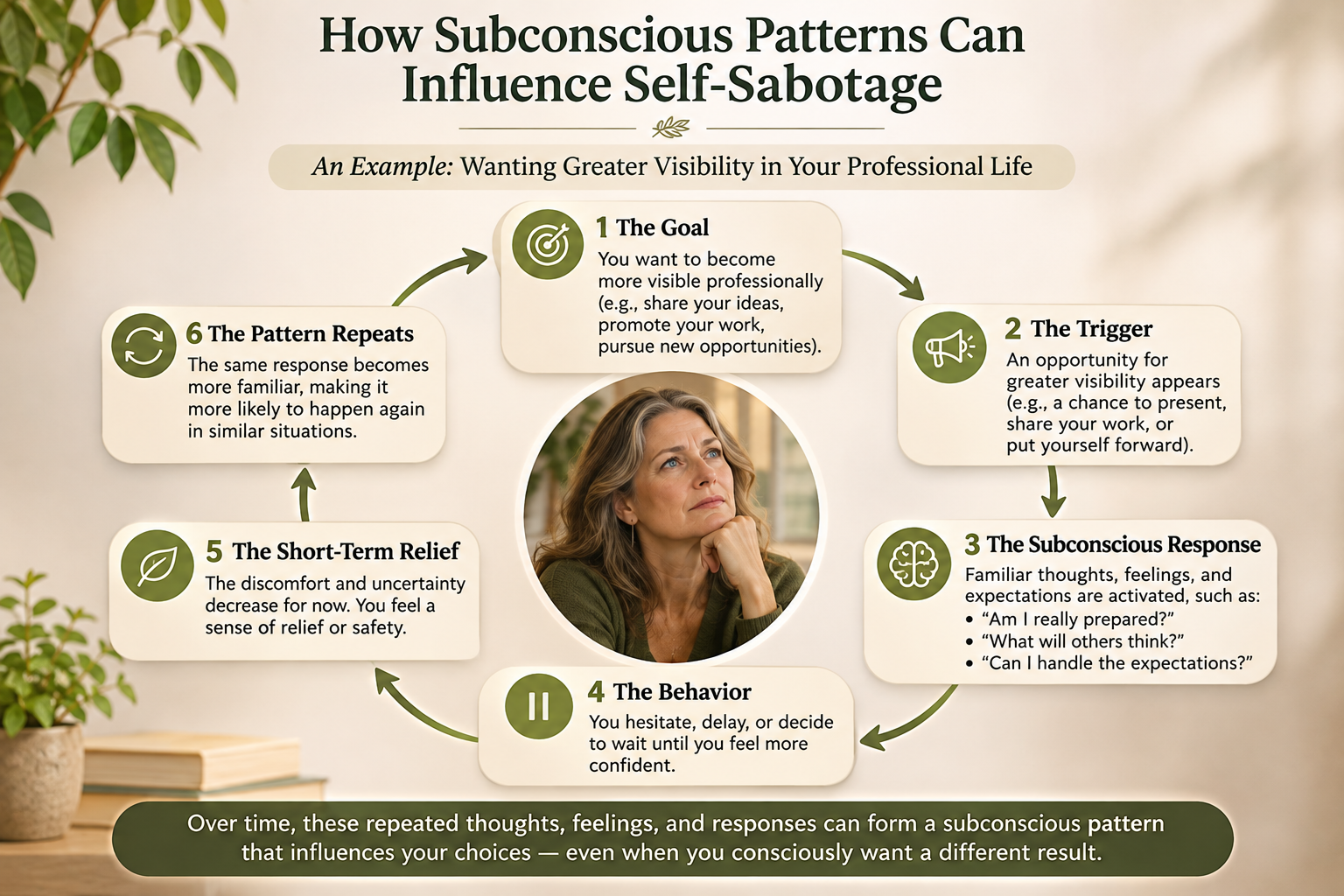
When we talk about subconscious patterns, we're referring to learned associations, expectations, and habitual responses that can influence our experiences without requiring deliberate consideration every time.
For example, you may have developed an association between making mistakes and feeling embarrassed.
Or between disappointing someone and experiencing conflict.
Perhaps receiving attention has become associated with criticism.
Or pursuing something important brings up concerns about whether you'll be able to maintain your success.
These associations may influence how you interpret situations and what you anticipate will happen.
Imagine someone who wants to become more visible professionally.
They know that sharing their ideas, promoting their work, or pursuing opportunities could support their goals.
They've developed the skills.
They understand what steps to take.
But whenever an opportunity for greater visibility appears, they hesitate.
They begin questioning whether they're prepared.
They worry about how others might perceive them.
And eventually, they decide to wait until they feel more confident.
From the outside, it may look like procrastination.
But their experience may involve concerns about visibility, judgment, expectations, or unfamiliar responsibilities.
Understanding those associations can provide a more complete picture of what's happening.
It also helps explain why two people can engage in the same behavior for very different reasons.
The behavior itself doesn't always reveal the meaning behind it.
That's something worth exploring individually.
5 Reasons You May Repeat the Same Self-Sabotaging Patterns
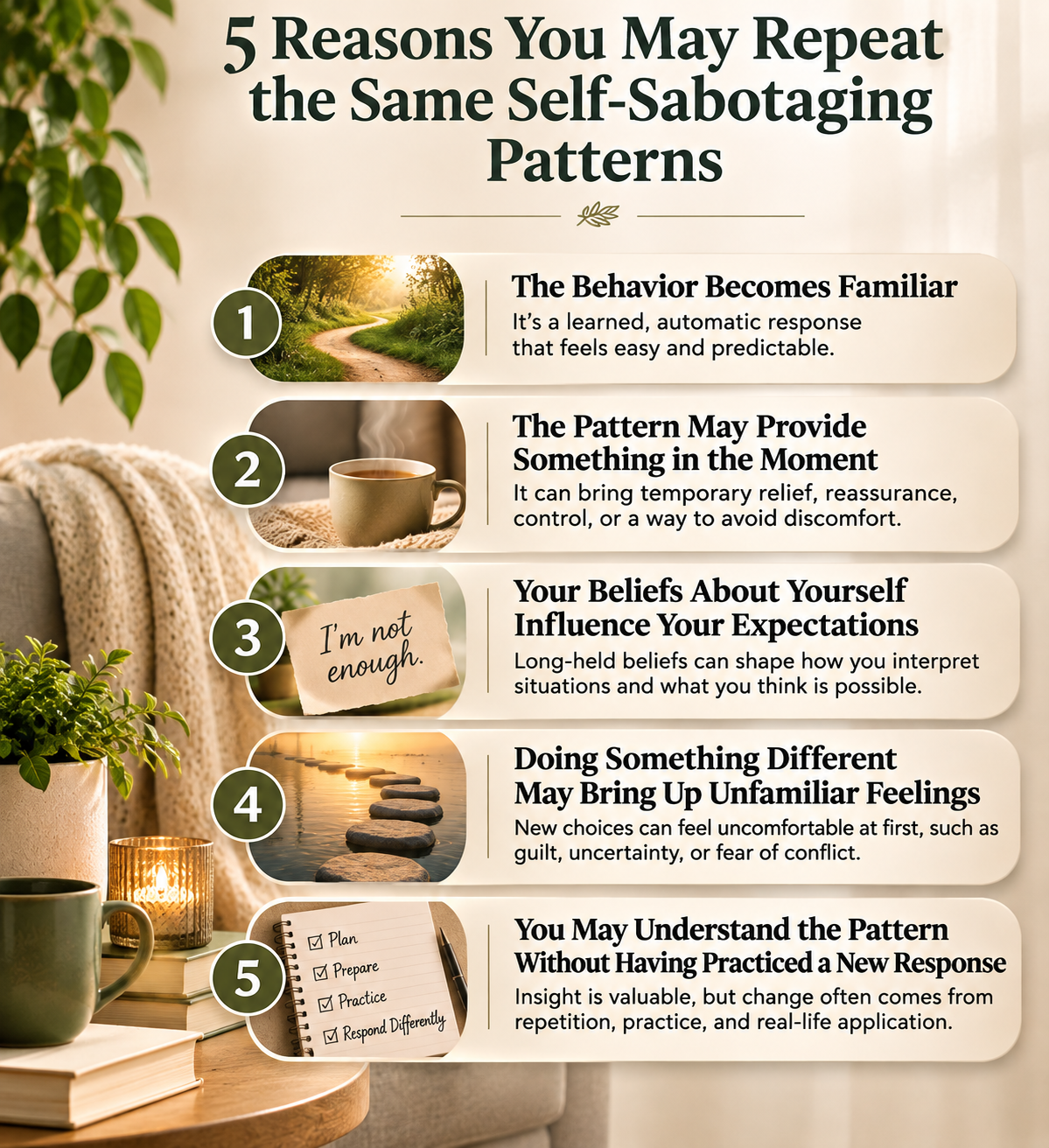
There are several reasons someone might continue repeating a behavior even after recognizing that it isn't supporting their goals.
1. The Behavior Has Become Familiar
Familiarity can influence how we respond to situations.
When you've approached something the same way repeatedly, that response may become habitual.
For example, if you've spent years avoiding difficult conversations, withdrawing may be your familiar response whenever conflict appears.
Even when you want to communicate more openly, the discomfort of doing something different may be noticeable.
You may begin experiencing thoughts such as:
What if this turns into an argument?
What if they don't understand me?
Maybe I should just let it go.
The familiar response may feel easier to access, particularly in emotionally charged situations.
A useful question becomes:
What response have I become accustomed to using when this situation appears?
2. The Pattern May Provide Something in the Moment
This is one of the more interesting aspects of recurring behavior.
Sometimes a response that creates long-term frustration also provides an immediate benefit.
Consider procrastination.
You have an important project to complete.
But whenever you think about beginning, you feel overwhelmed.
You question whether your work will be good enough.
You worry about making mistakes.
Eventually, you decide to work on something else.
And for a little while, you feel relieved.
The project is still unfinished. Your goal hasn't changed.
But the immediate discomfort has decreased.
That relief may make avoidance more appealing the next time a similar situation occurs.
The same principle can appear in other patterns.
People-pleasing may temporarily reduce concerns about disappointing someone.
Perfectionism may provide reassurance that you're doing everything possible to avoid mistakes.
Withdrawing from an opportunity may reduce uncertainty about what comes next.
This doesn't mean those behaviors are always intentional or that they serve the same purpose for everyone.
But it raises an important question:
What am I experiencing immediately after I engage in this familiar behavior?
Sometimes understanding that response helps explain why a pattern continues.
Related reading: Procrastination or Self-Sabotage? What May Really Be Keeping You Stuck
3. Your Beliefs About Yourself May Influence Your Expectations
Consider the statements you've made about yourself over the years.
I'm not good at speaking up.
I always mess things up.
I can't stay consistent.
I'm the kind of person who puts everyone else first.
Things never seem to work out for me.
Perhaps these statements began as observations about experiences you've had.
But over time, they may have become part of how you understand yourself.
And when a new situation appears, those beliefs may influence what you expect.
For example, someone who believes they're incapable of following through may approach a new goal while already anticipating that they'll eventually stop.
When they experience a setback, they may interpret it as confirmation of that belief.
See? This is what always happens.
Their interpretation of the setback can influence what they do next.
Rather than considering whether the plan needs adjusting, they may decide there's no point in continuing.
This is one way identity and self-sabotage can become connected.
The beliefs you've developed about yourself may shape how you interpret your experiences, even as you consciously work toward something different.
4. Doing Something Different May Bring Up Unfamiliar Feelings
Sometimes people recognize what they want to change but feel uncomfortable when they begin responding differently.
Imagine someone who has spent much of their life prioritizing other people's expectations.
They've decided to begin making decisions based on their own needs and values.
Initially, the idea feels empowering.
But the first time they set a boundary, they experience guilt.
They wonder whether they're being selfish.
They become concerned about how the other person feels.
And they begin questioning whether they made the right decision.
The discomfort may tempt them to return to their familiar behavior.
Yet the presence of discomfort doesn't necessarily mean the new response was inappropriate.
It may reflect unfamiliarity, uncertainty, or expectations they've developed through previous experiences.
Of course, discomfort can also provide important information about a situation.
The goal is to understand what you're experiencing rather than automatically interpreting every uncomfortable feeling as a reason to stop.
Ask yourself:
What feels unfamiliar about responding differently?
5. You May Understand the Pattern Without Having Practiced a Different Response
Insight can be meaningful.
You may recognize a connection between your past experiences and your current behavior.
You may understand why you tend to withdraw, procrastinate, or seek reassurance.
You may even recognize the pattern while it's happening.
But what happens next?
Have you explored how you want to respond?
Have you considered what might help when the familiar feelings appear?
Have you practiced approaching similar situations differently?
Recognizing a pattern provides information.
Developing a different response often involves applying that information in everyday experiences.
For example, someone who recognizes their tendency to people-please may begin practicing a pause before agreeing to requests.
Someone who procrastinates when overwhelmed may experiment with breaking a task into smaller steps.
Someone who becomes uncomfortable with visibility may gradually practice sharing their work in manageable ways.
These actions may seem small.
But they provide opportunities to experience responding differently.
And those experiences can contribute to developing new habits and expectations.
Why Understanding Where a Pattern Came From May Not Be Enough
Have you ever had an experience where something suddenly made sense?
Perhaps you were reflecting on a relationship pattern.
You recognized that you often became anxious when someone seemed distant.
Then you connected that response to earlier experiences when emotional distance felt particularly significant.
And suddenly, you understood something about yourself that you hadn't recognized before.
Oh. That's why I respond that way.
That realization can be meaningful.
It may help you approach your experiences with greater understanding.
But what happens the next time someone seems distant?
You may still experience anxiety.
You may still feel the urge to seek reassurance.
You may still begin anticipating rejection.
And you may wonder why your insight hasn't changed your response.
This is where it can be helpful to distinguish understanding the possible origins of a pattern from changing the response associated with it.
Knowing where a behavior may have developed can provide context.
But developing a different response may also involve recognizing what happens in the present, exploring your expectations, and practicing new ways of responding.
It's also worth remembering that the origins of a pattern aren't always obvious.
Sometimes there isn't one particular experience that explains everything.
Patterns can develop through multiple influences over time.
The goal of self-exploration is to understand your experience more clearly, rather than forcing every behavior into a particular explanation.
What Happens Between Recognizing a Pattern and Repeating It?
This is a question I would encourage you to spend some time exploring.
Because sometimes the most useful information is found in the moments between recognizing what you want and engaging in the behavior you later regret.
Imagine this situation.
You've decided to begin speaking up more often.
You want to express your preferences and communicate more openly.
Then you're having a conversation with someone, and they ask what you want.
You know your answer.
But before you say it, something happens.
Perhaps you wonder whether they'll agree.
Perhaps you anticipate disappointment.
Perhaps you become uncomfortable with the possibility of conflict.
And then you say:
Whatever you want is fine.
Later, you recognize the pattern.
But consider everything that happened between knowing your preference and giving your response.
There may have been thoughts.
Feelings.
Expectations.
Physical sensations.
Or memories of similar experiences.
These details can offer insight into what influences your behavior.
Instead of focusing exclusively on the moment you repeated the pattern, you can begin exploring what happened just before it.
What did I anticipate?
What did I feel?
What did I believe might happen if I responded differently?
These questions may help you identify opportunities to make more intentional choices.
How Self-Sabotage Can Become Part of Your Identity
There's another dimension of recurring self-sabotage that deserves attention.
The way you begin describing yourself.
Think about someone who has struggled with consistency for years.
They've started projects.
Made commitments.
Developed routines.
And repeatedly found themselves starting over.
Eventually, they begin saying:
I'm just an inconsistent person.
Or someone who has repeatedly struggled to set boundaries may describe themselves as:
I'm just a people-pleaser.
These descriptions may feel accurate because they reflect familiar experiences.
But what happens when a recurring behavior becomes part of how you define yourself?
You may begin expecting that behavior to appear.
You may interpret setbacks through that expectation.
And you may overlook experiences that suggest you're capable of responding differently.
Consider the difference between these statements:
I'm an inconsistent person.
And:
I've noticed that I struggle to maintain certain routines when my circumstances change.
The second statement describes an experience without turning it into a fixed definition of who you are.
That distinction can create room for curiosity.
Instead of asking whether you're simply the kind of person who struggles, you can begin asking what influences the struggle and what might support a different experience.
Your patterns may be familiar.
But they don't have to become the entirety of how you understand yourself.
Related reading: Why You Keep Starting and Stopping: Understanding the Self-Sabotage Pattern Behind Inconsistency
5 Questions to Help You Explore a Pattern You Already Recognize
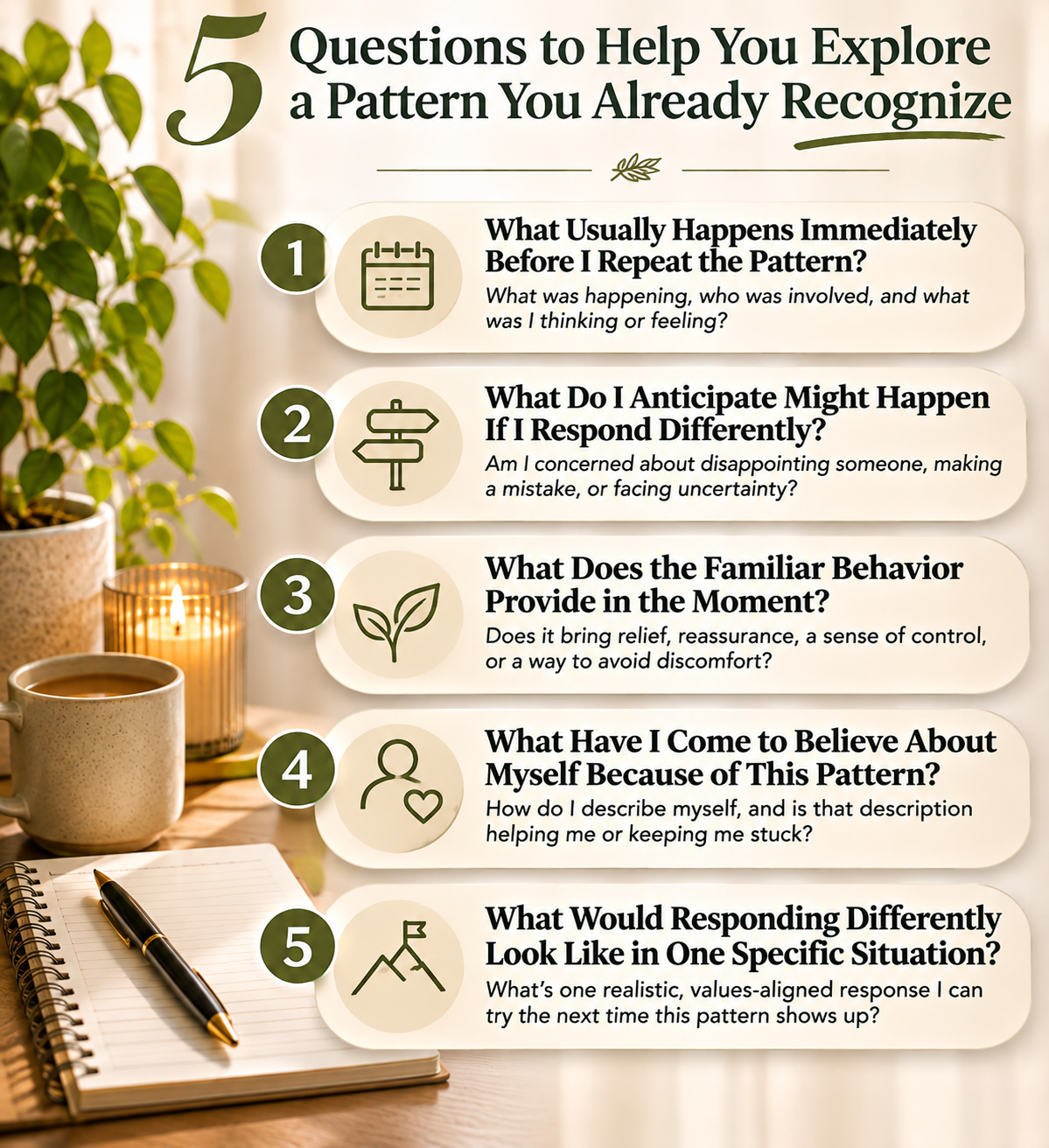
If you've been asking yourself why you continue repeating a behavior you already understand, consider reflecting on these questions.
1. What Usually Happens Immediately Before I Repeat the Pattern?
Think about a recent experience.
What was happening? Who was involved? What were you thinking or feeling?
Notice the details that stand out.
2. What Do I Anticipate Might Happen if I Respond Differently?
Perhaps you're concerned about disappointing someone.
Making a mistake.
Becoming more visible.
Experiencing rejection.
Or taking on unfamiliar responsibilities.
What expectations appear when you imagine a different response?
3. What Does the Familiar Behavior Provide in the Moment?
Does it bring relief?
Reassurance?
A sense of control?
A way to avoid uncertainty?
Or something else?
Consider what you experience immediately after engaging in the behavior.
4. What Have I Come to Believe About Myself Because of This Pattern?
Notice how you describe yourself.
Are those descriptions helping you understand your experiences?
Or have they become fixed expectations about what you're capable of doing?
5. What Would Responding Differently Look Like in One Specific Situation?
Rather than imagining a complete transformation, consider one familiar situation.
What response would align more closely with your values and goals?
And what might help you practice that response?
These questions aren't intended to tell you what your pattern means.
They're an opportunity to explore your experience and begin recognizing connections that may be meaningful to you.
How Do You Begin Changing a Pattern You Already Understand?
Once you've recognized a recurring pattern, you may wonder what to do with that awareness.
The next step doesn't necessarily involve making a dramatic change.
Sometimes it begins with developing a more intentional relationship with the situations where the pattern appears.
Become Curious About the Moment the Pattern Begins
Notice the circumstances that tend to precede the behavior.
What situations bring it up?
What expectations appear?
What emotions do you experience?
You may begin recognizing similarities across experiences that previously seemed unrelated.
Explore the Meaning You’ve Attached to the Situation
Sometimes the way you interpret an experience influences how you respond.
For example, someone may interpret another person's disappointment as evidence that they've done something wrong.
Someone else may interpret a setback as proof that they're incapable of succeeding.
Consider whether the meaning you're assigning to the situation is the only possible interpretation.
Identify a Response That Aligns With Your Goals
Once you've recognized the familiar response, consider what you would prefer to do.
If you tend to agree automatically, perhaps you'd like to give yourself time before answering.
If you withdraw when uncertain, perhaps you'd like to practice communicating what you're experiencing.
If you procrastinate when overwhelmed, perhaps you'd like to identify one manageable action.
The response will depend on your circumstances and what matters to you.
Practice and Observe
Changing a familiar behavior often involves repeated opportunities to respond differently.
Some experiences may feel easier than others.
You may notice progress in one situation and struggle in another.
Those experiences can provide information about what supports you and where additional exploration may be useful.
Reconsider How You Interpret Setbacks
A setback doesn't necessarily mean you've returned to the beginning.
Perhaps you recognized the pattern sooner.
Perhaps you noticed a feeling you previously overlooked.
Perhaps you paused before responding.
Or perhaps you learned something about the circumstances that make the pattern more likely to appear.
Those observations can become part of your ongoing understanding.
Related reading: How to Stop Self-Sabotaging: Why Willpower May Not Be Enough
What If You Already Know Better, but You’re Still Learning How to Respond Differently?

There's something I want you to consider.
When you say, I know better, what are you expecting that knowledge to accomplish?
Are you expecting yourself to respond differently immediately?
Are you assuming that understanding the behavior means you should no longer experience the thoughts or feelings associated with it?
Are you becoming frustrated because you've recognized the pattern more than once?
Perhaps the expectation itself deserves some attention.
Recognizing a behavior can be an important development in self-awareness.
But that awareness may also reveal how many different experiences, beliefs, and expectations are connected to the pattern.
You may begin noticing responses that previously happened automatically.
You may become more aware of the moments when you're uncomfortable.
You may recognize the difference between what you want and what you've become accustomed to doing.
And as you continue exploring those experiences, you may begin identifying opportunities to respond differently.
The question can begin shifting from "Why am I still doing this?" to "What am I beginning to understand about what happens when I do this?"
That change in perspective may help you approach the pattern with greater curiosity and intention.
You’ve Recognized the Pattern. Now Let’s Explore What’s Underneath It.

If you've ever found yourself thinking, "I know better, so why do I keep doing this?" you're asking the kind of question we explore inside the Stuck to Striving Community.
Recognizing a familiar behavior can be an important first step. But there's often more to discover about what happens before that behavior, the thoughts and expectations surrounding it, and the meaning you've attached to those experiences.
Inside this free community, you'll find thought-provoking questions and reflections, conversations in Erika's Corner, and educational resources that help you explore self-sabotage and subconscious patterns from different perspectives.
You'll also have opportunities to participate in weekly hypnotic experiences with me, followed by guided reflections to help you explore what stood out and what you may be beginning to understand about yourself.
Our approach is simple:
Experience. Reflect. Integrate.
You can join conversations, respond to questions, journal privately, or simply read and reflect at your own pace.
The intention is to help you become curious about your experiences, connect your own dots, and begin recognizing possibilities for responding differently.
Whether you're just beginning to recognize a pattern or have been exploring your experiences for some time, you're welcome to begin where you are.
Join the Free Stuck to Striving Community
Prefer a Self-Guided Experience?

If you'd like an additional resource to support your personal exploration, my Overcoming Self-Sabotage Hypnotic Programming Audio offers a self-guided hypnosis experience focused on familiar patterns, internal dialogue, and developing a different relationship with yourself.
It's an option for individuals who enjoy setting aside intentional time for reflection and hypnotic programming.
Explore the Overcoming Self-Sabotage Audio
Already Know Where You Want to Go?

If you already recognize the patterns that impact your progress, have a clear sense of what you want to achieve, and feel ready for individualized support, book a 15-minute consultation to explore working with me through one-on-one hypnotherapy.
Frequently Asked Questions About Repeating Self-Sabotaging Patterns
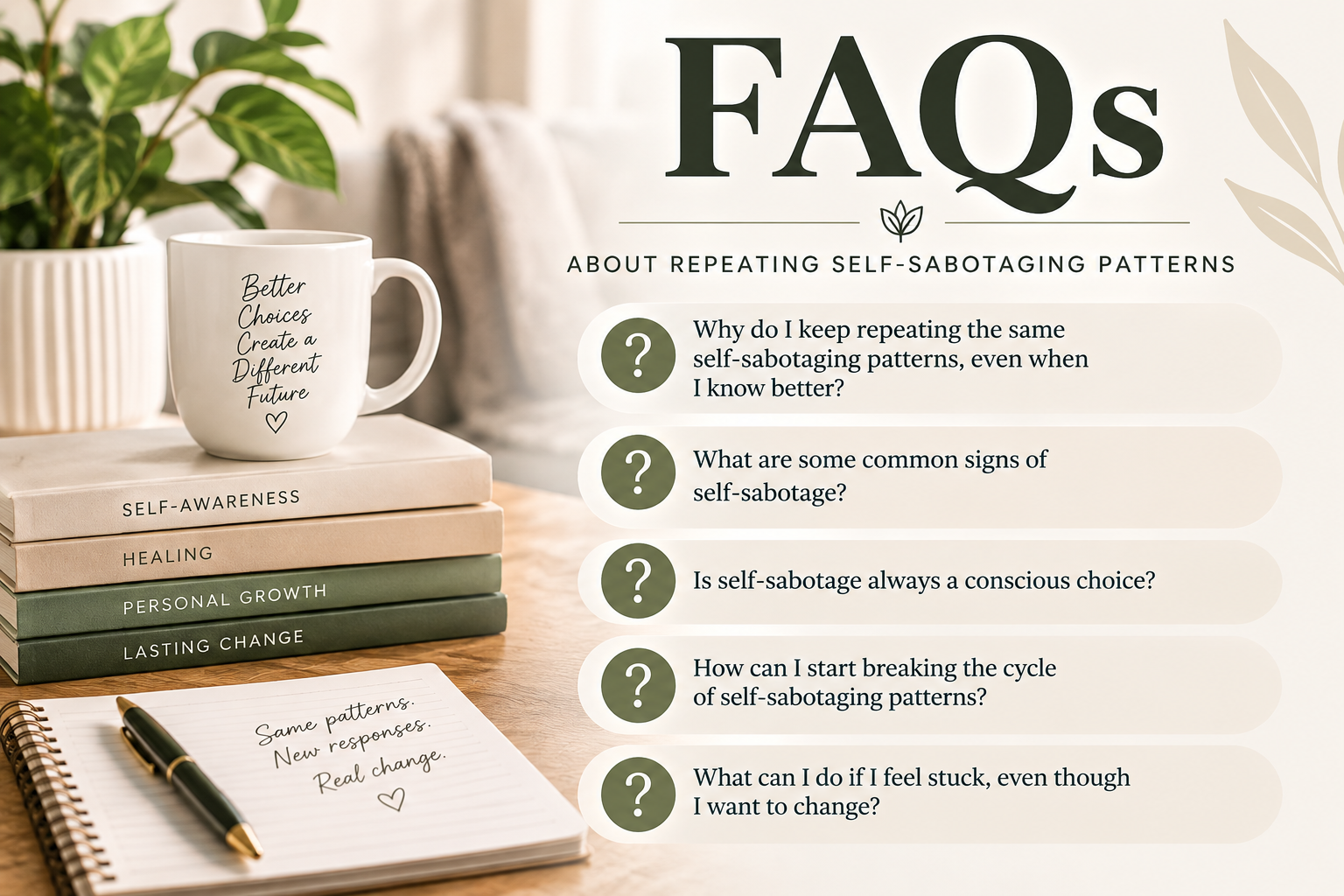
Why Do I Keep Self-Sabotaging Even When I Know Better?
Recognizing a behavior doesn't automatically change the habits, expectations, or emotional responses associated with it. Familiar patterns may continue because they've become habitual or provide short-term relief or reassurance. Understanding what happens before and after the behavior can help you explore why it continues.
Can You Be Aware of Self-Sabotage and Still Do It?
Yes. Someone can recognize a recurring pattern while continuing to experience the thoughts, feelings, and expectations that influence it. Awareness can help identify opportunities for change, while developing different responses may involve additional practice and support.
Why Do I Keep Repeating the Same Patterns in My Life?
Repeated patterns can involve learned habits, familiar emotional responses, beliefs about yourself, environmental influences, and recurring circumstances. Different patterns may have different explanations, so exploring your individual experiences can be useful.
Are Self-Sabotaging Behaviors Subconscious?
Some behaviors associated with self-sabotage may involve automatic habits and learned associations that operate without deliberate consideration. However, not every recurring behavior is subconscious, and there may be practical, emotional, or situational factors involved.
Why Doesn’t Understanding My Childhood Change My Behavior?
Understanding earlier experiences can provide meaningful context for current responses. However, insight into a possible origin doesn't automatically change habits or emotional associations. Developing new responses may also involve present-day awareness, practice, and appropriate support.
How Do I Stop Repeating Self-Sabotaging Behaviors?
Begin by exploring when the behavior occurs, what you anticipate, how you feel, and what the behavior provides in the moment. Identifying realistic alternative responses and practicing them in specific situations may help you begin changing familiar patterns.
Can Hypnotherapy Help With Recurring Self-Sabotaging Patterns?
Hypnotherapy may help some individuals explore habitual responses, internal dialogue, and beliefs associated with recurring patterns. Through focused attention, imagery, and suggestion, individuals may have opportunities to reflect on familiar experiences and mentally rehearse alternative responses. Results vary, and hypnotherapy is one of several possible approaches.
Read more: Can Hypnotherapy Help With Self-Sabotage? Understanding the Approach
A Different Way to Think About Knowing Better
Perhaps you've spent a long time feeling frustrated with yourself.
You recognize the behavior.
You understand why it creates problems.
You know what you'd prefer to do.
And yet, sometimes, you still find yourself responding in familiar ways.
But consider what you've already begun recognizing.
You're noticing patterns that may have once gone unquestioned.
You're becoming more aware of your expectations.
You're identifying the moments when your thoughts, feelings, and actions don't seem to align.
And you're beginning to ask different questions about your experiences.
Those observations can become part of how you develop greater self-awareness.
Perhaps the next time a familiar situation appears, you'll recognize something sooner.
Perhaps you'll notice an expectation you hadn't considered before.
Perhaps you'll pause and explore what you want to do.
And perhaps you'll begin practicing a response that feels more aligned with the direction you want your life to take.
Because understanding yourself can be an ongoing process.
And as your understanding develops, so can the possibilities you recognize for responding differently.
What might become possible if you began approaching your familiar patterns with curiosity about who you're becoming?