
Why You Keep Starting and Stopping: Understanding the Self-Sabotage Pattern Behind InconsistencyPost
You've decided that this time will be different.
Maybe you've committed to exercising regularly, growing your business, improving your finances, or finally working toward a goal you've been putting off.
You feel motivated.
You've made a plan.
You know what you want, and you're ready to begin.
For the first few days, maybe even the first few weeks, everything seems to be going well.
You're showing up.
You're following through.
You're making progress.
And then something changes.
You miss a day.
Your enthusiasm begins to fade.
You start questioning whether you can maintain what you've started.
Or perhaps life becomes more demanding, and the routines you were building begin slipping away.
Before long, you find yourself back where you started.
And eventually, you make another promise to yourself.
This time, I'm really going to stick with it.
If this sounds familiar, you may have wondered:
Why do I keep starting and stopping when I genuinely want to succeed?
It's an important question because repeatedly starting over can affect more than your progress toward a goal.
It can also influence how you begin seeing yourself.
And sometimes, understanding the pattern requires looking beyond motivation and discipline.
Key Takeaways
Repeatedly starting and stopping doesn't automatically mean you lack motivation or discipline.
Beginning a goal and maintaining progress involve different demands, expectations, and experiences.
Perfectionism, fear of success, unrealistic expectations, and familiar beliefs about yourself can sometimes contribute to inconsistency.
Temporary relief from stopping may make avoidance more appealing the next time discomfort appears.
Repeated setbacks can influence self-trust and the way you understand your ability to follow through.
Recognizing what happens immediately before you stop can help you develop a more informed response.
Hypnotherapy may offer an opportunity to explore beliefs and habitual responses associated with recurring self-sabotaging patterns.
Why Do I Keep Starting and Stopping Things?
Starting something new often comes with a particular kind of energy.
You can imagine the outcome you want.
You feel encouraged by the possibility of change.
You may even experience a sense of relief because you've finally decided to do something about a situation that's been bothering you.
And in those early moments, your attention is often focused on what you're moving toward.
But as time passes, the experience begins changing.
The excitement of beginning becomes the responsibility of continuing.
The goal that initially felt inspiring now requires consistent attention.
You may encounter setbacks, competing priorities, uncertainty, or days when you simply don't feel as motivated.
And this is where things can become interesting.
What happens when the emotional experience of pursuing your goal no longer feels the way it did when you started?
For some people, that transition is manageable.
They adjust their expectations, reconsider their approach, and continue.
For others, the change may trigger familiar thoughts and responses.
Maybe I'm not cut out for this.
I knew I wouldn't be able to keep it up.
I'll start again when I have more time.
I need to figure out a better plan first.
Sometimes those thoughts reflect genuine circumstances that require attention.
Other times, they may be part of a recurring pattern that appears whenever maintaining progress becomes uncomfortable.
Understanding the difference matters.
Starting Something and Sustaining It Are Two Different Experiences

Think about the last time you felt inspired to make a meaningful change.
Perhaps you wanted to develop a healthier routine.
You imagined feeling more energized, confident, and comfortable with yourself.
You researched different approaches.
You created a schedule.
You purchased what you needed.
And you began.
During those first few days, you might have felt encouraged simply because you were taking action.
But eventually, the novelty began wearing off.
Now the routine had to fit into your everyday life.
You had to navigate unexpected demands.
You had to decide what to do when your schedule changed.
You had to continue even when progress wasn't immediately noticeable.
The experience of starting had been driven partly by anticipation.
The experience of continuing required adaptation.
This distinction is important because people sometimes interpret the disappearance of initial excitement as evidence that something is wrong.
They assume they've lost motivation.
They begin questioning their commitment.
Or they decide the goal may not be right for them.
But a change in enthusiasm doesn't necessarily mean a change in desire.
You can still want something even when the process of achieving it becomes less exciting.
The question becomes:
How do you respond when your motivation changes but your goal still matters to you?
5 Reasons You May Keep Starting and Stopping

There isn't one explanation that applies to everyone.
However, several patterns may help explain why someone repeatedly begins working toward a goal and then struggles to maintain progress.
1. You May Be Relying on Motivation to Carry You Through
Motivation can be a wonderful starting point.
It helps you recognize possibilities and take action.
But motivation naturally fluctuates.
Some days, you're excited about what you're working toward.
Other days, your attention is divided, your energy is lower, or the goal feels less immediately rewarding.
If you've come to believe that feeling motivated is necessary for taking action, those fluctuations may influence your consistency.
You might begin thinking:
I'm just not feeling it today.
And eventually:
Maybe I'll start again when I'm more motivated.
Consider asking yourself:
What do I believe needs to be present before I can follow through?
2. Your Expectations May Be Difficult to Sustain
Sometimes people begin with expectations that don't leave much room for everyday life.
They decide they're going to exercise six days a week.
Work on their business every evening.
Completely change their eating habits.
Or follow an extremely structured routine without interruption.
Initially, the plan feels exciting.
But when something unexpected happens, maintaining that level of commitment becomes difficult.
And rather than adjusting the plan, they may abandon it altogether.
This can become particularly relevant when perfectionism is involved.
If your expectation is that you must follow the plan exactly, even a small interruption may feel like failure.
You might find yourself thinking:
I've already messed up, so I might as well start over.
For a deeper exploration of this pattern, read Perfectionism and Self-Sabotage: When Your Standards Keep You Stuck.
3. Progress May Introduce Unfamiliar Expectations
Sometimes the experience changes when you begin seeing results.
Imagine someone who's been working toward growing their business.
At first, they're excited about the possibilities.
They develop their services.
They begin promoting themselves.
They start attracting clients.
But as their business grows, they begin experiencing new responsibilities.
People expect more from them.
They have to make different decisions.
Their work becomes more visible.
And they may begin questioning whether they're prepared for what comes next.
They still want the success.
But they're becoming aware of everything they associate with maintaining it.
For some people, this can contribute to hesitation or pulling back.
This is one reason fear of success and self-sabotage can overlap with inconsistency.
4. Stopping May Provide Temporary Relief
This is a particularly interesting pattern to explore.
Imagine you've committed to completing an important project.
At first, you're excited.
But as you continue, you begin feeling overwhelmed.
You question your abilities.
You become concerned about whether the outcome will meet your expectations.
Eventually, you decide to take a break.
And immediately, you feel relieved.
The pressure decreases.
The uncertainty becomes less noticeable.
You can turn your attention toward something more comfortable.
That relief can be meaningful.
Taking a break may genuinely be what you need.
But when stepping away repeatedly becomes your primary response to discomfort, you may begin associating avoidance with relief.
Over time, that association can make it easier to disengage when similar feelings arise.
The question worth exploring is:
What changes for me emotionally when I decide to stop?
And what was I experiencing immediately before that decision?
5. Your Familiar Identity May Influence Your Expectations
Have you ever caught yourself saying:
I'm just not a consistent person.
I always start things and never finish them.
I'm good at beginning, but I'm terrible at following through.
These statements may seem like simple descriptions of your experiences.
But consider what happens when they become part of how you understand yourself.
You begin approaching new goals while anticipating that you'll eventually stop.
When you experience a setback, you may interpret it as confirmation of what you already believe.
See? I knew I wouldn't stick with it.
This can create a repeating cycle in which past experiences influence expectations, and those expectations influence how you respond to new challenges.
It may be helpful to explore whether your understanding of yourself still accurately reflects your abilities, circumstances, and possibilities.
How Starting and Stopping Can Become a Self-Sabotaging Cycle
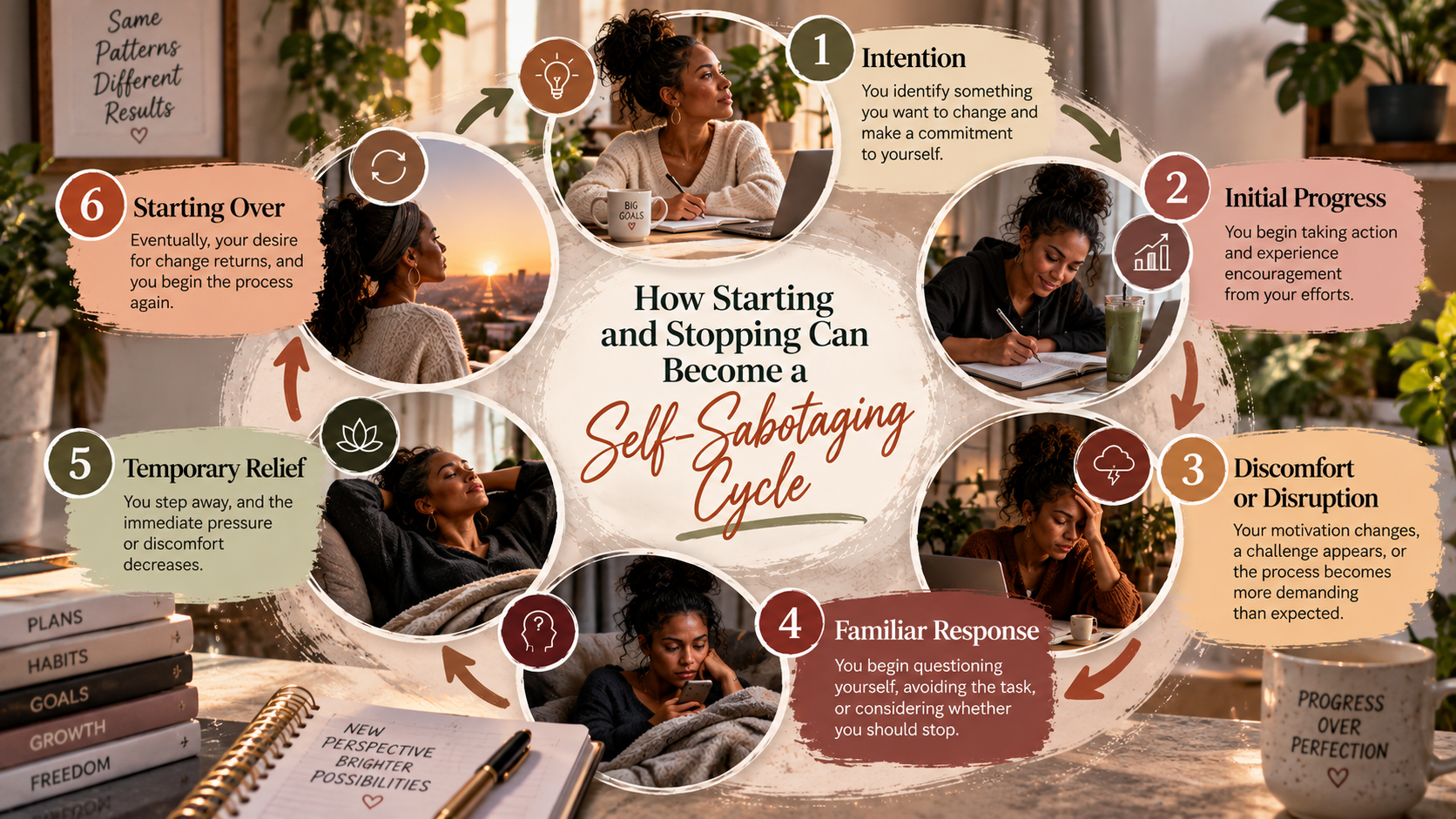
Sometimes the pattern follows a recognizable sequence.
1. Intention
You identify something you want to change and make a commitment to yourself.
2. Initial progress
You begin taking action and experience encouragement from your efforts.
3. Discomfort or disruption
Your motivation changes, a challenge appears, or the process becomes more demanding than expected.
4. Familiar response
You begin questioning yourself, avoiding the task, or considering whether you should stop.
5. Temporary relief
You step away, and the immediate pressure or discomfort decreases.
6. Starting over
Eventually, your desire for change returns, and you begin the process again.
Not everyone experiences this exact sequence.
But if you recognize it, consider where your behavior typically begins to change.
Is it when the initial excitement fades?
When you encounter a setback?
When someone begins expecting more from you?
Or when you start questioning whether you can sustain your progress?
Understanding the point where the shift occurs may offer more useful information than simply criticizing yourself for stopping.
The Relationship Between Inconsistency, Identity, and Self-Trust
One of the more overlooked consequences of repeatedly starting and stopping is how it can influence your relationship with yourself.
Think about what happens when you make a promise to someone.
You tell them you're going to do something.
You intend to follow through.
But then you repeatedly don't.
Over time, that person may begin questioning whether they can depend on your commitments.
Now consider what happens when the person making those promises is you.
You decide you're going to change your habits.
You commit to pursuing a goal.
You tell yourself that this time will be different.
And when you stop, you may begin experiencing disappointment.
Perhaps you become frustrated.
You criticize yourself.
Or you begin questioning whether you can trust yourself to follow through.
Eventually, your internal dialogue may shift from:
I want to accomplish this.
To:
I don't know if I can trust myself to stick with it.
That distinction matters.
Because now you're approaching the next goal with more than the challenge of accomplishing it.
You're also carrying the expectations you've developed from previous experiences.
And those expectations may influence how you interpret difficulties along the way.
_______________________________________________________
What Happens When You Begin Expecting Yourself to Stop?
Imagine beginning a new goal while already anticipating that you won't finish.
You might hesitate to invest time or resources.
You may avoid telling others about your plans.
You might become overly focused on whether you're doing everything correctly.
Or you may interpret an ordinary setback as evidence that you're repeating the same pattern.
In this way, your expectations can become part of the experience.
This doesn't mean that simply thinking differently guarantees a different outcome.
But it does suggest that your relationship with your past experiences may be worth exploring.
Are you responding to what's happening now, or are you responding to what you've come to expect will happen?
Why Knowing What to Do Doesn't Always Mean You'll Follow Through

This is one of the questions I find most interesting when exploring self-sabotage.
Someone may understand exactly what they need to do.
They know the steps.
They've developed a plan.
They recognize the benefits.
And they genuinely want the outcome.
Yet when it's time to act consistently, they struggle.
Why?
Because understanding something intellectually doesn't automatically determine how you'll respond when circumstances change.
Consider someone who knows they need to establish boundaries.
They understand the importance of protecting their time.
They recognize that constantly saying yes leaves them overwhelmed.
But when someone asks them for another favor, they experience discomfort.
They worry about disappointing the person.
And before they realize it, they've agreed to something they didn't want to do.
The challenge isn't necessarily a lack of knowledge.
It's what happens when that knowledge meets a familiar emotional response.
A similar experience can occur with consistency.
You may understand why following through matters.
But when discomfort, uncertainty, or pressure appears, you may find yourself responding in ways that have become familiar.
This is one reason exploring the beliefs and emotional associations connected to a behavior can be valuable.
5 Questions to Help You Recognize Your Starting-and-Stopping Pattern
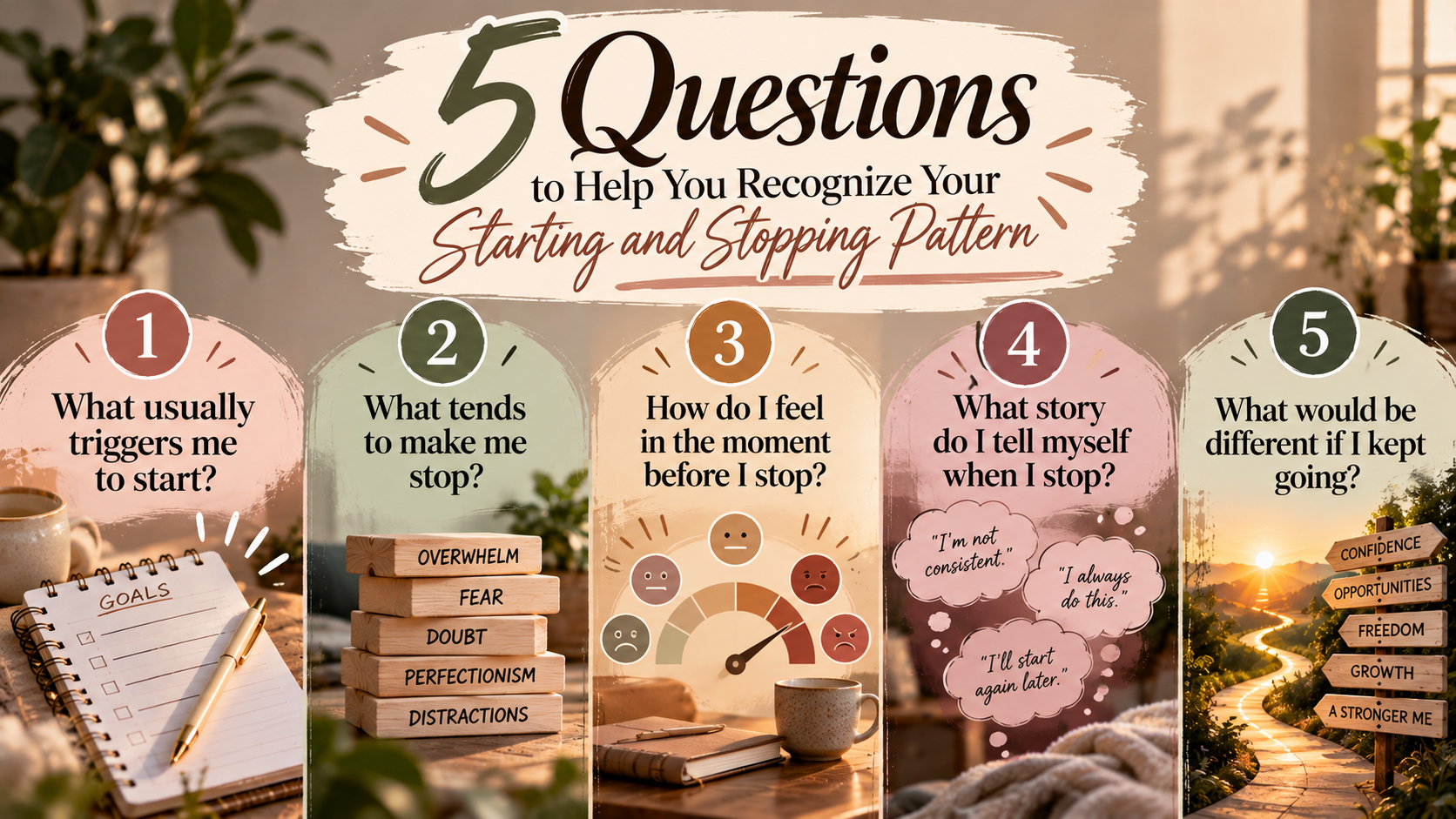
If you've noticed yourself repeatedly beginning goals and then stepping away, these questions may help you explore your experience.
1. What usually happens right before I stop?
Think about a recent example.
Was there a particular situation, thought, feeling, or change in circumstances?
What do you remember about that moment?
___________________________________________________________
2. What am I expecting from myself when I begin?
Consider whether your expectations are realistic and flexible.
What does following through mean to you?
And what happens when your progress looks different from what you imagined?
______________________________________________________________
3. What changes emotionally when I decide to stop?
Do you experience relief?
Disappointment?
Frustration?
Freedom?
Or something else?
What might that response tell you about the experience you were having before you stopped?
_______________________________________________________________
4. What have I come to believe about my ability to be consistent?
Notice the statements you make about yourself.
Where did those beliefs come from?
And do they accurately reflect your experiences today?
________________________________________________________________
5. What would continuing look like if I allowed myself to adjust?
Sometimes people imagine consistency as following a plan exactly.
But what if maintaining progress involved adapting your approach when circumstances change?
What would that look like for you?
These questions aren't intended to produce one particular explanation.
They're opportunities to become more curious about the circumstances and meanings surrounding your behavior.
What Can You Do When You Recognize the Pattern?
Recognizing a recurring pattern creates an opportunity to consider a different response.
Here are several ways to begin.
Notice the Difference Between Pausing and Abandoning
Taking a break and giving up on a goal aren't necessarily the same thing.
Sometimes rest, reevaluation, or a change in priorities is appropriate.
The important question is whether you're making a deliberate decision or automatically responding to discomfort.
You might ask:
Am I choosing to pause because it supports my circumstances, or am I stepping away because something about continuing feels uncomfortable?
Reconsider What Consistency Means to You
Does consistency mean doing something perfectly every day?
Or could it mean maintaining a relationship with your goal over time, even when your level of effort changes?
Someone who exercises twice during a demanding week may still be maintaining progress.
Someone who returns to a project after a setback may still be developing consistency.
The way you define follow-through can influence how you respond when things don't go according to plan.
Explore the Expectations Behind Your Goals
Sometimes the pressure associated with a goal comes from what you believe accomplishing it will mean.
You may associate consistency with proving your worth.
You may believe that successful people never struggle.
Or you may feel that every effort must produce noticeable results.
Consider whether those expectations are helping you move forward or making the experience more difficult.
Develop a Different Response to Discomfort
When you notice the urge to stop, become curious about what's happening.
What are you anticipating?
What are you feeling?
What meaning are you attaching to the situation?
Then consider what response would support your goal while respecting your current circumstances.
Sometimes that response may involve taking a smaller step.
Other times, it may involve changing your approach or seeking additional support.
Recognize the Progress You've Already Made
If you've repeatedly started and stopped, it's possible you've spent more time focusing on the stopping than on what you've accomplished.
Consider what you've learned through your previous attempts.
What worked?
What helped you make progress?
What would you approach differently now?
Your previous experiences may contain useful information about what supports your ability to continue.
How I Approach Starting-and-Stopping Patterns in My Hypnotherapy Practice

When someone tells me they struggle with consistency, I'm interested in understanding their individual experience.
Because two people can describe the same behavior while experiencing very different things internally.
One person may begin feeling overwhelmed when their responsibilities increase.
Another may become uncomfortable when progress makes them more visible.
Someone else may hold expectations that make ordinary setbacks feel unacceptable.
And another person may have developed a familiar belief that they're simply incapable of following through.
Rather than assuming why the pattern exists, I prefer to explore what happens for that person.
For example, I might ask:
When you think about the last time you stopped, what stands out to you?
What was happening just before you made that decision?
What did stopping allow you to experience?
When you imagine continuing, what comes up for you?
And what would following through mean about the person you're becoming?
These questions can help someone begin recognizing connections between their experiences, beliefs, and responses.
In my hypnotherapy practice, I work with clients to explore recurring patterns and the subconscious associations that may contribute to them.
That exploration is individualized.
The goal is to develop greater awareness of the pattern and support responses that align more closely with the person's goals and values.
Can Hypnotherapy Help With Inconsistency and Difficulty Following Through?
Hypnotherapy may be an option for individuals who want to explore beliefs, internal dialogue, and habitual responses associated with repeatedly starting and stopping.
Through focused attention, relaxation, imagery, and suggestion, hypnotherapy can provide an opportunity to reflect on familiar patterns and mentally rehearse alternative responses.
For example, someone who associates setbacks with failure may want to explore a more flexible understanding of progress.
Another person may want to examine the expectations they've developed about their ability to follow through.
And someone who becomes uncomfortable when approaching success may want to explore the meaning they've attached to achievement and responsibility.
Experiences and outcomes vary.
It's also important to recognize that difficulty following through can involve practical circumstances, competing responsibilities, health concerns, or executive functioning challenges.
Understanding those factors can help someone identify appropriate strategies and support.
For individuals who recognize recurring self-sabotaging patterns, hypnotherapy may offer an additional avenue for self-exploration.
What If Consistency Is About the Relationship You're Building With Yourself?

There's another way to consider the experience of starting and stopping.
Perhaps you've spent years approaching your goals through promises about what you're finally going to accomplish.
This time, I'm going to be disciplined.
This time, I'm going to stay motivated.
This time, I'm going to prove I can do it.
And when something interrupts your progress, you feel as though you've failed to become the person you intended to be.
But consider a different question.
What kind of relationship are you developing with yourself as you work toward your goals?
Are you learning to recognize when you need to adjust?
Are you developing greater awareness of your expectations?
Are you becoming more willing to return to something after a setback?
Are you discovering what actually supports your ability to follow through?
Sometimes meaningful progress involves developing a different understanding of consistency.
One that makes room for changing circumstances, realistic expectations, and continued learning.
And perhaps that understanding can influence the way you approach your next goal.
Recognizing the Pattern Is a Beginning. What Comes Next?
Sometimes becoming aware of your starting-and-stopping pattern brings up another question:
How do I begin building a different relationship with consistency and follow-through?
Self-awareness can develop through ongoing reflection, thoughtful questions, and a willingness to explore familiar beliefs.

That's one reason I created the Stuck to Striving Community.
It's a space centered on self-awareness, personal reflection, and exploring patterns that may be keeping you feeling stuck.
Whether you're learning to recognize your responses or reconsidering the expectations you've developed about yourself, you're invited to continue that exploration with us.
Explore the Stuck to Striving Community
Ready to Explore What's Keeping You From Following Through?

If you recognize recurring patterns of starting and stopping, questioning your abilities, or struggling to maintain progress toward meaningful goals, personalized hypnotherapy may be worth exploring.
During a free 15-minute consultation, we can discuss what you've been experiencing, what you'd like to change, and whether hypnotherapy may be a good fit for your goals.
Schedule Your Free 15-Minute Consultation
Prefer to Begin on Your Own?

My Overcoming Self-Sabotage Hypnotic Programming Audio offers a self-guided experience for individuals interested in exploring their internal dialogue and relationship with familiar patterns.
Explore the Overcoming Self-Sabotage Audio.
Frequently Asked Questions About Starting, Stopping, and Self-Sabotage
Why do I keep starting things and never finishing them?
There can be several explanations, including changing motivation, unrealistic expectations, competing priorities, fear of failure, perfectionism, executive functioning difficulties, or discomfort associated with progress. Understanding what happens before you stop may help clarify your individual pattern.
Is starting and stopping a form of self-sabotage?
It can be, particularly when someone repeatedly disengages from meaningful goals in response to familiar fears, expectations, or avoidance patterns. However, not every interruption or unfinished goal represents self-sabotage.
Why do I lose motivation after starting something?
Initial excitement often changes as a goal becomes part of everyday life. You may encounter challenges, changing priorities, or periods when progress feels less rewarding. Losing enthusiasm doesn't necessarily mean you've stopped caring about the goal.
Can perfectionism make it difficult to stay consistent?
Yes. When someone expects themselves to follow a plan perfectly, ordinary setbacks may feel unacceptable. This can contribute to all-or-nothing thinking and repeated attempts to start over.
Why do I struggle to follow through even when I know what to do?
Knowing what to do and consistently taking action involve different processes. Emotional responses, habits, competing demands, expectations, and practical barriers may influence follow-through.
Can hypnotherapy help with self-sabotage and inconsistency?
Hypnotherapy may help some individuals explore beliefs, internal dialogue, and habitual responses associated with recurring patterns. Results vary, and the most appropriate approach depends on the individual's circumstances and goals.
A Different Way to Think About Starting Over
Perhaps you've spent a long time measuring your progress by how consistently you've followed a plan.
You remember the goals you began.
The routines you established.
The promises you made to yourself.
And the moments when things didn't go the way you expected.
But what if those experiences also contain information about what you've been learning?
Perhaps you're beginning to recognize the expectations that make progress feel difficult.
Perhaps you're noticing how you respond when your motivation changes.
Or perhaps you're discovering that the way you've been defining consistency hasn't allowed much room for your actual life.
These realizations can become part of how you approach future goals.
Because continuing doesn't always look like following the same plan in exactly the same way.
Sometimes it involves reconsidering your approach.
Sometimes it involves responding differently to a familiar moment.
And sometimes it begins with asking yourself a more useful question:
What would it look like to become someone who knows how to continue, even when the experience of moving forward changes?