
Perfectionism and Self-Sabotage: When High Standards Keep You Stuck
You want to do things well.
You take pride in your work, pay attention to details, and hold yourself to high standards. When you commit to something, you want the outcome to reflect the effort you've invested.
And there's something valuable about that.
But what happens when those standards begin making it difficult to move forward?
Perhaps you've spent weeks preparing to launch something, yet every time you're ready, you find another detail that needs improving.
Maybe you hesitate to share your ideas because you haven't quite figured out how to communicate them perfectly.
Or you accomplish something meaningful, only to immediately focus on everything you could have done better.
From the outside, these behaviors might look like dedication, discipline, or ambition.
But internally, you may feel as though you're constantly working toward a standard that keeps moving further away.
At what point does striving to do your best begin interfering with your ability to move forward?
That's where perfectionism and self-sabotage can begin to overlap.
Key Takeaways
Having high standards and experiencing perfectionism are not necessarily the same thing.
Perfectionism may become self-sabotaging when fear of mistakes, judgment, or falling short repeatedly interferes with your goals.
Perfectionism can show up through procrastination, overthinking, excessive preparation, difficulty making decisions, and dissatisfaction with accomplishments.
For some people, perfectionism is connected to beliefs about self-worth, acceptance, competence, or what it means to be successful.
Understanding what a mistake or imperfect outcome represents to you can offer valuable insight into the pattern.
Hypnotherapy may provide an opportunity to explore subconscious beliefs and habitual responses associated with perfectionism.
What Is Perfectionism, and How Is It Different From Having High Standards?

It's important to recognize that wanting to do something well isn't automatically a problem.
High standards can encourage growth, discipline, creativity, and personal development.
They can motivate you to develop your skills, honor your commitments, and take pride in what you accomplish.
Perfectionism, however, can introduce a different relationship with performance.
Instead of viewing a high standard as something you're working toward, you may begin experiencing it as something you must meet to feel competent, accepted, or satisfied with yourself.
Consider two people preparing for an important presentation.
One person wants to deliver an excellent presentation. They prepare carefully, practice, make adjustments, and eventually decide they're ready.
The other person also wants to deliver an excellent presentation.
But as the presentation approaches, they repeatedly revise their slides, question whether their ideas are good enough, and imagine everything that could go wrong.
Even after practicing successfully, they continue feeling unprepared.
Both people value doing well.
The difference is how they experience the possibility of falling short.
For one person, the standard provides direction.
For the other, the standard may become a source of pressure that makes moving forward increasingly difficult.
High standards can guide your efforts. Perfectionism can make your sense of adequacy depend on the outcome.
And that distinction matters when we're exploring self-sabotage.
When Does Perfectionism Become a Form of Self-Sabotage?
Perfectionism may become self-sabotaging when the pursuit of an ideal outcome repeatedly interferes with the very thing you're trying to accomplish.
Imagine wanting to start a podcast.
You have ideas you're excited to share. You've researched your audience, purchased equipment, and outlined several episodes.
But every time you're ready to record, you find another reason to wait.
You need a better microphone.
Your introduction doesn't sound quite right.
You want to learn more about editing.
Perhaps you should redesign the cover art first.
Each concern seems reasonable on its own.
But months later, you still haven't published an episode.
The interesting part is that you may genuinely believe you're doing everything necessary to make your podcast successful.
Yet the continuous preparation is preventing you from doing the one thing that would allow your podcast to exist.
This is where an important question emerges:
What would it mean to you if you shared something before you felt completely ready?
For some people, the answer may be relatively simple: they prefer being prepared.
For others, the possibility of being imperfect may bring up concerns about judgment, failure, embarrassment, or not being good enough.
And those concerns can influence behavior in ways that aren't always immediately obvious.
If you'd like a broader understanding of these patterns, explore our article, What Is Self-Sabotage? Why You Keep Getting in Your Own Way.
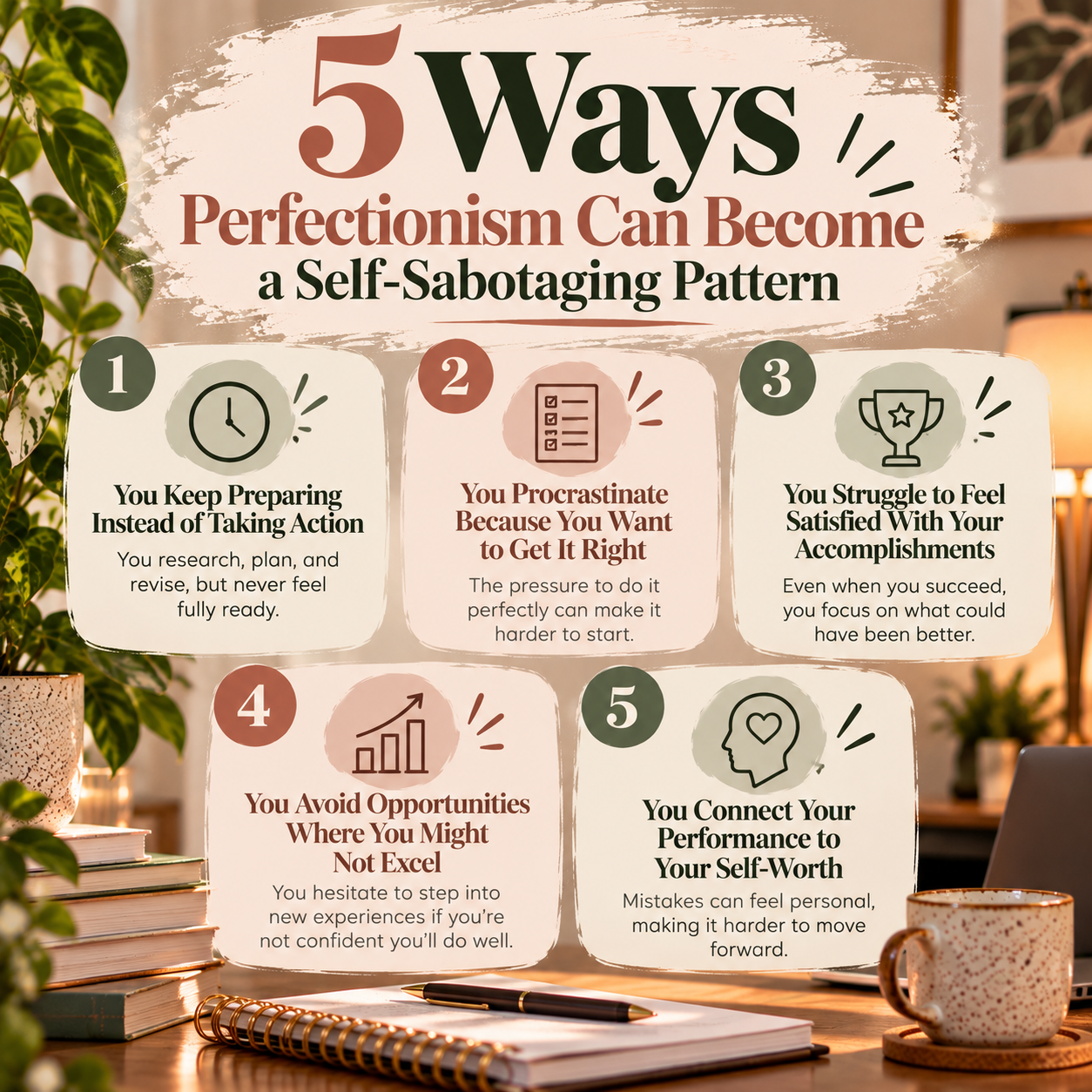
5 Ways Perfectionism Can Become a Self-Sabotaging Pattern
Perfectionism doesn't always look like someone obsessively organizing their home or correcting every small detail.
Sometimes it appears in much subtler ways.
1. You Keep Preparing Instead of Taking Action
You research, organize, plan, and revise.
You tell yourself that once everything is in place, you'll finally begin.
But the requirements for being ready keep changing.
What started as preparation becomes an ongoing process of postponement.
You may be waiting for a level of certainty that the situation simply cannot provide.
Ask yourself:
How will I know when I'm ready, and what happens if I never feel completely ready?
2. You Procrastinate Because You Want to Get It Right
Sometimes procrastination isn't about lacking interest in a task.
It may be connected to the pressure surrounding how well you believe you need to perform.
You know the task matters.
You want to complete it successfully.
But beginning means eventually producing something that can be evaluated.
And the possibility of making a mistake can feel uncomfortable enough that postponing the task becomes appealing.
This creates an interesting contradiction.
You care deeply about the outcome, yet the pressure to achieve that outcome may contribute to your avoidance.
We explore this connection further in Procrastination or Self-Sabotage? What May Really Be Keeping You Stuck.
3. You Struggle to Feel Satisfied With Your Accomplishments
You reach a goal you've been working toward for months.
Perhaps you receive recognition, complete a certification, launch a project, or accomplish something you once considered difficult.
For a brief moment, you feel proud.
Then your attention shifts.
You notice what could have been better.
You compare your accomplishment with someone else's.
You begin thinking about what you need to achieve next.
The accomplishment that once represented success suddenly feels insufficient.
It's worth exploring what happens internally when you receive evidence that you've done something well.
Are you able to experience your accomplishments, or do you immediately begin evaluating what you should have done differently?
4. You Avoid Opportunities Where You Might Not Excel
Imagine being offered an opportunity that could help you grow professionally.
It's something you've wanted.
But accepting it would mean entering an environment where you're still learning.
You might make mistakes.
You might need guidance.
Other people might see you figuring things out.
If you've become accustomed to feeling competent and capable, the idea of being inexperienced can feel particularly uncomfortable.
You may begin questioning whether the opportunity is right for you.
Or convince yourself that you need additional training before accepting it.
Sometimes the concern isn't whether you want to grow.
It's what growing might require you to experience along the way.
5. You Connect Your Performance to Your Self-Worth
This is one of the deeper patterns worth exploring.
For some people, doing well becomes closely connected to how they evaluate themselves.
An accomplishment may reinforce the belief that they're capable, valuable, or deserving of recognition.
A mistake, however, may feel like evidence that they're inadequate.
When performance carries that much personal meaning, ordinary challenges can begin feeling like judgments about who you are.
Consider the difference between these two experiences:
I made a mistake.
And:
Making that mistake means I'm not good enough.
The event may be the same.
But the meaning attached to it can create a very different emotional response.
And that meaning may influence what you're willing to attempt in the future.
Why Does Perfectionism Sometimes Feel So Necessary?
This is where I believe the conversation becomes particularly interesting.
When someone recognizes that perfectionism is interfering with their progress, they may assume the solution is simply to lower their standards.
But what if those standards serve a purpose in how they experience themselves?
Perhaps being prepared helps them feel confident.
Maybe achieving exceptional results has become an important part of their identity.
Or perhaps making mistakes has become associated with criticism, disappointment, or losing the approval of others.
These associations can develop through a variety of experiences.
For example, someone who consistently received recognition for their achievements may have learned to place considerable importance on performing well.
Another person may have experienced criticism when they made mistakes and developed a strong preference for avoiding situations where they might fall short.
These experiences don't determine someone's future behavior.
However, they may contribute to the beliefs and expectations that influence how a person approaches challenges.
And this brings us to a question I find particularly meaningful:
What does being perfect allow you to feel about yourself?
Does it help you feel capable?
Accepted?
Respected?
In control?
Or perhaps it provides reassurance that you've done everything possible to avoid a disappointing outcome.
The answer will be different for each person.
And understanding that answer may be more useful than simply telling yourself to stop being a perfectionist.
The Relationship Between Perfectionism, Identity, and Self-Worth

Think about how you describe yourself.
Perhaps you've always been the responsible one.
The person who gets things done.
The person everyone depends on.
The one who has the answers.
The one who rarely makes mistakes.
These descriptions may reflect genuine strengths.
But what happens when your sense of identity becomes closely connected to maintaining them?
Imagine someone who has always been recognized for being exceptionally capable.
They've built a reputation for handling difficult situations and producing excellent results.
Now they're considering something entirely new.
Something that excites them but also requires them to become a beginner again.
They may want the opportunity.
Yet being inexperienced feels unfamiliar.
They might find themselves delaying the decision, questioning their readiness, or setting increasingly demanding conditions before moving forward.
On the surface, the behavior looks like hesitation.
But underneath, there may be questions about identity.
Who am I when I don't already know what I'm doing?
What does it mean about me if I need help?
Can I still feel confident in myself while I'm learning?
These are the kinds of questions that can help us explore the relationship between perfectionism and self-sabotage.
Because sometimes the difficulty isn't simply the task.
It's the meaning attached to the version of yourself who would be doing it.
How Perfectionism Can Keep You in a Cycle of Starting and Stopping
Perfectionism can also influence how consistently someone follows through on their goals.
You may begin something with enthusiasm.
You establish a routine, create a plan, and imagine how successful you'll feel once you've accomplished your goal.
Initially, everything goes well.
Then something interrupts your progress.
You miss a day.
You make a mistake.
Your results aren't what you expected.
Suddenly, the experience feels different.
Instead of viewing the interruption as part of the process, you may begin questioning whether you've already failed.
Perhaps you tell yourself that you'll start again next week.
This time, you'll be more disciplined.
This time, you'll follow the plan perfectly.
But when another interruption occurs, the cycle begins again.
The challenge may involve the expectations you've created around what successful progress is supposed to look like.
If consistency means never missing a day, even a small interruption can feel significant.
If progress means always improving, an ordinary setback can become discouraging.
And if success requires doing everything correctly, continuing after a mistake may feel harder than starting over.
Consider this question:
What would consistency look like if it included the ability to continue after an imperfect day?
That perspective can open the door to a different relationship with progress.
How to Recognize When Your Standards Are Keeping You Stuck
One way to explore perfectionism is to pay attention to the moments when your standards begin influencing your willingness to act.
You might notice yourself postponing a decision, repeatedly revising something, or avoiding an opportunity.
Rather than immediately criticizing yourself, become curious about what you're experiencing.
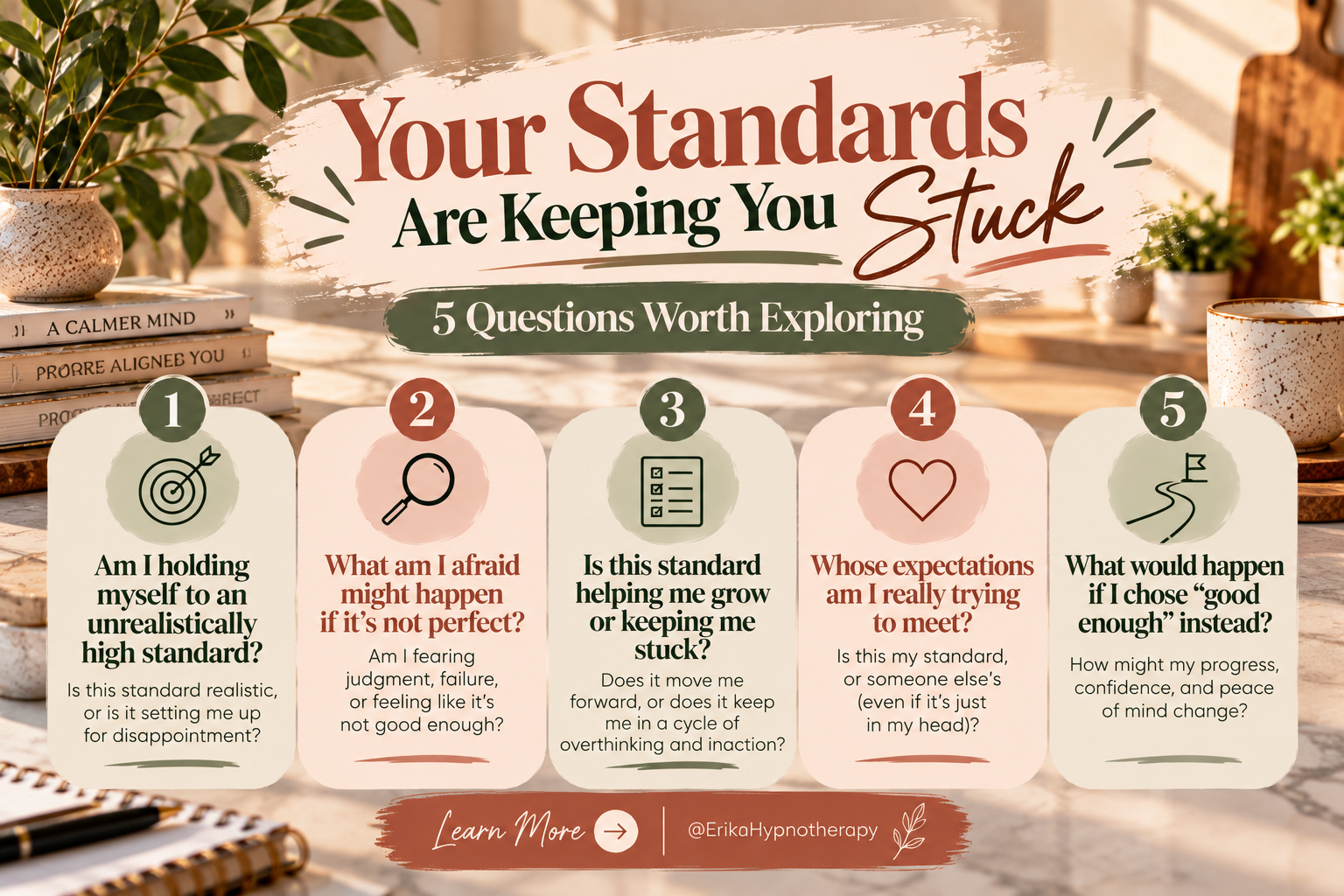
Here are five questions worth exploring:
What am I expecting from myself in this situation? Consider whether your expectations are realistic, flexible, and appropriate for the task.
What would it mean to me if I didn't meet that expectation? Notice whether your response involves disappointment about the result or a broader judgment about yourself.
What am I hoping to prevent by getting everything right? Explore whether you're anticipating criticism, embarrassment, uncertainty, or another uncomfortable experience.
How would I approach this differently if I trusted myself to respond to mistakes? Consider what changes when your confidence includes your ability to adapt.
What might become possible if I allowed progress to include learning? Reflect on the opportunities that may become more accessible when perfection is no longer the requirement for beginning.
You don't need to have immediate answers to every question.
Sometimes simply noticing which question brings up the strongest response can provide a useful starting point.
How I Approach Perfectionism and Self-Sabotage in My Hypnotherapy Practice

When someone tells me they're a perfectionist, I'm interested in understanding what that means to them personally.
Because perfectionism can look very different from one person to another.
One person may struggle to begin tasks because they're afraid of making mistakes.
Another may accomplish extraordinary things but rarely feel satisfied.
Someone else may avoid opportunities where they can't immediately perform at a high level.
The behaviors may appear similar, but the experiences surrounding them can be quite different.
In my hypnotherapy practice, I like to explore the relationship between what someone is doing, what they're experiencing, and what the behavior may represent to them.
For example, if someone tells me they need everything to be perfect, I might ask:
What does perfect mean to you?
How do you know when something is good enough?
What happens for you when something doesn't meet that standard?
And what does that experience lead you to believe about yourself?
These questions create opportunities for the person to develop their own understanding.
Because the meaning I might assign to someone's experience isn't necessarily the meaning they have assigned to it.
And discovering that distinction can be valuable.
My approach to hypnotherapy involves exploring subconscious beliefs, emotional associations, and habitual responses that may be connected to recurring patterns of self-sabotage.
The goal is to help clients develop greater awareness and explore ways of responding that support the changes they want to make.
Can Hypnotherapy Help With Perfectionism?
Hypnotherapy may be an option for individuals who want to explore recurring beliefs and responses associated with perfectionism.
During hypnotherapy, focused attention, relaxation, imagery, and suggestion can be used to support reflection and explore alternative ways of experiencing familiar situations.
For example, someone who associates mistakes with personal inadequacy may want to explore a different relationship with learning and performance.
Another person may want to develop greater comfort with uncertainty or with sharing their work before it feels completely polished.
The experience is individualized, and outcomes vary.
Hypnotherapy is not a guaranteed solution for perfectionism. When perfectionism is connected to significant anxiety, obsessive-compulsive symptoms, or other mental health concerns, evaluation and support from an appropriately licensed professional may also be important.
For someone exploring everyday patterns of self-sabotage, however, hypnotherapy may provide another avenue for examining how their beliefs and habitual responses influence their choices.
How to Move Forward Without Waiting for Perfect
Recognizing perfectionism is one thing.
Developing a different relationship with your standards is another.
Here are several ways to begin.
Allow Your Standards to Support the Goal
Before beginning a task, consider what the situation actually requires.
Does it need to be exceptional?
Or does it need to be clear, useful, accurate, and complete?
Different situations call for different levels of precision.
Being intentional about your standards can help you direct your energy where it matters most.
Define What Completion Looks Like
If you frequently revise or postpone projects, establish reasonable criteria for completion before you begin.
What would make the work ready to share?
What information is necessary?
What would be useful to improve later rather than immediately?
This can help distinguish meaningful improvements from an endless pursuit of refinement.
Practice Continuing After an Imperfect Moment
Pay attention to what happens when something doesn't go according to plan.
Perhaps you miss a workout, make a mistake, or receive feedback that something needs improvement.
Instead of automatically restarting the entire process, consider what continuing would look like.
You may discover that your ability to adapt is just as important as your ability to prepare.
Become Curious About the Meaning of Mistakes
When you make a mistake, notice the story that follows.
Are you disappointed with the outcome?
Or are you making conclusions about your intelligence, abilities, or worth?
Understanding that distinction can help you recognize when an ordinary experience has taken on a much larger personal meaning.
Expand Your Definition of Success
What if success included your willingness to begin?
Your ability to learn?
Your capacity to make adjustments?
Your willingness to continue when things don't go exactly as planned?
Consider how your experience might change if these qualities became part of what you recognized and valued in yourself.
Feeling Stuck Between Wanting More and Waiting Until You're Ready?

Sometimes recognizing a pattern is the beginning of a much larger conversation.
You may be starting to notice how often your expectations influence your decisions, how you respond to mistakes, or whether you allow yourself to pursue opportunities that matter to you.
If you'd like a space to continue exploring these experiences, I invite you to join Stuck to Striving.
The community is centered on reflection, awareness, and exploring the patterns that can keep us feeling stuck.
Explore the Stuck to Striving Community
Interested in Exploring Your Individual Patterns?

If perfectionism, procrastination, or self-doubt have become recurring challenges, personalized hypnotherapy may be another option to consider.
During a free 15-minute consultation, we can discuss what you've been experiencing, what you'd like to change, and whether hypnotherapy may be appropriate for your goals.
Schedule Your Free 15-Minute Consultation
Prefer to Begin on Your Own?

My Overcoming Self-Sabotage Hypnotic Programming Audio offers a self-guided experience for individuals who want to begin exploring their internal dialogue and relationship with familiar patterns.
Explore the Overcoming Self-Sabotage Audio.
Frequently Asked Questions About Perfectionism and Self-Sabotage
Is perfectionism a form of self-sabotage?
Perfectionism isn't automatically self-sabotage. However, it can become self-sabotaging when unrealistic expectations, fear of mistakes, or excessive self-criticism repeatedly interfere with your ability to pursue important goals.
What's the difference between perfectionism and having high standards?
High standards can provide direction and encourage growth. Perfectionism often involves rigid expectations and a heightened concern about mistakes, evaluation, or falling short.
Why do perfectionists procrastinate?
Some people who experience perfectionism delay tasks because they anticipate mistakes, criticism, or outcomes that may not meet their expectations. Postponing the task can temporarily reduce those uncomfortable feelings.
Can perfectionism be connected to low self-worth?
For some individuals, perfectionism is associated with evaluating their worth through achievement, approval, or performance. However, not everyone who experiences perfectionism has low self-worth.
Why do I struggle to feel proud of my accomplishments?
When your expectations continually increase, you may focus more on what could have been improved than on what you've achieved. Exploring how you define success and evaluate yourself can help you better understand this experience.
Can hypnotherapy help with perfectionism?
Hypnotherapy may help some individuals explore beliefs, emotional associations, and habitual responses connected to perfectionism. Results vary, and it may be appropriate to consider other forms of support depending on the nature and severity of the concern.
A Different Way to Think About Being Good Enough
Perhaps you've spent years believing that your high standards are what make you successful.
And maybe those standards have helped you accomplish meaningful things.
But it's worth considering whether every expectation you've created still serves the person you're becoming.
Are your standards helping you move toward what you want?
Or are they creating conditions that make it increasingly difficult to begin, continue, or appreciate what you've accomplished?
There's an important difference between wanting to grow and feeling that who you are today is never quite enough.
And understanding that difference may change how you approach your goals.
What might you allow yourself to pursue if being good enough was something you could recognize along the way, rather than something you had to prove at the finish line?