
Fear of Success and Self-Sabotage: Why Getting What You Want Can Feel Uncomfortable
You've been working toward something you genuinely want.
Maybe it's growing your business, pursuing a new career, developing a meaningful relationship, or finally following through on a personal goal.
You've imagined what achieving it would feel like.
You've thought about the opportunities it could create and how your life might change.
And then something interesting happens.
You begin making progress.
The opportunities you've been hoping for start appearing.
People begin recognizing your abilities.
You find yourself getting closer to the very thing you've been working toward.
But instead of feeling as excited as you expected, you begin experiencing something else.
Hesitation.
Uncertainty.
Perhaps even an unexpected desire to slow things down.
You might start questioning whether you're ready.
You begin focusing on everything that could go wrong.
Or you find yourself procrastinating on something you were previously excited about.
And eventually, you may wonder:
Why am I getting in my own way when this is exactly what I wanted?
This is one way fear of success and self-sabotage can begin to overlap.
And the interesting part is that you may genuinely want the outcome while feeling uncomfortable with what achieving it could mean for you.
Key Takeaways
Fear of success isn't necessarily about being afraid of accomplishing something. It may involve concerns about what happens after you succeed.
Visibility, responsibility, expectations, changing relationships, and unfamiliar experiences can contribute to hesitation.
Fear of success may become self-sabotaging when someone repeatedly avoids opportunities or interrupts progress toward goals they genuinely value.
The meaning someone attaches to success can be influenced by their beliefs, identity, and previous experiences.
Recognizing what happens immediately before you pull back can help you better understand the pattern.
Hypnotherapy may offer an opportunity to explore beliefs and habitual responses connected to success and personal growth.
What Is Fear of Success?
Fear of success refers to concerns or discomfort associated with achieving a desired outcome or experiencing the changes that may accompany it.
At first, that might sound contradictory.
Why would someone feel uncomfortable about something they've spent months or even years trying to accomplish?
Consider someone who wants to start a successful business.
They enjoy their work.
They believe in what they offer.
They want more clients, greater financial freedom, and opportunities to make a meaningful impact.
But as their business begins growing, they notice themselves becoming hesitant.
They delay responding to promising opportunities.
They second-guess their pricing.
They avoid promoting their services.
Or they begin questioning whether they're qualified to operate at the level they're approaching.
From the outside, it may appear that they're struggling with confidence or motivation.
But what if they're also thinking about everything that comes with being successful?
More people paying attention.
Greater responsibility.
Higher expectations.
The possibility of disappointing others.
Or having to see themselves differently.
Suddenly, the goal involves more than simply achieving something.
It also involves adapting to what achieving it might require.
Sometimes the most revealing question isn't whether you want to succeed. It's what you believe success will change.
Why Would Someone Be Afraid of Being Successful?

Success can represent different things to different people.
For one person, success may represent freedom.
For another, it may represent responsibility.
Someone else might associate success with visibility, pressure, or the possibility of losing relationships they've come to value.
This is why two people can pursue similar goals while experiencing very different emotional responses to the prospect of achieving them.
Imagine receiving an opportunity to speak at an important professional event.
You recognize that it could help you advance your career.
You want the opportunity.
But when you're invited, your thoughts begin shifting.
What if people expect more from me afterward?
What if I make a mistake?
What if everyone realizes I'm not as capable as they think?
What if my life becomes more demanding?
The opportunity itself may be desirable.
But the expectations you've associated with it may feel uncomfortable.
And when those concerns become influential enough, you may begin making decisions that move you away from the opportunity.
5 Reasons Success May Feel Uncomfortable

1. Success May Bring Greater Visibility
You may enjoy doing meaningful work while feeling uncomfortable with increased attention.
Perhaps you want to build a successful business but hesitate to share your expertise publicly.
Maybe you want recognition for your accomplishments but feel exposed when people begin noticing you.
Visibility can introduce concerns about criticism, judgment, and how others perceive you.
You may begin wondering whether you can continue meeting people's expectations once they see what you're capable of.
Consider asking yourself:
What changes for me when other people begin recognizing what I can do?
2. Success May Create New Responsibilities
Sometimes achieving a goal introduces responsibilities that weren't present when you first began pursuing it.
A promotion may involve managing employees.
A growing business may require making more decisions.
A new opportunity may demand greater consistency or accountability.
You may want the achievement while feeling uncertain about your ability to manage what comes afterward.
The concern may involve whether you can sustain your success rather than whether you can achieve it.
3. Success May Change Your Relationships
As your circumstances change, some of your relationships may change too.
You might have less time available.
Your priorities may shift.
You may begin establishing different boundaries.
Or you may worry about how people close to you will respond to your growth.
Perhaps you've always been the person others could depend on.
Now you're considering opportunities that require more of your attention.
You may begin wondering whether prioritizing your goals will disappoint the people around you.
This is one area where fear of success and people-pleasing can intersect.
If this sounds familiar, you may also find it helpful to explore People-Pleasing and Self-Sabotage: When Putting Others First Means Abandoning Yourself.
4. Success May Increase Expectations
Imagine working toward a goal and finally achieving it.
People congratulate you.
They begin recognizing your abilities.
They expect you to continue performing at that level.
What happens internally when you consider those expectations?
Do you feel encouraged?
Or do you begin wondering whether you can maintain what you've accomplished?
For someone who associates self-worth with performance, success may introduce concerns about having to continually prove themselves.
This can also overlap with perfectionism.
You may begin believing that every future accomplishment needs to meet or exceed your previous one.
5. Success May Challenge Your Familiar Identity
This is the area I find particularly interesting.
Sometimes success introduces the possibility of becoming someone you've wanted to be but haven't yet experienced yourself as.
You may have spent years thinking of yourself as someone who is still figuring things out.
Someone who's working toward success.
Someone who's preparing for the next opportunity.
And then the opportunity arrives.
People begin treating you as someone who has expertise, influence, or leadership.
But internally, you may still be relating to yourself through an earlier understanding of who you are.
The question becomes:
What happens when the way other people begin seeing you changes faster than the way you've learned to see yourself?
The Relationship Between Fear of Success, Identity, and Self-Worth
Identity is more than the roles we occupy.
It also involves the beliefs, expectations, and stories we've developed about ourselves through our experiences.
You might think of yourself as someone who is responsible.
Someone who is dependable.
Someone who struggles with consistency.
Someone who always has to work harder than everyone else.
Or someone who hasn't quite reached the level they want to achieve.
These understandings can influence how you interpret new experiences.
For example, imagine someone who has spent years believing they're always the person learning from others.
Then they're offered an opportunity to teach.
They have the knowledge.
They have the experience.
Other people recognize their abilities.
But they begin thinking:
Who am I to teach someone else?
What if I'm not ready?
What if they expect me to know everything?
Notice what's happening.
The opportunity is asking them to step into a role that may be unfamiliar.
Their hesitation may be connected to how they understand themselves in relation to that role.
Of course, sometimes hesitation also reflects practical considerations, such as needing additional training or evaluating whether an opportunity is appropriate.
But when someone repeatedly questions their abilities despite having relevant experience, it may be useful to explore the beliefs influencing their response.
What version of yourself do you believe you must become before you're allowed to accept the opportunity in front of you?
And what might happen if you began reconsidering that requirement?
How Fear of Success Can Become a Self-Sabotaging Pattern

Fear of success doesn't always look like deliberately turning down opportunities.
Sometimes it appears through smaller behaviors.
You might:
Delay submitting an application for a position you want.
Keep revising a project instead of sharing it.
Avoid promoting a business you've worked hard to establish.
Minimize your accomplishments when someone recognizes them.
Withdraw from opportunities that could bring greater responsibility.
Begin questioning your goals when progress becomes noticeable.
These behaviors can have different explanations.
Procrastination may be related to workload, executive functioning, competing priorities, or other circumstances.
But when a behavior repeatedly appears around opportunities for growth, it may be worth exploring whether concerns about success are contributing.
Consider someone who spends months preparing to launch a business.
They develop their services.
They create their website.
They invest in their education.
But when it's time to begin actively promoting themselves, they hesitate.
They decide to revise their website again.
They purchase another course.
They spend more time preparing.
And although preparation can be valuable, they never seem to reach the point where they feel ready to be seen.
The question isn't simply why they're procrastinating.
It's also:
What changes when preparation becomes participation?
That transition may introduce visibility, expectations, uncertainty, or a new understanding of their professional identity.
For a deeper exploration of delaying important goals, read Why Do I Procrastinate Even When Something Matters to Me?
Why You May Pull Back When Things Start Going Well
One of the more confusing experiences associated with self-sabotage is noticing that your behavior changes when you're finally making progress.
You may feel motivated while you're working toward something.
You establish routines.
You begin following through.
You experience encouraging results.
Then, as the possibility of success becomes more immediate, your behavior shifts.
You start second-guessing yourself.
You become less consistent.
You focus on potential problems.
Or you begin pulling away from the opportunity.
It may be helpful to pay attention to the moment immediately before that shift.
What happened?
Did someone compliment your work?
Did you receive an unexpected opportunity?
Did your responsibilities increase?
Did someone begin expecting something different from you?
And perhaps most importantly:
What did that moment mean to you?
Sometimes identifying the meaning you've attached to an experience can help you better understand why your response changed.
If this pattern sounds familiar, explore Why Do I Self-Sabotage When Things Are Going Well?, where we examine what can happen when progress itself begins feeling unfamiliar.
5 Questions to Help You Explore Your Relationship With Success

If you've noticed hesitation when approaching something you genuinely want, consider these questions.
1. What do I believe will change about my life if I succeed?
Consider the practical and emotional changes you anticipate.
What feels exciting?
What feels uncomfortable?
2. What will other people expect from me if I achieve this goal?
Notice whether you're anticipating greater responsibility, visibility, criticism, or pressure.
3. What does being successful mean about who I am?
Explore how success fits with the way you currently understand yourself.
Does it feel consistent with your identity?
Or does it introduce a version of yourself that feels unfamiliar?
4. What am I concerned I might lose if I become successful?
Perhaps you're thinking about time, freedom, relationships, privacy, or familiarity.
What feels important to preserve?
5. What happens immediately before I begin questioning my progress?
Look for specific situations, thoughts, or experiences that appear before you hesitate or pull back.
The purpose of these questions is to support curiosity about your experience.
You may discover that success itself feels exciting while certain expectations you've associated with it feel less comfortable.
How I Approach Fear of Success in My Hypnotherapy Practice

When someone tells me they're afraid of success, I want to understand what success represents to them.
Because the phrase fear of success can mean many different things.
One person may associate success with being judged.
Another may worry about maintaining higher expectations.
Someone else may feel uncomfortable becoming more visible.
And another person may discover that their hesitation is connected to how they've learned to understand themselves.
Rather than assuming what's underneath the behavior, I prefer to explore the individual's experience through thoughtful questions.
For example, I might ask:
When you imagine achieving this goal, what do you notice?
What changes when you imagine other people recognizing your success?
What do you believe will be expected of you?
And what would it mean about you if you were already capable of stepping into this opportunity?
These conversations may reveal beliefs and emotional associations that influence how someone approaches their goals.
My approach to hypnotherapy involves exploring subconscious patterns and the meanings people have developed through their experiences.
The goal is to help clients develop greater awareness of their habitual responses and consider ways of moving forward that are consistent with their values and aspirations.
Can Hypnotherapy Help With Fear of Success and Self-Sabotage?
Hypnotherapy may be an option for individuals who want to explore beliefs, internal dialogue, and habitual responses associated with success.
Through focused attention, relaxation, imagery, and suggestion, hypnotherapy can offer an opportunity to reflect on familiar patterns and rehearse alternative ways of responding.
For example, someone who associates professional visibility with criticism may want to explore how they interpret being seen and recognized.
Another person may want to develop a more flexible understanding of their abilities and what it means to grow into new responsibilities.
Hypnotherapy experiences are individualized, and results vary.
It's also important to recognize that hesitation about success can involve realistic concerns. Career demands, financial uncertainty, changing responsibilities, and relationship dynamics may require practical decisions and support.
For individuals who notice recurring self-sabotaging patterns, hypnotherapy may be one way to explore the beliefs and emotional responses that contribute to those experiences.
What Can You Do When Success Begins Feeling Uncomfortable?
Recognizing hesitation can create an opportunity to respond differently.
Here are several ways to begin.
Separate the Goal From What You've Associated With It
Ask yourself what you actually want to achieve.
Then consider the expectations and assumptions you've attached to that outcome.
For example, wanting a successful business doesn't necessarily mean you must become available to everyone at all times.
Wanting recognition doesn't mean you must always perform perfectly.
Some of the pressure you associate with success may come from assumptions worth reconsidering.
Notice When You Begin Moving Into Preparation Mode
Preparation is useful.
But if you repeatedly delay taking action until you feel completely ready, consider what you're waiting for.
What would need to happen before you believed you were prepared?
And is that expectation realistic?
Explore What Success Means to Your Identity
Consider the version of yourself you imagine becoming when you achieve your goal.
What qualities does that person possess?
Which of those qualities might you already be developing or expressing?
How might you begin relating to yourself differently as you grow?
Allow Your Understanding of Yourself to Evolve
Sometimes your circumstances change before your self-perception catches up.
You may have developed abilities and experience that weren't present when you first formed certain beliefs about yourself.
Consider whether those beliefs still accurately reflect who you are today.
Pay Attention to the Moment Before You Pull Back
When you notice hesitation, pause long enough to become curious about it.
What are you thinking?
What are you anticipating?
What does the opportunity represent?
And what response would be consistent with the direction you genuinely want to move?
Over time, these moments of awareness may help you recognize when familiar expectations are influencing your decisions.
When Becoming the Person You Want to Be Feels Unfamiliar

There's something interesting about working toward a goal.
For a long time, you may experience yourself as someone who's trying to get somewhere.
You're learning.
Preparing.
Building.
Improving.
And those activities become familiar parts of your identity.
But eventually, you may begin approaching the very outcome you've been working toward.
People recognize your growth.
New opportunities become available.
You begin occupying roles that once felt far away.
And now you're invited to consider yourself differently.
Perhaps you're becoming someone who leads.
Someone who is visible.
Someone who makes decisions with greater confidence.
Someone who receives opportunities instead of continually preparing for them.
That transition can bring excitement and uncertainty at the same time.
And it's worth exploring what happens when you begin seeing yourself through the possibilities of who you're becoming rather than exclusively through the experiences of who you've been.
What if the opportunity in front of you is inviting you to reconsider what you're capable of?
Recognizing the Pattern Is a Beginning. What Comes Next?
Sometimes understanding your hesitation brings up another question:
How do I begin moving forward when part of me still feels uncertain?
Developing awareness of your patterns can be an ongoing process.
And having a space to explore your experiences, reflect on familiar beliefs, and consider different possibilities may be helpful.
That's why I created the Stuck to Striving Community.

It's a space centered on self-awareness, thoughtful reflection, and exploring patterns that may be keeping you feeling stuck.
If you're interested in continuing that exploration, I'd love to invite you to join us.
Explore the Stuck to Striving Community
Ready to Explore What's Behind Your Hesitation?
If you recognize recurring patterns of pulling back from opportunities, questioning your abilities, or struggling to follow through when success becomes possible, personalized hypnotherapy may be worth exploring.
During a free 15-minute consultation, we can discuss what you've been experiencing, what you'd like to change, and whether hypnotherapy may be a good fit for your goals.
Schedule Your Free 15-Minute Consultation
Prefer to Begin on Your Own?

My Overcoming Self-Sabotage Hypnotic Programming Audio offers a self-guided experience for individuals interested in exploring their internal dialogue and relationship with familiar patterns.
Explore the Overcoming Self-Sabotage Audio.
Frequently Asked Questions About Fear of Success and Self-Sabotage
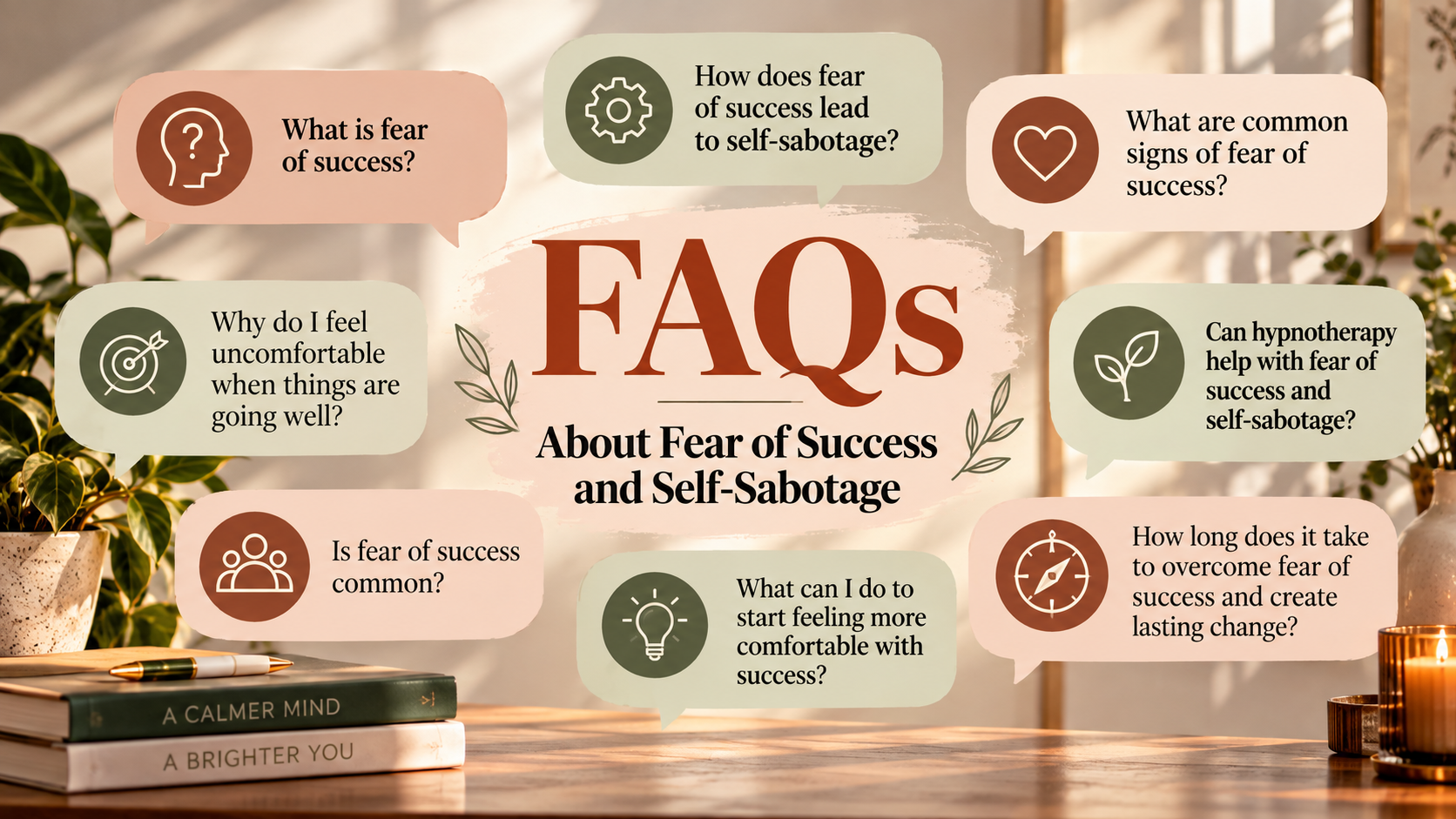
Is fear of success a real thing?
Yes. People can experience anxiety, hesitation, or conflicting feelings about achieving goals they genuinely want. These concerns may relate to visibility, expectations, responsibility, relationships, or anticipated changes.
Why would I sabotage something I really want?
There can be several reasons. Sometimes people experience discomfort about the responsibilities or changes associated with achieving a goal. Other times, procrastination, competing priorities, uncertainty, or practical circumstances contribute to the behavior.
What are signs of fear of success?
Possible signs include repeatedly delaying opportunities, minimizing accomplishments, avoiding visibility, questioning your abilities when progress becomes noticeable, or withdrawing from situations that could help you achieve your goals.
Is fear of success the same as fear of failure?
No, although they can overlap. Fear of failure often involves concerns about mistakes, rejection, or disappointing outcomes. Fear of success may involve concerns about what happens if you achieve the goal, including new expectations or responsibilities.
Can perfectionism contribute to fear of success?
Yes. Someone who believes they must continually meet extremely high standards may associate success with increasing pressure to perform. This can make new opportunities feel demanding rather than rewarding.
Can hypnotherapy help with fear of success?
Hypnotherapy may help some individuals explore beliefs, internal dialogue, and habitual responses associated with success and self-sabotage. Experiences and outcomes vary.
A Different Way to Think About Success

Perhaps you've spent years imagining what success would look like.
You've thought about the opportunities.
The freedom.
The recognition.
The possibilities.
And now that you're moving closer to those experiences, you're noticing that success may involve changes you hadn't fully considered.
You may have new responsibilities.
Different expectations.
More visibility.
Or opportunities that invite you to see yourself differently.
It's worth becoming curious about which aspects of success feel exciting and which feel uncomfortable.
Because sometimes understanding your hesitation begins with recognizing what you've come to believe success will require of you.
And perhaps the question worth exploring is this:
If you believed you could grow into the opportunities you're working toward, what might you allow yourself to pursue?